10 Employee Performance Review Tips for Managers in 2025
Employee performance reviews are a critical management responsibility. A good review motivates your team, clarifies expectations, and supports career growth. A poor review creates confusion, damages trust, and leads to disengagement. The difference between a constructive experience and a demotivating one depends on your preparation and approach. Many managers find the process stressful. They are unsure how to deliver feedback that is both honest and encouraging. The goal is not to evaluate past performance. The goal is to build a clear path forward for future success.
This guide provides ten specific, actionable employee performance review tips to help you lead fair, productive, and motivating conversations. You will learn proven methods to structure feedback, set clear goals, and follow up to ensure continuous improvement. These strategies are for busy managers who need a reliable process for conducting reviews that produce positive results for their direct reports and the organization.
Inside this list, you will find:
- Actionable checklists for pre-review preparation.
- Conversation scripts and sample phrasing for delivering difficult feedback.
- Recommended feedback frameworks like SBI and SMART goals.
- Guidance on creating meaningful development plans.
- Mini-templates you can adapt for immediate use.
By implementing these techniques, you can change your performance reviews from a dreaded annual task into a tool for employee development and team alignment. These practical insights will equip you to handle even the most challenging performance conversations with confidence and clarity. This fosters a culture of continuous growth and accountability. You will get everything you need to improve your performance management process.
1. Set Clear, SMART Goals Before the Review Period
The most effective employee performance reviews do not start with the review meeting. They begin months earlier, with a shared understanding of what success looks like. Establishing clear goals at the start of a performance cycle provides a concrete framework for evaluation. It removes ambiguity and subjectivity, creating a more objective and fair process for everyone.

The SMART framework, first introduced by George Doran, is an excellent tool for this purpose. It ensures every objective is Specific, Measurable, Achievable, Relevant, and Time-bound. This structure turns vague aspirations into actionable targets. It directly connects an employee’s daily work to broader organizational priorities. When you and your employee agree on these goals upfront, the performance review becomes a straightforward discussion about progress against those defined benchmarks.
How to Implement SMART Goals
Instead of broad directives, use precise targets. This approach provides clarity and a direct way to measure outcomes. The difference is significant. A vague goal like "improve customer satisfaction" becomes a SMART goal when framed as "Increase our Net Promoter Score (NPS) from 45 to 52 by the end of Q4."
Here are a few examples across different roles:
- Sales: Increase qualified leads generated through LinkedIn outreach by 20% in Q2.
- Software Development: Reduce the average bug resolution time for critical-level tickets from 48 hours to 24 hours within the next three months.
- Marketing: Grow organic website traffic by 15% quarter-over-quarter by publishing four new search-optimized blog posts per month.
Actionable Tips for Managers
To get the most out of this tip, follow a few best practices.
- Involve employees in goal-setting. When team members help create their objectives, they feel a greater sense of ownership and are more motivated to achieve them.
- Review goals periodically. Business priorities shift. Check in quarterly to ensure goals are still relevant and adjust them if necessary.
- Track progress visibly. Use a shared document or project management tool to monitor progress. This keeps goals top of mind and facilitates ongoing coaching conversations.
By grounding your performance management process in SMART goals, you create a transparent, data-driven foundation for a productive review. Explore additional SMART goals examples for employees to find inspiration for your team.
2. Use 360-Degree Feedback for Comprehensive Perspectives
A manager’s perspective is crucial, but it offers only one view of an employee's contributions. To create a balanced and fair evaluation, you need a wider lens. This is where 360-degree feedback helps. It gathers confidential, anonymous input from the people who work most closely with an employee, including peers, direct reports, and external clients.

This comprehensive approach, used by organizations like the Center for Creative Leadership, minimizes the impact of individual bias. It uncovers blind spots an employee or manager might not see. It provides a holistic picture of their strengths and development areas. By collecting diverse viewpoints, you change the performance review from a one-on-one monologue into a well-rounded developmental conversation.
How to Implement 360-Degree Feedback
The goal is to gather specific, constructive insights, not opinions. Leading companies use this method to foster leadership and improve team dynamics. For example, Google uses upward feedback to evaluate manager effectiveness. Microsoft uses multi-source feedback in its leadership development programs. This process helps identify patterns in behavior and impact.
Here are a few examples of how feedback can highlight different competencies:
- Peer Feedback: Highlights an employee's collaboration skills, willingness to support teammates, and communication style within a project team.
- Direct Report Feedback: Offers insight into a manager's leadership, mentorship, and ability to empower their team.
- Self-Assessment: Provides a baseline to compare against the perceptions of others, highlighting areas of strong self-awareness or significant blind spots.
Actionable Tips for Managers
To make this one of the most effective employee performance review tips, you need a structured approach.
- Ensure complete anonymity. Reviewers must feel safe to provide honest and candid feedback without fear of retaliation. Use a third-party tool if necessary.
- Provide clear instructions. Ask reviewers to comment on specific competencies, such as "Communication," "Problem-Solving," or "Teamwork," and request concrete examples.
- Frame it as a development tool. Emphasize the purpose is growth, not punishment. This positions the feedback as a supportive resource for career development.
- Review results with a neutral party. Discuss the aggregated report with an HR partner before meeting with the employee to help interpret the data and prepare a constructive conversation.
Using 360-degree feedback creates a richer, more objective foundation for a performance review. It empowers employees with the insights they need to grow.
3. Provide Frequent, Real-Time Feedback Instead of Annual Reviews
The traditional annual review, where feedback is saved for a single meeting, is an outdated model. Effective performance management changes this dynamic from a once-a-year event to a continuous conversation. Providing consistent, real-time feedback creates a culture of ongoing development. Employees receive guidance when it is most relevant. This approach prevents surprises, builds trust, and allows for immediate course correction and recognition.
Companies like Adobe and Accenture have moved away from annual reviews in favor of frequent "check-ins" and a continuous performance development model. This modern approach keeps employees engaged and aligned with evolving business priorities. Instead of documenting past events, the focus is on forward-looking growth and immediate improvement. This makes the entire process more impactful for both the employee and the organization.
How to Implement Continuous Feedback
The goal is to make feedback a normal, expected part of your routine. This demystifies the review process and integrates coaching into daily work. Instead of waiting for a formal meeting to discuss a missed deadline from three months ago, you address it the next day, while the context is still fresh. Similarly, celebrating a win as it happens reinforces positive behaviors and lifts morale instantly.
Here are a few examples of how this looks in practice:
- Project-Based: After a major project milestone is completed, provide immediate feedback on what went well and what to improve for the next phase.
- Skill Development: If an employee uses a new skill in a presentation, offer specific praise and constructive notes on their delivery right after the meeting.
- Customer Interaction: Following a client call, share observations on their communication style and how effectively they addressed the customer's needs.
Actionable Tips for Managers
To successfully adopt this tip, you need to build consistent habits.
- Schedule regular one-on-ones. Hold bi-weekly or weekly meetings dedicated to open dialogue about progress, roadblocks, and development. Discover how to create a productive agenda for one-on-one meetings to make these sessions count.
- Use a simple feedback framework. The Situation-Behavior-Impact (SBI) model helps you deliver clear, objective, and actionable feedback without sounding critical.
- Document key conversations. Keep brief, informal notes on important feedback points. This creates a helpful reference for formal check-ins without making the process overly bureaucratic.
4. Focus on Development and Growth Rather Than Criticism
The most impactful employee performance reviews shift the focus from a critique of past actions to a collaborative plan for future growth. Adopting a development-oriented approach turns the conversation from judgment to partnership. Instead of dwelling on mistakes, you and your employee work together to build skills, identify opportunities, and map out a path for career advancement.
This forward-looking perspective, supported by researchers like Carol Dweck and organizations like Gallup, turns the review into a motivational tool. It frames challenges as learning opportunities and connects an individual’s professional aspirations to the company's needs. When employees see their manager is invested in their long-term success, they become more engaged and committed.
How to Implement a Growth-Focused Review
A development-focused review prioritizes learning and potential. Instead of asking "What went wrong on the Q2 project?", you ask "What key lessons did you learn from the Q2 project that we can apply to our next initiative?" This reframing changes the entire dynamic of the conversation.
Here are a few examples of this approach:
- Netflix: The company culture emphasizes what employees can learn and achieve next, fostering continuous improvement.
- Salesforce: Performance conversations are explicitly linked to career progression. Every review includes a discussion about the employee's future path.
- Patagonia: The review process highlights employee development and internal mobility, encouraging team members to grow within the organization.
Actionable Tips for Managers
To make this one of your most effective employee performance review tips, integrate a few key practices into your process.
- Ask learning-oriented questions. Inquire about what the employee learned from both successes and failures to encourage self-reflection.
- Frame skill gaps as opportunities. Present areas for improvement as chances to acquire new, valuable skills through training, mentoring, or special projects.
- Co-create a development plan. Work with the employee to build a simple, actionable plan that outlines specific goals, resources, and a timeline for their professional growth.
- Discuss long-term aspirations. Go beyond the current role to understand where the employee wants to be in two or five years and how you can support that journey.
5. Document Performance Evidence Throughout the Year
An effective performance review relies on a foundation of objective evidence, not recent memory. The practice of documenting performance throughout the year ensures evaluations are fair, balanced, and comprehensive. This ongoing record-keeping helps managers overcome recency bias. Recency bias is when an employee's performance in the weeks before the review disproportionately influences the entire assessment.
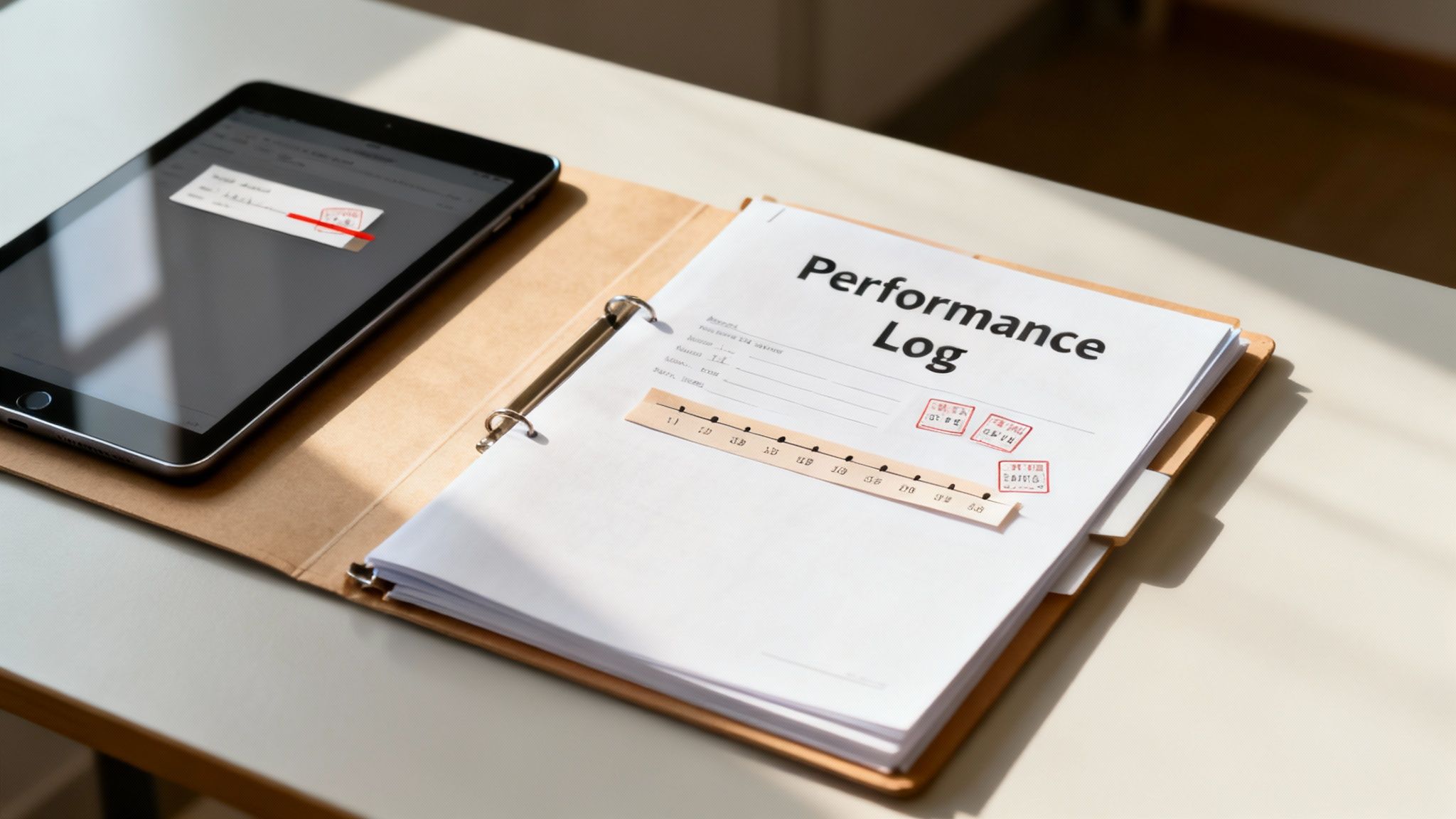
Maintaining a log of specific achievements, challenges, and critical incidents provides a factual basis for the conversation. This approach moves the review from a subjective discussion to a data-informed dialogue about an employee’s contributions over the entire performance period. It also serves as important legal protection for the organization. It creates a clear and consistent record of performance discussions and outcomes.
How to Implement Performance Documentation
The key is to create a consistent habit of recording observations as they happen. This can be as simple as a dedicated digital document or as sophisticated as an integrated performance management system. The goal is to capture concrete examples that illustrate an employee's strengths and areas for development.
Here are a few practical examples of documentation:
- Project Completion: "On May 15, Alex successfully launched the Q2 marketing campaign, which exceeded its lead generation target by 18% within the first month."
- Problem-Solving: "During the system outage on July 22, Sam identified the root cause within 30 minutes, minimizing customer impact and documenting the solution for the team."
- Developmental Feedback: "In the August 10 team meeting, Jamie missed the deadline to present project updates. We discussed time management strategies in a 1-on-1 that afternoon."
Actionable Tips for Managers
To make documentation a seamless part of your workflow, consider these employee performance review tips.
- Use a central system. A performance management tool like BambooHR or a shared document provides a single source of truth that is easy to update and reference.
- Record both wins and challenges. A balanced log ensures you present a fair picture of performance. You acknowledge accomplishments alongside areas for improvement.
- Be specific and objective. Include dates, metrics, and the context surrounding an event. Focus on behavior and outcomes, not personal opinions.
- Share feedback promptly. Documenting an incident is only the first step. Discuss your observations with the employee close to when they occur to provide timely coaching.
6. Prepare Thoroughly and Reduce Bias in Evaluations
A fair and effective performance review depends on meticulous preparation and a conscious effort to mitigate unconscious bias. Without a structured approach, managers can fall prey to common cognitive shortcuts. One is the recency effect, focusing only on recent events. Another is the halo effect, where one positive trait overshadows other performance areas. Taking the time to prepare systematically ensures your evaluation is balanced, objective, and based on the employee's contributions throughout the entire review period.

This process involves more than recalling recent wins or challenges. It requires a systematic review of all available data, from project outcomes and peer feedback to progress against SMART goals. Research from institutions like Harvard Business School and organizations like Catalyst highlights how structured evaluations lead to more equitable outcomes. By implementing bias-reduction strategies, you build trust and ensure every employee is assessed on their actual performance, not on subjective impressions.
How to Implement Bias Reduction
To create a more objective review process, focus on systems and standards. For example, instead of relying on memory, use a standardized evaluation rubric with behavioral anchors for each rating. For instance, a "Meets Expectations" for communication is defined by specific, observable actions. This consistency is a cornerstone of effective employee performance review tips.
Consider these practical applications:
- Calibration Meetings: Managers meet to discuss their team members' ratings and justifications. This process helps align evaluation standards across different teams and corrects for individual manager biases.
- Structured Rating Scales: Use a 1-5 scale where each number corresponds to a clear definition of performance, leaving little room for subjective interpretation.
- Diverse Review Panels: For senior or leadership roles, involve a panel of diverse reviewers to provide multiple perspectives and reduce the impact of any single person's bias.
Actionable Tips for Managers
To put this into practice, integrate these habits into your review preparation workflow.
- Review the full performance period. Actively look for notes, project data, and feedback from the beginning, middle, and end of the cycle to counteract recency bias.
- Define competencies clearly. Create a rubric that outlines what success looks like for key skills like "collaboration" or "problem-solving" in that specific role.
- Standardize your questions. Ask every employee in a similar role the same core set of questions to ensure you gather comparable information for your evaluation.
- Train yourself on common biases. Learn to recognize affinity bias (favoring people like you), the halo/horns effect, and other common pitfalls. Find resources on unconscious bias to build your awareness.
7. Make Performance Reviews a Two-Way Conversation
The traditional performance review often feels like a monologue where a manager delivers feedback to a subordinate. A more effective approach changes this one-sided delivery into a genuine two-way dialogue. This method encourages employees to share their perspectives, challenges, and insights. It makes the review a collaborative process rather than a top-down judgment.
This conversational format fosters psychological safety and demonstrates that the organization values its employees' voices. When employees feel heard and respected, they are more engaged in their development and more receptive to constructive feedback. This is a critical element of modern, employee-centric performance management and one of the most impactful employee performance review tips.
How to Implement a Two-Way Conversation
The key is to structure the meeting to explicitly invite and incorporate the employee's perspective from start to finish. Instead of saving a few minutes for questions at the end, integrate their input throughout the discussion. This approach ensures you gain a full understanding of their experience.
Consider these examples of shifting from a monologue to a dialogue:
- Manager Monologue: "Here is your rating for the project management competency. You need to improve your communication with stakeholders."
- Two-Way Dialogue: "Let's talk about the recent project. From your perspective, what went well with stakeholder communication, and what were the biggest challenges you faced?"
- Manager Monologue: "Your goal for next quarter is to increase output by 15%."
- Two-Way Dialogue: "The team's objective is to increase output by 15%. What resources or support do you believe you'll need to contribute to that goal?"
Actionable Tips for Managers
To successfully create a two-way conversation, you must prepare a structure that facilitates it.
- Share materials in advance. Send the employee their performance summary and a self-assessment form a few days before the meeting. This gives them time to reflect and prepare their thoughts.
- Start with their self-assessment. Begin the review by asking the employee to walk you through their self-evaluation. This sets a collaborative tone from the outset.
- Ask open-ended questions. Use prompts like, "Tell me about your proudest accomplishment this quarter," or "What obstacles are getting in your way?"
- Practice active listening. Pay full attention, take notes on their comments, and ask clarifying questions. Show you are processing their feedback, not waiting for your turn to speak.
- Explicitly ask what support they need. A simple question like, "What can I do differently to better support you in your role?" can yield invaluable insights.
8. Link Performance Reviews to Compensation and Career Advancement Transparently
One of the best ways to motivate employees is to show them exactly how their performance impacts their career and earnings. When the connection between a review, a raise, and a potential promotion is unclear, the entire process can feel arbitrary and discouraging. A transparent system removes this ambiguity and builds trust. It makes the review a meaningful tool for growth.
This approach involves creating and communicating a clear framework that directly links performance ratings to compensation adjustments, bonus payouts, and advancement opportunities. When employees understand the "why" behind compensation decisions, they are more engaged and have a clear roadmap for their professional development. Companies like Buffer and GitLab have championed this transparency. They often publish salary bands and career ladders for everyone to see.
How to Implement Transparent Links
Instead of keeping compensation and promotion criteria behind closed doors, make the system explicit. This shifts the conversation from a subjective judgment to an objective evaluation against established standards. A vague promise of "a bonus for good work" becomes a clear formula like "Achieving a 4-Exceeds Expectations rating makes you eligible for a 12-15% performance bonus."
Here are a few examples of this in practice:
- Compensation: Publish a policy stating that a "Meets Expectations" rating corresponds to a 2-3% merit increase, while "Exceeds Expectations" earns a 4-6% increase.
- Promotions: Create a public career ladder that details the specific skills, competencies, and performance results required to move from a Level II to a Level III Engineer.
- Bonuses: Tie a portion of the annual bonus directly to the achievement of the SMART goals set at the beginning of the performance cycle.
Actionable Tips for Managers
To successfully implement this tip, you must focus on clarity and consistency.
- Publish your compensation philosophy. Create a document accessible to all employees that explains how the company approaches pay, including its market benchmarks and rating system.
- Discuss career paths during the review. Use the performance conversation to show employees where they stand on the career ladder and what they need to do to reach the next level.
- Be explicit about the numbers. During the compensation part of the discussion, explain exactly how the performance rating translated into their specific merit increase or bonus amount.
By creating a transparent link between performance and rewards, you empower your team with the knowledge they need to take control of their career growth.
9. Address Performance Problems Early with Clear Improvement Plans
Effective performance management requires addressing issues as they arise, not waiting for the annual review. Allowing problems to persist creates frustration for the team and puts the organization at risk. A proactive approach involves creating a formal Performance Improvement Plan (PIP) to provide struggling employees with a clear path to success. This method is one of the most essential employee performance review tips for ensuring fairness and clarity.
A PIP is a documented tool that outlines specific performance deficiencies, establishes clear expectations for improvement, and details the support the company will provide. It changes a difficult situation into a structured, time-bound opportunity for the employee to meet performance standards. This protects the organization by creating a clear record of actions taken. It also gives the employee a genuine chance to succeed.
How to Implement a Performance Improvement Plan
A PIP should be a collaborative, transparent tool, not a surprise punishment. It works best when focused on specific, measurable outcomes. For instance, instead of a vague goal like "be more responsive," a PIP would state, "Acknowledge all high-priority client emails within four business hours and provide a resolution or next steps within 24 hours."
Here are a few examples of PIP objectives:
- Project Management: Reduce project budget overruns from an average of 15% to less than 5% on all assigned projects by the end of the 60-day plan.
- Customer Support: Achieve a Customer Satisfaction (CSAT) score of 90% or higher for all resolved tickets during the next 90 days.
- Data Analysis: Decrease the error rate in weekly financial reports from 8% to below 2%, verified by a peer review process over the next 30 days.
Actionable Tips for Managers
To implement a PIP effectively, you must be methodical and supportive. Follow a structured process to ensure the plan is fair and has the highest chance of success.
- Document everything. Before meeting with the employee, gather specific, dated examples of the performance issue.
- Consult HR. Always partner with your Human Resources department to ensure the process is compliant and fair.
- Set a clear timeline. Most PIPs run for 30, 60, or 90 days, with specific milestones and regular check-ins.
- Define success metrics. The plan must explicitly state what the employee needs to do to successfully complete it.
- Schedule weekly check-ins. Use these meetings to review progress, discuss obstacles, and offer coaching.
A well-executed PIP provides structure during a challenging time. Learn more about how to write a performance improvement plan to ensure you handle these situations correctly.
10. Follow Up After Reviews with Action Planning and Accountability
A performance review meeting is a starting point, not a finish line. The conversation loses its value if it does not translate into tangible action. Effective follow-up changes the discussion into a development roadmap. It ensures insights lead to real growth and behavioral change. This process closes the loop, making the review a meaningful part of an ongoing performance management cycle.
The true impact of a review is measured by what happens afterward. Documenting specific next steps, assigning clear ownership, setting deadlines, and establishing a regular check-in cadence creates a system of accountability. It ensures both you and your employee are committed to the development plan. It also ensures progress is actively monitored, not left to chance.
How to Implement Action Planning
Translate development goals into concrete, trackable steps. Instead of a general suggestion like "improve communication skills," create a specific action plan such as "Enroll in the company's 'Effective Presentations' workshop by the end of Q2 and lead two team meetings in Q3." This approach provides a clear path forward.
Here are a few examples across different development areas:
- Leadership: Complete a project management certification by the end of the year to better lead the upcoming platform migration.
- Technical Skills: Dedicate four hours per month to online courses on advanced data analysis and present key learnings to the team quarterly.
- Time Management: Implement the Pomodoro Technique for all deep work sessions and track daily task completion rates in a shared document for the next 30 days.
Actionable Tips for Managers
To make your follow-up one of the most effective employee performance review tips, integrate it into your regular management routine.
- Summarize action items in writing. Send a follow-up email within 24 hours of the review, outlining the agreed-upon goals, action items, and deadlines.
- Schedule check-in meetings. Immediately book 30, 60, and 90-day check-ins to discuss progress, offer support, and adjust the plan as needed.
- Make development visible. Use your performance management system or a shared document to track progress on action items. This keeps goals top of mind for both you and the employee.
- Connect actions to resources. Actively help employees find the right courses, mentors, or project opportunities to support their development goals.
10-Point Employee Review Tips Comparison
| Practice | 🔄 Implementation complexity | ⚡ Resource requirements | 📊 Expected outcomes | 💡 Ideal use cases | ⭐ Key advantages |
|---|---|---|---|---|---|
| Set Clear, SMART Goals Before the Review Period | Medium — initial planning & alignment | Low–Medium — manager time + tracking tools | Measurable targets, fairer evaluations, higher motivation | Goal-driven teams, sales, project milestones | Transparent expectations; objective measurement |
| Use 360-Degree Feedback for Comprehensive Perspectives | High — coordinate multiple raters & anonymity | High — time, HR coordination, often software | Broader perspectives, blind‑spot visibility, development signals | Leadership assessment, multi‑stakeholder roles | Reduces single‑rater bias; improves self‑awareness |
| Provide Frequent, Real‑Time Feedback Instead of Annual Reviews | Medium — establish cadence & train managers | Medium — ongoing manager time, lightweight tools | Faster corrections, increased engagement, continuous improvement | Fast‑paced work, development‑focused orgs | Immediate course correction; stronger relationships |
| Focus on Development and Growth Rather Than Criticism | Medium — requires planning & coaching skills | Medium — development programs, mentoring | Higher motivation, retention, skill development | High‑potential employees; retention strategies | Builds morale; focuses on career progression |
| Document Performance Evidence Throughout the Year | Medium — sustained discipline for records | Low–Medium — logging tools, time to record | Objective reviews, legal protection, pattern detection | Compliance‑sensitive orgs; long‑term tracking | Reduces recency bias; provides concrete examples |
| Prepare Thoroughly and Reduce Bias in Evaluations | High — training, rubrics, calibration sessions | Medium–High — training time, calibration meetings | Fairer, consistent evaluations; better talent decisions | Large orgs; equity and legal defensibility needs | Improves consistency; reduces unfair bias |
| Make Performance Reviews a Two‑Way Conversation | Low–Medium — facilitation skills & prep | Low — time for dialogue and prep materials | Increased engagement, context disclosure, mutual actions | One‑on‑ones; development conversations | Increases ownership; surfaces hidden issues |
| Link Performance Reviews to Compensation and Career Advancement Transparently | High — policy design, budget alignment | High — compensation systems, payroll integration | Clear link between performance and rewards; higher motivation | Pay‑sensitive cultures; retention of top talent | Clarifies rewards; aligns performance with pay |
| Address Performance Problems Early with Clear Improvement Plans | Medium — structured plans & monitoring | Medium — manager follow‑up, HR involvement | Opportunity to improve, documented process, fewer surprises | Performance issues; legal/compliance cases | Fair chance to improve; creates documentation trail |
| Follow Up After Reviews with Action Planning and Accountability | Low–Medium — document & track actions | Low–Medium — tracking tools, manager time | Reviews produce tangible change; sustained development | Any org seeking execution and development | Ensures accountability; prevents 'review and forget' |
Turn Your Next Review into a Productive Conversation
Moving beyond the traditional performance appraisal requires a fundamental shift in mindset. The employee performance review tips in this guide are not a checklist. They represent a new operating system for fostering growth, building trust, and driving results. An effective performance review is a milestone, not an endpoint. It is one structured conversation within a much larger, ongoing dialogue about expectations, progress, and professional development.
The core principle is to change the review from a backward-looking judgment into a forward-looking partnership. This means replacing infrequent, high-stakes meetings with a culture of continuous feedback. It means preparing with documented evidence instead of relying on recent memory. It also means focusing on development instead of dwelling on past mistakes.
Key Takeaways for Immediate Impact
To make your next review cycle more effective, concentrate on these foundational practices:
- Preparation is paramount. Gather specific examples of performance throughout the entire review period. Use frameworks like SBI (Situation, Behavior, Impact) to structure your notes and deliver clear, objective feedback.
- Dialogue over monologue. Structure the meeting to be a two-way conversation. Ask open-ended questions, listen actively to the employee's perspective, and create a safe space for honest discussion about challenges and aspirations.
- Focus on the future. The most productive reviews connect past performance to future growth. Collaboratively set clear SMART goals and define a tangible development plan that supports the employee's career path.
The Value of a Modern Performance Culture
Mastering these skills elevates your leadership. When you conduct fair, constructive, and motivating reviews, you build stronger relationships with your team members. This creates a positive feedback loop. Employees feel seen, valued, and supported, which directly improves engagement, motivation, and retention.
Your role is to act as a coach, not just a manager. By applying these employee performance review tips, you help your team members identify their strengths, address their weaknesses, and see a clear path for advancement within the organization. This commitment to their growth is one of the most useful tools you have for building a high-performing and resilient team.
Actionable Next Steps
Do not try to implement every tip at once. Choose one or two areas to focus on for your next performance review cycle.
- Start with documentation. For the next month, commit to documenting one specific example of positive performance or a coaching opportunity for each team member every week.
- Practice the two-way conversation. In your next one-on-one meeting, dedicate half the time to asking questions about your employee's goals, challenges, and what support they need from you.
- Define one SMART goal together. Work with an employee to convert a vague objective into a specific, measurable, achievable, relevant, and time-bound goal.
By taking these small, deliberate steps, you will begin to build the habits needed for exceptional performance management. The goal is progress, not perfection. Each well-run review strengthens your team, clarifies expectations, and reinforces a culture where everyone is invested in growth and success.
Ready to streamline your preparation and lead more effective reviews? PeakPerf provides guided templates based on proven frameworks to help you draft clear, professional, and actionable talking points in minutes. Stop stressing over what to say and start focusing on the conversation. Try PeakPerf today and turn every performance review into a leadership moment.


