
Your Management Development Plan Template & Guide
A management development plan is an actionable roadmap you build to systematically improve a manager's skills and prepare them for future roles. This guide gives you a free, downloadable management development plan template and shows you exactly how to use it. Let's build a plan that creates growth.
What Is a Management Development Plan?
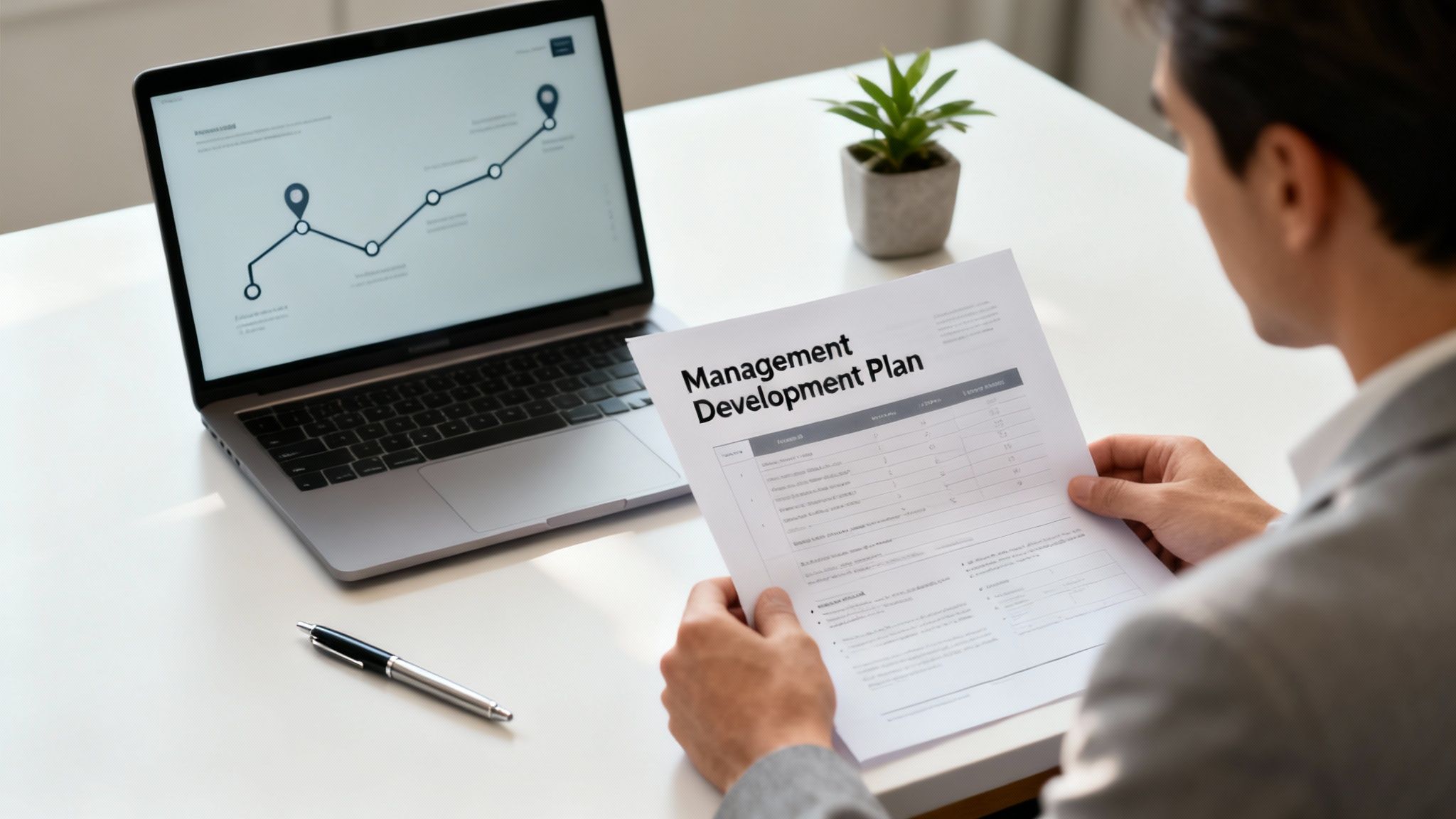
A management development plan moves beyond a simple performance review. It is a structured way to align a manager's personal and professional growth directly with the company's goals. This process ensures every development dollar and hour spent contributes straight to the bottom line.
This plan is not a performance improvement plan (PIP). A PIP is reactive and designed to fix current performance issues. A development plan is proactive. You use it for managers who are already meeting or exceeding their goals. You are not fixing problems; you are building new capabilities to prepare them for their next challenge.
Why Your Business Needs a Development Plan
When you use a formal management development process, the benefits extend to everyone: the organization, the teams, and the managers. Organizations that invest strategically in employee development see 11% higher profitability and are twice as likely to retain their people. A well-designed plan is a core part of this success.
Here is what you stand to gain:
- Improved Talent Retention: When managers see a clear path forward, their engagement and commitment increase. A lack of career development is a top reason why 41% of employees quit, making these plans essential for retention.
- Stronger Team Performance: Good managers lead good teams. When you sharpen a manager's skills in coaching, feedback, and delegation, you directly improve the productivity and morale of everyone who reports to them.
- A Sustainable Leadership Pipeline: A structured plan helps you identify and groom high-potential people for future leadership roles. This "build from within" approach strengthens your entire organization and reduces the high costs of hiring leaders from outside.
A management development plan is a commitment. The organization commits to investing in its leaders. The manager commits to owning their growth. This mutual investment drives long-term success.
Connecting Individual Growth to Company Goals
A management development plan template forges a direct link between what an individual manager needs to learn and what the company needs to achieve.
For example, your company may plan to expand into a new market. This means your managers will need to become proficient at change management and cross-functional collaboration. A development plan makes that connection explicit. It translates a high-level business strategy into tangible, individual actions.
The process starts when you identify the core competencies needed for a manager to succeed in your environment. Then, you assess your managers against those competencies to find their unique strengths and growth opportunities. This targeted approach ensures your training budgets and coaching resources are spent where they will have the biggest impact on business results. This strategic alignment separates an effective plan from a generic training checklist.
Putting Your Management Development Plan Template to Work
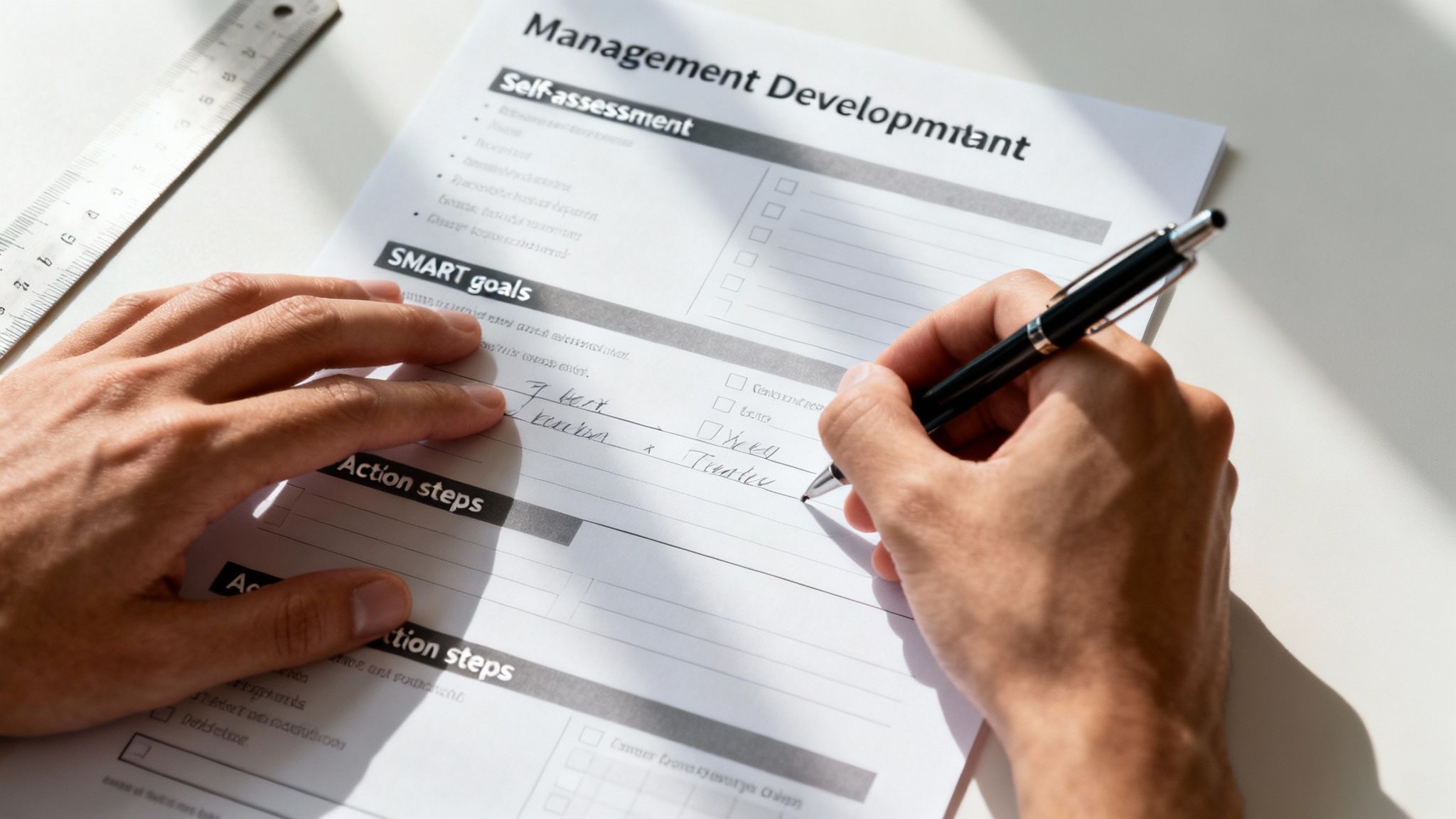
You have the template. A blank document does not drive growth; action does. Let's walk through exactly how to transform this template from a simple file into a roadmap for your managers.
We will go field by field, starting with the manager’s self-reflection and then moving to identifying the most critical development areas. From there, we will set sharp SMART goals, define concrete action steps, and determine what success looks like. The goal is to make this a living tool, not another document that gathers digital dust.
Starting With the Self-Assessment
Everything starts with an honest self-assessment. This is where the manager takes a candid look at their current skills, strengths, and areas for improvement. If you skip this step or rush it, the entire plan will be built on a weak foundation.
The template guides the manager to think about their performance against core leadership competencies. Urge them to get specific. Instead of saying "I need to communicate better," they should think of recent situations where they succeeded or failed. This level of self-awareness is the foundation of any meaningful development.
A self-assessment is not about finding fault. It is about drawing an accurate map of where a manager is right now. Honest reflection empowers them to take ownership of their growth journey from day one.
This initial review leads to a much more productive conversation between the manager and their own leader. It gets both people on the same page. They work from a shared understanding of the manager's current capabilities. That alignment makes the goals you set later feel relevant and achievable.
Identifying Key Development Areas
With a clear self-assessment, you can focus on the development areas that will have the biggest impact. Resist the urge to fix everything at once. Pick two or three key focus areas for the planning period. Trying to address more can lead to burnout and minimal progress.
These development areas need to connect to two things: the manager’s own career goals and the company's strategic needs. For instance, if the business is scaling fast, a great development area might be "Leading Through Change." If a manager wants a director role, "Strategic Thinking and Financial Acumen" would be a smart focus.
Here are a few examples of well-defined development areas:
- Improving Team Communication: Focusing on delivering clearer feedback, running more efficient meetings, and fostering psychological safety.
- Delegation and Empowerment: Learning to assign tasks effectively, trusting team members with ownership, and avoiding micromanagement.
- Strategic Project Management: Developing the ability to align project goals with business outcomes, manage resources efficiently, and communicate progress to stakeholders.
Setting SMART Goals for Managers
Now translate those broad development areas into sharp, actionable SMART goals. This framework, Specific, Measurable, Achievable, Relevant, and Time-bound, is your best tool for turning vague intentions into actual objectives.
One of the most common mistakes is a goal like "become a better communicator." It sounds nice, but what does it mean? How do you know when you have achieved it? A SMART goal leaves no room for guessing.
Example for a First-Time Manager:
- Goal: Improve team meeting effectiveness by implementing a structured agenda and action-item summary for all weekly team meetings over the next quarter.
- Measurement: Success will be measured by a 15% reduction in post-meeting clarification emails and positive feedback from at least 80% of team members in a quarterly anonymous survey.
Example for an Experienced Director:
- Goal: Develop strategic planning skills by leading the creation of the department's fiscal year budget and three-year roadmap, presenting the final proposal to the executive team by the end of Q3.
- Measurement: Success will be defined by the plan's approval from the leadership team with no more than one round of major revisions and positive feedback on the clarity and strategic alignment of the presentation.
Defining Action Steps and Timelines
Every goal is backed by a series of small, manageable steps. This is where you break down the "what" into the "how." For each SMART goal, list the specific tasks the manager will undertake to get there.
This could be a mix of activities, like formal training, finding a mentor, or taking on a specific on-the-job project. Well-structured employee development plan templates are popular because they provide a clear framework. They often follow models like the 70-20-10 rule, which allocates development to on-the-job learning (70%), social interactions and mentorship (20%), and formal education (10%).
Attach a realistic timeline to each action step. Deadlines create accountability and keep the momentum going. It should feel like a slight stretch, but not impossible. For more information, our detailed guide on creating a leadership development plan template offers more strategies for building effective timelines.
Outlining Success Metrics
Finally, how will you know if the plan is working? The success metrics are the clear, observable outcomes that prove a goal has been met. These need to be clear and agreed upon by both the manager and their leader from the start.
Good metrics go beyond checking a box on a to-do list. They measure the impact of the manager's changed behavior.
- Quantitative Metrics: These are the numbers. Examples include a 10% increase in team engagement scores, a 20% reduction in project delays, or a 5% improvement in customer satisfaction ratings for their department.
- Qualitative Metrics: This is about observation. Examples include feedback from 360-degree reviews, direct notes from their manager on improved meeting facilitation, or positive comments from colleagues in other departments on better collaboration.
When you define these metrics upfront, you eliminate guesswork. Everyone knows exactly what success looks like. This makes check-ins and progress reviews far more objective and productive.
Defining Core Competencies for Managerial Success
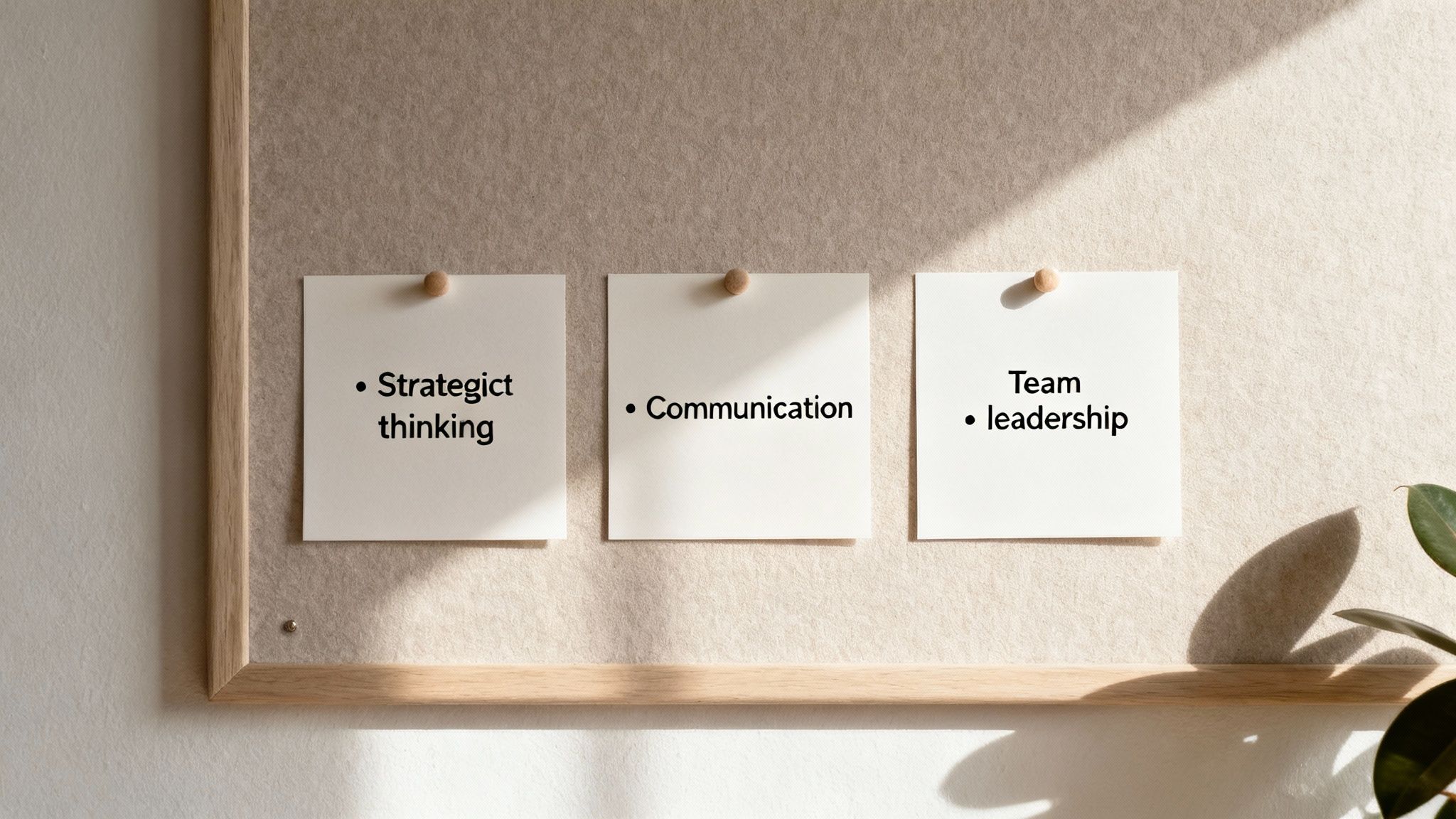
Before you fill out the template, you need a clear picture of what "great" management looks like at your company. The difference between a plan that drives growth and one that ticks boxes is a focus on the right skills.
Effective management is not an abstract concept. It is built on specific, observable behaviors. This means we have to move past generic phrases like "leadership skills" and break down what successful leaders do. These core competencies are the foundation for every goal in the development plan.
Core Management Competencies and Development Activities
Let's map out the key competency areas and what they look like in practice. The table below connects broad skill areas to specific skills and provides examples of development activities you could use in a manager's plan.
| Competency Area | Specific Skill | Example Development Activity |
|---|---|---|
| Strategic Thinking | Business Acumen | Subscribe to two industry newsletters (e.g., Harvard Business Review, Stratechery) and present key takeaways at one team meeting per month. |
| Communication | Constructive Feedback | Complete a workshop on the SBI (Situation-Behavior-Impact) feedback model and conduct three documented SBI feedback sessions with direct reports this quarter. |
| Team Leadership | Coaching for Performance | Read The Coaching Habit and apply the "seven essential questions" in all 1-on-1s for the next 60 days to shift from problem-solver to coach. |
| Execution Excellence | Project Management | Shadow a senior project manager for one week on a key company initiative and create a lessons-learned document to apply to their own team's projects. |
This is not an exhaustive list, but it gives you a solid framework for thinking about development in a more structured, actionable way. Use these ideas as a starting point to tailor the plan to each manager's unique needs.
Strategic Thinking Skills
Strategic thinking is about seeing the big picture. It is the ability to connect your team's daily work to the company's mission. A manager with strong strategic skills does not just manage tasks; they align their team's energy with business outcomes.
This becomes important as managers advance. They must anticipate roadblocks, spot opportunities others miss, and make decisions that set the stage for long-term success.
Key strategic competencies include:
- Analytical and Critical Thinking: Using data to dissect problems and make decisions that are not based on gut feelings.
- Business Acumen: Understanding the market, your customers, and what makes the business operate financially.
- Vision and Goal Alignment: Translating high-level company objectives into clear, motivating goals the team can support.
- Innovative Problem Solving: Looking past the obvious fixes to find smarter, more effective ways to solve challenges.
Communication and Interpersonal Skills
No manager can succeed without being a phenomenal communicator. This is not about being a smooth talker. It is about creating an environment of trust, clarity, and psychological safety where people feel heard and respected.
Good communication prevents misunderstandings, keeps morale high, and makes sure everyone is working toward the same goal. It holds together relationships with direct reports, peers, and senior leaders.
Essential communication skills are:
- Active Listening: Genuinely hearing what people are saying without immediately planning your response.
- Providing Constructive Feedback: Delivering clear, specific, and actionable feedback using frameworks like SBI (Situation-Behavior-Impact).
- Conflict Resolution: Mediating disagreements fairly and helping people find common ground.
- Clear Articulation: Presenting ideas, plans, and instructions in a way that is impossible to misunderstand.
An effective management development plan template helps you target these exact skills. It provides the structure to turn a vague goal like "improve communication" into a specific action, such as "Lead three project kickoff meetings using a new, structured agenda to ensure team alignment."
Team Leadership and Coaching
A good manager’s legacy is the good team they build. This set of skills is about empowering others to perform at their best. It requires a shift from being a star individual contributor to being a coach and talent developer.
True leadership is about creating the conditions for others to succeed. That means knowing when to provide guidance and when to step back and let the team own the work. Honing these abilities is a top priority for any manager. You can find more tips in our guide on how to improve management skills.
Top skills for team leadership are:
- Delegating Tasks Effectively: Matching the right work with the right person and setting clear expectations.
- Coaching for Performance: Helping team members see their own strengths and build new capabilities.
- Motivating and Inspiring Others: Fostering a positive team culture that people want to be a part of.
- Fostering Collaboration: Designing a team environment where people want to work together.
Operational and Execution Excellence
A manager has to get things done. Operational excellence is about making sure the team runs like an efficient machine, projects stay on track, and goals are met consistently. This demands a tight grip on processes, resources, and performance metrics.
The pressure here is increasing. The World Economic Forum projects that 59% of workers will need significant reskilling by 2030. This puts managers on the front lines of leading their teams through constant change. A solid development plan is crucial for managing this shift.
Key operational competencies include:
- Project Management: Planning, executing, and monitoring projects to meet deadlines and stay within budget.
- Time Management and Prioritization: Helping the team focus their limited time on the work that matters.
- Managing Budgets and Resources: Making smart financial decisions that support the team's objectives.
- Performance Management: Setting clear expectations for performance and holding people accountable in a fair and consistent way.
Real-World Examples of Development Plans
Theory is useful, but seeing finished plans makes the process clear. Let’s move from the abstract to the practical and see how this template comes to life for managers at different career stages.
We will look at three scenarios. Notice how each example uses the same template structure, but the goals, actions, and metrics are customized to fit the individual’s unique challenges and ambitions. Think of these as a starting point you can adapt for your own team.
Example 1: The New Team Lead
First, meet Alex. Alex was a top software engineer. That performance led to a recent promotion to Team Lead for the front-end developers. While Alex knows the tech, this is the first time managing direct reports. This plan is about building foundational leadership skills from scratch.
Name: Alex Rivera
Role: Team Lead, Front-End Development
Planning Period: Q3 - Q4
- Development Area 1: Effective Delegation and Empowerment
- SMART Goal: By the end of Q4, delegate at least 30% of non-critical coding tasks to team members to create more time for strategic planning and coaching, measured by tracking task allocation in our project management tool.
- Action Steps:
- Finish the "Delegation for First-Time Managers" online course by July 31st.
- Run weekly 1-on-1s with each direct report to better understand their skills and career goals, which will help with task assignment.
- Build a team skills matrix by August 15th to visualize who is best suited for different types of work.
- Success Metrics: Cut my personal coding time by five hours per week. Get positive feedback from at least two team members who feel they have more ownership over their work.
- Development Area 2: Time Management and Prioritization
- SMART Goal: Use the time-blocking technique on my personal calendar, setting aside dedicated blocks for team management, strategic work, and deep focus time. I will aim for 90% adherence to this schedule over the next 90 days.
- Action Steps:
- Read "Deep Work" by Cal Newport and share a summary of key takeaways with my manager by August 1st.
- Schedule a recurring "plan the week" session every Friday afternoon to lock in priorities and block out my calendar.
- Keep a daily journal for the first 30 days to track where my time goes and spot distractions.
- Success Metrics: No missed deadlines for key managerial duties (like performance reviews or project status reports) for the entire quarter.
Example 2: The Mid-Level Manager
Now let's look at Maria, an experienced Marketing Manager. She has successfully led her team for three years and is excellent at execution, but her sights are set on a Director role. Her development plan focuses on shifting from tactical execution to a more strategic, cross-functional mindset.
Name: Maria Chen
Role: Marketing Manager
Planning Period: January - June
- Development Area 1: Strategic Planning and Vision
- SMART Goal: Lead the creation of the H2 marketing strategy for my product line, presenting a comprehensive plan to the VP of Marketing by May 1st that clearly connects to the company's revenue targets.
- Action Steps:
- Set up meetings with the heads of Sales and Product by February 15th to understand their goals and pain points.
- Run a competitive analysis on our top three market competitors and present the findings to my team by March 30th.
- Enroll in a "Finance for Non-Financial Managers" workshop to get smarter about budget impact and ROI.
- Success Metrics: The H2 marketing plan is approved with only minor revisions. The plan clearly shows how our marketing activities will drive core business objectives.
- Development Area 2: Cross-Functional Collaboration
- SMART Goal: Launch and lead a new monthly cross-departmental sync with Sales and Product to improve campaign alignment, leading to a 10% lift in marketing-qualified leads (MQLs) from our new campaigns by the end of Q2.
- Action Steps:
- Create a shared dashboard by January 31st to track key metrics across the marketing and sales funnels.
- Shadow a Product Manager for a full day to get a deeper appreciation for their development cycle.
- Present a "lessons learned" recap from a recent campaign to the cross-functional group to build trust and open communication.
- Success Metrics: Get positive feedback from both the Head of Sales and Head of Product on the improved collaboration. Hit the 10% MQL growth target.
Example 3: The Senior Leader
Finally, there is David. As Director of Operations, he has been a pillar of the company for a decade and is being considered for a Vice President role. His development plan is less about functional skills and more about honing executive-level competencies like managing large-scale change and influencing at an enterprise level. If you want to dive deeper, you can check out some more career development plan samples on our blog.
These examples show a critical point: a development plan template is just a starting line. Its power comes from tailoring it to the person's specific role, context, and career dreams. It is never a one-size-fits-all document.
Name: David Ortega
Role: Director of Operations
Planning Period: Full Year
- Development Area 1: Leading Large-Scale Change
- SMART Goal: Spearhead the implementation of the new enterprise resource planning (ERP) system across the entire operations division, hitting a 95% user adoption rate within six months of launch.
- Action Steps:
- Become a certified Prosci Change Management Practitioner by the end of Q1.
- Build a change champion network with reps from each operations team to gather real-world feedback and drive grassroots adoption.
- Create and roll out a comprehensive communication plan, including weekly updates, town halls, and targeted training sessions.
- Success Metrics: Hit all project milestones on time and within budget. Achieve the target user adoption rate. Post-launch surveys show a positive sentiment score of 80% or higher on the change process itself.
- Development Area 2: Executive Presence and Influence
- SMART Goal: Sharpen my presentation and communication skills to influence senior stakeholders more effectively. My goal is to deliver the Q3 quarterly business review to the executive leadership team and receive positive feedback on its clarity and strategic impact.
- Action Steps:
- Hire an executive coach for six sessions specifically focused on high-stakes communication.
- Join Toastmasters and attend meetings twice a month to practice public speaking in a low-risk setting.
- Volunteer to present at an industry conference to build my external profile and polish my message.
- Success Metrics: Receive specific, positive feedback from at least two executive team members on the Q3 business review. My boss notes increased confidence and effectiveness in high-level meetings.
Tracking Progress and Measuring Impact

A management development plan is only as good as the results it produces. Creating the plan is the easy part. The real work starts when you track progress and determine if the manager’s efforts are making a difference.
Without a solid tracking system, even the most thoughtful plan becomes a static document. We need to turn it into a living tool for growth. This creates a rhythm of accountability that connects development activities to tangible improvements.
Establishing a Consistent Review Cadence
The single most critical element here is consistency. Sporadic check-ins will not work. You have to build a predictable schedule for reviewing the development plan. This means carving out dedicated time to talk about wins, roadblocks, and any needed adjustments.
For most plans, a quarterly review is a good frequency. It is frequent enough to maintain momentum but gives the manager enough time to make progress on their goals. These are not performance reviews. They are collaborative, forward-looking conversations focused entirely on the manager’s growth.
During these meetings, you should:
- Walk through the SMART goals and get a status update on each action item.
- Celebrate milestones and completed tasks, which is key for motivation.
- Discuss any obstacles or challenges that are getting in the way.
- Adjust timelines or action steps based on new information or shifting priorities.
Simple and Effective Tracking Methods
You do not need complicated software to monitor a development plan. The best tracking methods are the simplest ones because people will use them. The goal is clarity, not complexity.
A shared spreadsheet is a straightforward approach. List each SMART goal, its action steps, and deadlines. Then add columns for status updates like "Not Started," "In Progress," and "Complete." This creates a single source of truth that both the manager and their leader can check anytime.
Another tool is 360-degree feedback. This involves gathering anonymous input from the manager’s direct reports, peers, and their own boss. It gives you a well-rounded view of whether the manager's new behaviors are having a positive impact on the people around them.
A plan without measurement is a wish list. Tracking transforms intentions into outcomes by creating a feedback loop. It answers the crucial question: "Is this working?"
Measuring Impact Beyond the Checklist
Checking a box, like attending a workshop, is not the real goal. The true goal is the impact that new skill has on the team and the business. Measuring this means looking beyond the plan's to-do list. You need to connect development activities to real-world business metrics.
Start by looking at changes in team performance. Has team productivity gone up since the manager started working on their delegation skills? Are project deadlines being met more consistently? These hard numbers provide solid evidence of the plan’s effectiveness.
Do not forget the qualitative side. Pay attention to employee engagement scores on the manager’s team. A jump in those scores often points directly to improved leadership. Also consider the manager’s own confidence and self-reported skill level. Those are important progress indicators, too.
Data backs this up. Organizations with structured tracking see real results. For instance, some studies found that 80% of leadership goals were met when companies used simple spreadsheet-based tracking. This happens because systems that monitor things like percentage completion, skill metrics, and ROI give you clear visibility into behavior change. You can find more insights on leadership development templates and their impact at TogetherPlatform.com.
Getting Ahead of Common Questions
Once you roll out a management development plan, questions will come up. That is a good thing. It means your managers are taking this seriously and thinking through how to make it work.
Let's walk through some of the most common questions and provide clear, straightforward answers.
How Often Should We Update This Thing?
A development plan is not a "set it and forget it" document. Think of it as a living guide for a manager's growth.
The best rhythm is a formal check-in every quarter. This is not a performance review. It is a dedicated coaching session to talk about what's working, celebrate wins, and figure out how to get past roadblocks. This regular cadence keeps the plan from gathering dust and helps maintain momentum.
Beyond those quarterly check-ins, the plan needs a full refresh once a year. You will also want to revisit it anytime there is a big shift, such as a change in their role, new responsibilities, or a pivot in the company's strategy.
Who Is Responsible for Creating the Plan?
This is a team effort, but ownership starts with the manager. The process should begin with them doing their self-assessment and drafting their goals and action steps. This gets them invested in their own growth from day one.
Once the manager has a first draft, their direct leader steps in. The leader’s job is to be a coach and a guide. They help sharpen the goals, make sure everything aligns with what the team and company need, and identify the right resources and support.
HR typically provides the template and the framework. The real substance of the plan, and its success, comes down to the partnership between the manager and their leader.
Is This a PIP?
This is a critical distinction. Confusing a development plan with a Performance Improvement Plan (PIP) is a surefire way to create anxiety and kill the positive, forward-looking atmosphere you are trying to build.
They are two different tools for two different situations.
- Management Development Plan: This is about proactive growth. You use it for managers who are already meeting or exceeding the expectations of their current role. The goal here is to build new skills and prepare them for what is next, such as bigger challenges and more responsibility.
- Performance Improvement Plan (PIP): This is a reactive, corrective tool. A PIP comes into play when a manager is failing to meet the basic requirements of their job. It lays out specific, non-negotiable actions they must take to get their performance back to an acceptable level, usually within a tight timeframe.
A development plan helps a good manager become a great leader. A PIP is a formal process to help a struggling manager get back on solid ground. A development plan is a sign of investment. A PIP is a formal notice that performance must improve, now.
At PeakPerf, we build tools to help managers manage their toughest moments with confidence. Our lightweight toolbox guides you through creating effective development plans, preparing for performance reviews, and delivering clear feedback. Turn hours of stressful prep into minutes of focused, productive work. Get started for free at PeakPerf.


