360 review feedback: A manager's practical guide to growth
360 review feedback is not your typical performance review. It is a development tool. It works by gathering anonymous, confidential input about an employee from the people who work with them every day. These people include their manager, their direct reports, and their peers.
The point is to give someone a panoramic view of their skills and behaviors, not just a top-down snapshot. Its real mission is to build self-awareness.
What Is 360 Review Feedback For?

The 360 feedback process helps an employee see themselves as others see them. It shifts the focus from a single, high-stakes assessment to a rounded, confidential picture of their professional impact. It is one of the most effective tools for personal and professional growth when done right.
A well-managed 360 gives people a multi-dimensional look at their own performance. It highlights the strengths they might undervalue. It also shows the blind spots they do not know they have.
Fostering a Culture of Growth
When you get a 360 system running well, you start building a culture where continuous improvement is normal. It pulls your team away from the dread of a once-a-year review. It makes giving and receiving constructive comments a normal part of the job.
This shift pays off in a few key ways:
- Stronger Team Communication: When people get used to providing thoughtful, structured feedback, it leads to more open dialogue and collaboration day-to-day.
- Improved Leadership Potential: This process helps spot and develop future leaders. It gives them early, invaluable insights into their management style and interpersonal skills.
- Enhanced Self-Awareness: Employees start to connect their actions and how they affect others. This is the foundation of stronger working relationships.
A well-run 360 feedback process is not about finding fault. It is about uncovering opportunities for development that are invisible from a single perspective. The goal is growth, not judgment.
The Impact on Performance and Engagement
Data supports this. Companies that implement 360-degree feedback have seen an average performance increase of around 14.9%. When people get regular, well-rounded feedback, they feel more engaged and invested. You can read more about how 360 feedback impacts engagement and performance on straitsresearch.com.
360 feedback is a strategic tool. It delivers the specific insights you need to build targeted, effective development plans that tie an individual's growth to the company's goals. You're not just giving feedback; you are empowering your people to take ownership of their own careers.
How to Prepare for the Feedback Conversation
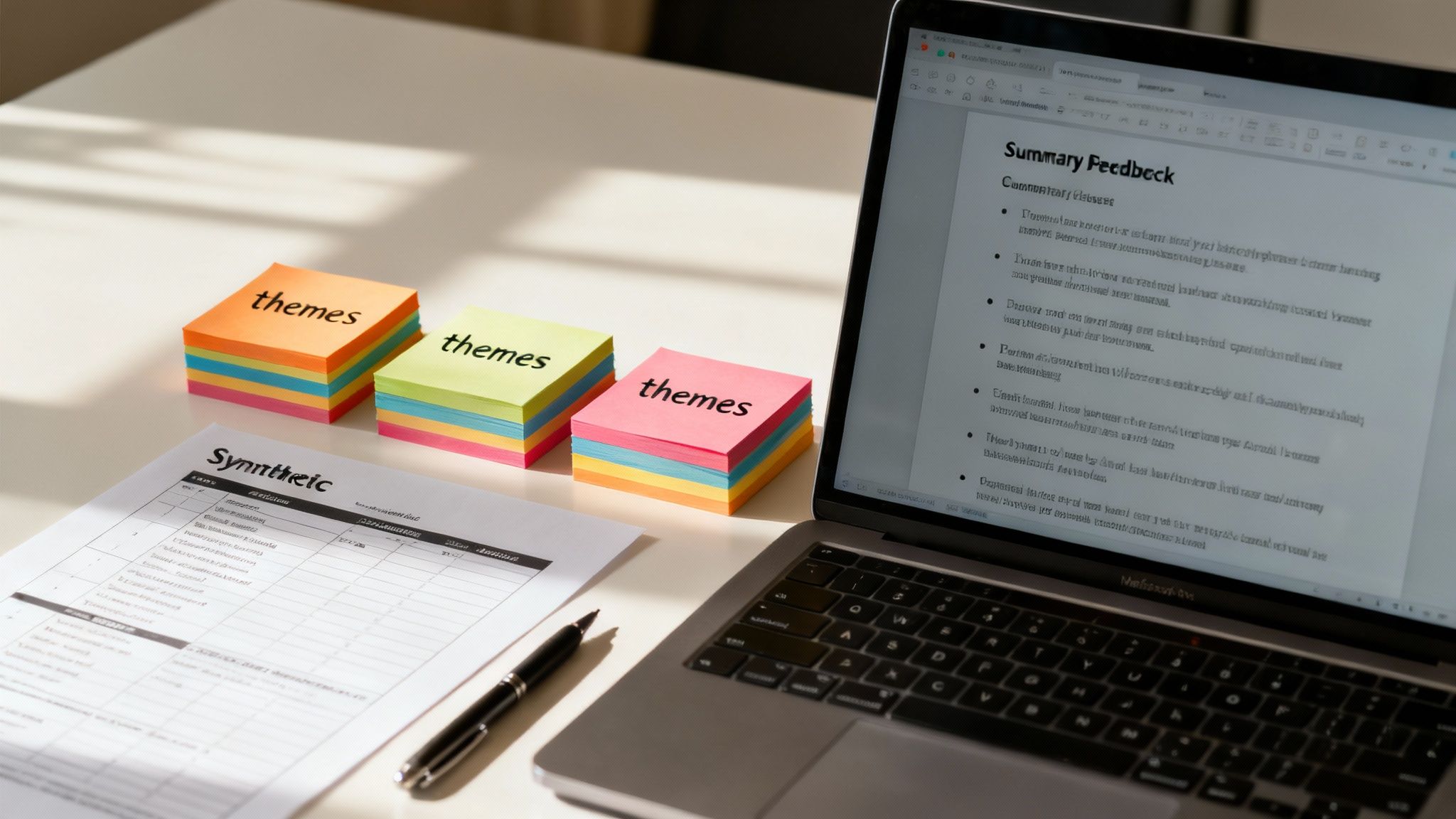
The most productive 360 review feedback sessions are won before you sit down with your employee. Your work starts with the raw data. You have a collection of comments, ratings, and observations. Your job is to turn it all into a coherent story that helps someone grow.
Before you have a meaningful dialogue, you have to synthesize the information.
Start by looking for the big picture. As you read through everything, you will notice recurring themes from different reviewers. Pay close attention to these patterns. The praise and the constructive critiques are both important for a balanced, fair conversation.
Synthesize Feedback into Themes
Your first task is to group similar comments. Instead of walking your employee through a long, disconnected list of remarks, you want to build a narrative. For example, you might see three separate comments about your employee’s sharp project management skills. Two others might mention they sometimes miss smaller details.
This is a theme.
Aim to identify two to four major themes to structure the entire conversation. This keeps the feedback focused. It also prevents the employee from feeling like they are being hit with a dozen different things at once.
Your role here is more of a thoughtful editor than a presenter. You need to find the signal in the noise. Consolidate everything into a clear view that helps your employee focus on what matters for their development.
What about the one-off comments? You know the ones: a single, intensely negative remark or an unusually glowing piece of praise that no one else echoes. Acknowledge them, but do not let an outlier hijack the conversation. Keep the focus on the trends that are backed by multiple sources.
Address Conflicting Comments
It is common to see conflicting feedback. One peer might praise your employee as a fantastic collaborator. Another might say they tend to work in a silo. This is not a problem. It is an opportunity.
Present the contrast directly and without judgment. You can frame it as a point of exploration: "I noticed some interesting feedback. A few people highlighted your collaborative spirit on the X project. Someone else felt you were more siloed on the Y initiative. Can you help me understand how your approach might look different in those situations?"
This opens the door to self-awareness. It helps them see how their actions are perceived differently depending on the context.
Set a Clear and Fair Agenda
A structured agenda is your best friend. It keeps the conversation on track. It ensures you cover the most important points. It also gives you both enough time for a real back-and-forth discussion. Showing up with a clear plan is a sign of respect for your employee’s time and emotional energy.
Your agenda should be simple. Outline the purpose of the meeting. List the key themes you will discuss. State the desired outcome, which is always a collaborative development plan.
A well-prepared agenda transforms a tense talk into a constructive partnership. If you want to build great meeting structures, check out our guide on the ideal agenda for one on one meetings.
Getting the prep work right is half the battle. It empowers you to lead a productive dialogue, anticipate how your employee might react, and steer the conversation toward positive, actionable growth.
Delivering Feedback That Inspires Action

This is the moment of truth. All your prep work leads to this conversation, where feedback either lands constructively or falls flat. The goal is to turn a tense meeting into a real, action-oriented dialogue where your employee feels heard and empowered.
To do this, you have to get specific. Vague comments like "You need to be more of a team player" do not work. They are subjective, confusing, and guarantee a defensive reaction. You need a way to keep the conversation grounded in observable facts, not fuzzy personality critiques.
Use the SBI Framework for Clarity
The Situation-Behavior-Impact (SBI) framework becomes your best friend. It is a simple tool that strips the judgment out of feedback and makes it clear.
Here is how it breaks down:
- Situation: Pinpoint the specific context. When and where did this happen?
- Behavior: Detail the exact, observable actions. What did the person say or do?
- Impact: Explain the effect. How did that behavior affect the project, the team, or you?
Using SBI shifts the conversation from feeling like an accusation to being a straightforward observation. You are recounting an event and its outcome. This helps the employee connect their actions with the results. This clarity is the secret to giving constructive feedback that sticks.
The table below shows a few examples of how to transform fuzzy, unhelpful comments into something concrete using SBI.
Applying the SBI Framework to 360 Feedback
| Vague Feedback Comment | SBI Framed Feedback |
|---|---|
| "Comes across as uninterested in meetings." | "(Situation) In Tuesday’s project kickoff, (Behavior) I noticed you were looking at your phone and did not contribute during the brainstorming session. (Impact) As a result, we missed out on your perspective, and the team felt the project was not a priority for you." |
| "Needs to be a better team player." | "(Situation) When the marketing team asked for help with the product launch last week, (Behavior) you mentioned you were too busy with your own tasks to assist. (Impact) The impact was that they had to work late to meet the deadline, which created some tension between the departments." |
| "Lacks initiative on projects." | "(Situation) On the Q3 reporting project, (Behavior) you completed all the assigned tasks but did not flag the data discrepancy you found. (Impact) Because it was not raised early, we had to spend two days re-running the numbers, which delayed the final report to leadership." |
See the difference? One is an opinion. The other is a set of facts you can discuss and solve together.
Structuring the Conversation
How you kick off the meeting sets the entire tone. Start by reminding them why you are having this conversation: it is about their growth and development. This frames the discussion as a supportive partnership, not a trial.
You could open with something like: "Thanks for coming in. As we talked about, the point of this 360 feedback is to give you a well-rounded picture of your strengths and find a few areas for your growth. I have gone through all the comments, and I am here to talk through the themes with you."
The most effective feedback conversations feel less like a performance review and more like a collaborative problem-solving session. Your role is to guide the employee toward their own insights using the data you have gathered.
When it's time to deliver the tougher points, lean on the SBI model. Instead of saying, "You were too aggressive in the marketing meeting," try this:
"(Situation) During yesterday's marketing budget meeting, (Behavior) you interrupted the design team three times while they were presenting their mockups. (Impact) I noticed their energy dropped, and we had to schedule a follow-up because they did not get through their full presentation."
This gives them a specific, tangible moment to reflect on. Right after you deliver the SBI, ask an open-ended question. "What is your take on that?" or "How did you see that situation?"
Then, the most important part: be quiet. Give them the space to think and respond. That silence shows respect and encourages them to take ownership of what comes next.
Building an Actionable Development Plan Together

A feedback conversation without a clear next step is just a conversation. The point of collecting 360 review feedback is to spark meaningful action. After you have walked through the key themes with your employee, the next move is to build a concrete development plan together. This is how you turn insights into a real roadmap for their growth.
Your immediate job is to help the employee process everything without getting overwhelmed. A report packed with comments can feel like a long to-do list. You need to help them find the signal in the noise and zero in on what matters for their career.
Identify Two or Three Focus Areas
Resist the urge to tackle everything at once. Ask the employee to pick two or three areas for development based on the feedback. Why only a few? Because focus is everything. It channels their energy into making tangible progress on high-impact items instead of scattering their efforts across ten different things.
You can guide this conversation with a few simple questions:
- Which pieces of feedback resonated with you?
- Where do you see the biggest opportunity for your own growth here?
- If you could improve one skill that would make the biggest difference in your role, what would it be?
This approach immediately gives the employee a sense of ownership. They are not being told what to fix. They are actively choosing their path forward using the data you have provided.
This shift toward development is why 360 feedback is growing. The global market was valued at around USD 1.1 billion and is projected to hit nearly USD 2.49 billion by 2032. This is a strategic move. Over 85% of Fortune 500 companies use this process for leadership development because it works.
Set SMART Goals for Each Focus Area
Once you have your focus areas, it is time to define what success looks like. This is where SMART goals are your best friend. They need to be Specific, Measurable, Achievable, Relevant, and Time-bound. This framework transforms a vague intention like “get better at communication” into a concrete, actionable objective.
For example, if a focus area is "improving meeting leadership," a SMART goal is not "run better meetings." It is this:
"Over the next quarter, I will lead the weekly team project sync. For each one, I will create and circulate an agenda 24 hours in advance and end the meeting with a clear summary of action items and owners. To track my progress, I will ask for specific feedback from two peers after four weeks."
See the difference? This goal is specific. It gives the employee a clear, tangible target to aim for.
Document the Plan and Schedule Check-Ins
The last piece of the puzzle is to get it all down on paper and set up a rhythm for follow-up. A written plan becomes your shared source of truth. It clearly outlines the goals, the specific activities they will undertake, and the timeline.
These development activities do not have to be complicated. They could include things like:
- Taking a targeted online course on public speaking.
- Finding a mentor in another department to learn from.
- Leading a small, low-risk project to practice a new skill.
Finally, schedule regular, brief check-ins specifically to talk about their progress. These are not performance reviews. They are quick, supportive conversations to see what is working, offer help, and make adjustments along the way. This consistent follow-up proves you are invested in their growth. It turns a one-time feedback event into an ongoing development journey.
Navigating Difficult Feedback Conversations
Even when you run a flawless 360 review feedback process, some conversations are tough. This is where your role shifts from facilitator to coach. Your mission is to steer the conversation toward growth, even when emotions are high.
Strong reactions like defensiveness or outright disagreement are normal. It is human. When an employee pushes back, your first job is to listen. Do not formulate a counter-argument. Simply acknowledge what they are feeling with a neutral phrase.
Something like, "It sounds like that piece of feedback was surprising," or "I can see this is difficult to hear," works well.
This simple act of validation is not about agreeing with them. It is about showing you are on their side, not there to prosecute them. Fight the urge to "prove" the feedback is right. Instead, gently guide them back to the bigger picture: the themes that emerged and the goal of helping them develop.
De-escalating Emotional Reactions
If an employee gets visibly upset or overwhelmed, the best thing you can do is hit the pause button. Give them a moment. You might suggest taking a quick five-minute break or sit in silence to let them process.
Once they seem ready, try shifting them from an emotional state to a more analytical one with open-ended questions:
- "Tell me more about what part of that feedback is most concerning to you."
- "Even if it feels mostly off-base, is there a small grain of truth in that comment we could explore?"
- "How does this line up, or not line up, with your own view of your performance?"
These questions help your employee engage with the 360 review feedback constructively instead of shutting down.
Your goal is not to win an argument or force someone to agree. It is to create a safe space for them to look at how others perceive them and chart a path forward.
Common Process Mistakes That Create Conflict
Often, a fiery feedback conversation is a symptom of a broken process. Knowing the common pitfalls can help you sidestep them and protect the trust your team has in the system. A few classic blunders almost guarantee a bad reaction.
The biggest one? Tying 360 feedback directly to compensation or promotions. That is a cardinal sin. It turns a developmental tool into a high-stakes judgment. It cranks up fear and defensiveness. This process only works when it is walled off from performance ratings and pay discussions.
Another frequent misstep is letting employees pick the wrong raters. If they only choose their work buddies, the feedback is a useless echo chamber of praise. Make sure the rater list is balanced, with peers, reports, and managers who have seen them in action and can give real, specific examples.
Confidentiality is everything. If people suspect their anonymous comments could get back to them, you can kiss honest input goodbye. A breach of trust here undermines the entire system.
Common Questions About 360 Review Feedback
Even the best-laid plans can stir up questions. When it comes to something as personal as feedback, addressing concerns head-on is the only way to build trust and make sure everyone gets the most out of the process.
Let's walk through some of the most common questions managers and employees have about 360 feedback.
How Is Anonymity Protected in 360 Feedback?
Confidentiality is everything. Without it, the whole system of honest feedback falls apart.
Modern platforms are built to protect rater anonymity from the ground up. Feedback is almost always aggregated into themes. Any individual comments are scrubbed of identifying information before they reach a manager’s desk.
To make this work, there is usually a minimum number of raters required, often three to five peers. This simple rule makes it nearly impossible for an employee to guess who said what. You have to communicate this protection clearly and often to get the candid feedback everyone needs.
The credibility of your entire 360 review feedback process hinges on one promise: complete confidentiality. If that trust is broken even once, it is difficult to get it back.
Is This Tied to My Performance Rating or Pay?
This is a critical distinction, so let's be clear: 360 feedback is a developmental tool, not an evaluation tool. It should be kept completely separate from performance reviews, compensation talks, and any promotion decisions.
The moment you tie feedback to pay, the dynamic shifts. Raters might soften their comments to avoid hurting a colleague's bonus. Worse, they might use it to settle old scores. Keeping the process focused on growth is the only way to ensure the feedback stays honest and constructive.
What If I Disagree with the Feedback I Receive?
It is normal, even expected, to disagree with some of the comments you receive. The first step is to take a breath, listen with an open mind, and fight the urge to get defensive. As a manager, your role is to help your direct report analyze the feedback, not to force them to accept every point as gospel truth.
Instead of immediately dismissing a comment, encourage your employee to ask a few clarifying questions:
- Even if this feels off the mark, is there a small kernel of truth in here?
- Could my actions have been perceived this way, even if that was not my intent?
- Is this a one-off comment, or does it connect to a larger theme in the report?
The goal is not to agree with everything. The goal is to build self-awareness by understanding how your behaviors land with the people you work with every day.
The use of 360-degree feedback has exploded for a reason. Today, about 73% of leading U.S. organizations use these systems to guide development. Modern tools are getting smarter, too. They often include things like sentiment analysis and automated reporting to make the data even more useful. You can read more about trends in 360 feedback tools to see how companies are getting more from their feedback processes.
Turn tough leadership moments into confident conversations with PeakPerf. Our lightweight toolbox helps you prepare for feedback sessions, performance reviews, and development planning in minutes. Use proven frameworks like SBI and SMART goals to deliver clear, fair, and actionable guidance every time. Start for free at https://peakperf.co.


