Agenda for one on one meeting: A Practical Guide
A one-on-one meeting agenda turns a casual chat into a productive session. It is the structured list of topics that guides the conversation toward feedback, growth, and alignment. A good agenda ensures both you and your direct report show up ready to use your time together.
Why You Need a One on One Meeting Agenda

Look at your calendar. You probably have many recurring one-on-ones. These meetings are critical connection points, especially as work has changed. Without a plan, they become rambling status updates or unfocused chats that leave everyone feeling they wasted their time.
A solid agenda is the shared roadmap that prevents this drift. When you prepare an agenda, you send a clear signal: this meeting is important, and I value your time and input. That preparation sets a professional tone and establishes a clear purpose before the meeting begins.
The True Cost of Agenda-Less Meetings
We have all been in meetings that go nowhere. Thirty minutes pass on surface-level topics, and you realize afterward you never discussed a critical project blocker or a career development goal. These missed conversations accumulate, leading to disengagement and preventable performance issues.
The risk extends beyond wasted time. An unstructured meeting can feel like an interrogation if the manager asks a random list of questions. If an employee is expected to lead without guidance, they can feel anxious or put on the spot. This uncertainty undermines the trust and psychological safety you are trying to build.
A well-planned agenda for your one-on-one meeting helps you avoid these traps by creating a balanced framework. It carves out dedicated space for everything that matters.
- Employee-Led Topics: This empowers your direct report to bring their most pressing issues, blockers, and ideas to the table first.
- Manager-Led Topics: This creates a natural spot for you to provide coaching, share feedback, and align on key priorities.
- Future-Focused Items: This ensures you talk about the big picture, such as career growth, development goals, and long-term plans.
Building a Foundation for Productive Conversations
The number of one-on-ones has grown. Professionals now average 5.6 one-on-one meetings per week, a 500% increase since early 2020. These meetings consume nearly 9% of our total working hours. With that much time invested, we must make them count. You can read more about these productivity trends and their impact on work schedules.
A consistent agenda format turns your one-on-one from a reactive check-in into a proactive coaching session. It helps you track progress, identify patterns, and provide targeted support over time.
An agenda is more than a to-do list for your meeting. It is a tool for building a stronger, more transparent relationship with your direct report. It creates a reliable and predictable space for meaningful dialogue, ensuring every conversation moves your team member and your goals forward.
Building Your Collaborative Meeting Template
A reusable template is the key to a consistently productive one on one. This is not about creating a rigid script that stifles conversation. It is about building a reliable framework you and your direct report can count on. When you use a shared, collaborative document, you empower your employee to add topics, gather thoughts, and co-own the meeting.
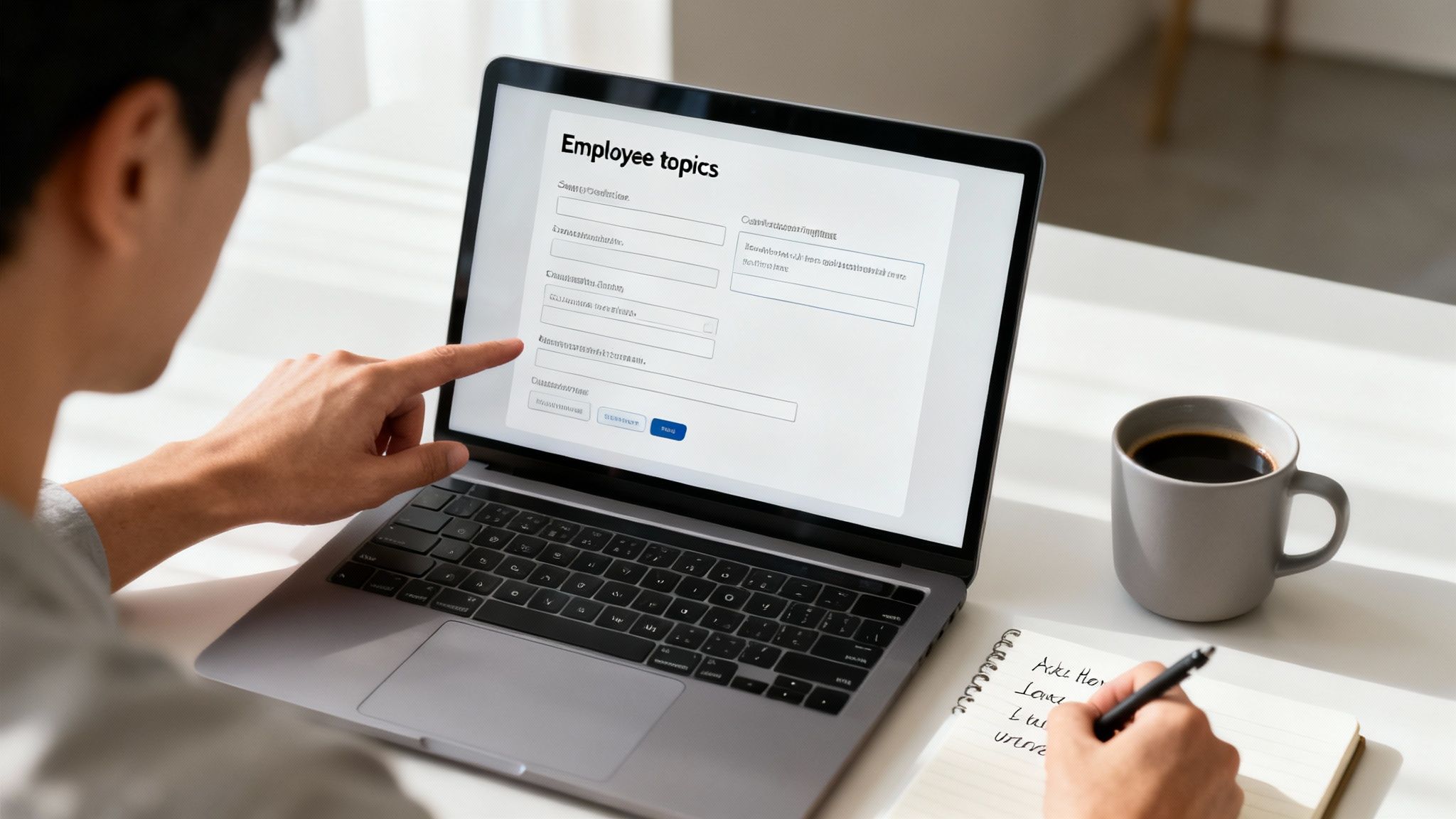
This sense of shared ownership separates a great one on one from a bad status update. Without a plan, meetings drift. While only 37% of meetings use a formal agenda, an even smaller 30% are considered productive. The lesson is clear: structure drives results.
How do you build an agenda that works? You must create space for both voices in the room.
A balanced agenda ensures the conversation covers immediate needs, ongoing development, and future goals. Here is a simple breakdown of the essential components to include in your template.
Essential Components of a Collaborative Agenda
| Agenda Section | Purpose and Focus | Example Talking Point |
|---|---|---|
| Employee-Led Topics | Empower your team member to drive the conversation with their priorities. | "What is one thing that is slowing you down right now?" |
| Manager-Led Topics | Provide coaching, share feedback, and ensure alignment with team goals. | "I was impressed with how you handled that client email yesterday." |
| Future Focus | Connect today's work to long-term career growth and development. | "Let's talk about the skill you wanted to develop. What is a small step we can take this quarter?" |
| Action Items | Document clear next steps to ensure accountability and follow-through. | "So, you will draft the project outline by Friday, and I will get you the budget numbers." |
By structuring your agenda this way, you create a natural flow that moves from your employee's immediate concerns to broader strategic alignment and concrete next steps.
Start with Employee-Led Topics
Always let your employee go first. Kicking off the agenda with their topics sends a strong message: this meeting is for them. It is not a reporting session for you.
Giving them the floor right away builds psychological safety and encourages them to surface the real issues on their mind.
When you share the agenda document, prompt them to add a few items. You might ask them to think about:
- Recent Wins: What is something you are proud of from last week?
- Current Blockers: Where are you stuck? What is getting in your way?
- New Ideas: Is there a better way we are doing something?
These simple prompts guide their thinking without boxing them in. If you need more ideas, check out our guide on one to one questions you can ask.
Add Manager-Led Topics
Your section comes second. This is your time to offer coaching, deliver feedback, and connect their work to the bigger picture. The key is to prepare your talking points ahead of time. Never surprise an employee with a heavy topic they are not ready for.
Your agenda items might look like this:
- Positive Feedback: "I liked how you handled the client call on Tuesday. Your calm and clear communication made a huge difference."
- Coaching Opportunities: "Let's walk through the project brief together. I want to be sure we are aligned on the next steps before you begin."
- Information Sharing: "I wanted to give you a heads-up about the team restructuring. Here is what it means for our projects."
By listing your topics in advance, you create transparency. Your employee knows what is coming, which reduces anxiety and opens the door for a much more honest dialogue.
Finish with Future Focus and Action Items
The final part of your agenda should be dedicated to looking ahead. This is what prevents your one on ones from feeling like you are rehashing the past week. Dedicate a few minutes to talk about career development, skills they want to build, and long-term goals.
Then, before you wrap up, document the next steps. Every action item needs an owner and a deadline. No exceptions. This simple habit creates accountability and makes sure the great conversation you had turns into progress. This is how talk becomes action.
How to Adapt Your Agenda for Different Meetings
A rigid, one-size-fits-all agenda will not work. The conversation you have during a weekly check-in feels different from a quarterly career deep-dive, and your agenda needs to reflect that.
When you tailor your agenda, you send a clear signal to your employee: you understand the context and you are respecting the purpose of your time together. It also means you both show up ready for the right kind of conversation. Think of it like a toolkit. You would not use a hammer to saw a board.
Here are four practical templates for the most common one-on-ones, each designed for a specific job.
The Weekly Check-In Agenda
This is your most common touchpoint, the regular pulse of the team. The goal here is tactical: clear roadblocks, align on priorities, and keep momentum going. It is all about looking ahead to the next few days.
Keep the energy light and supportive. You are not doing a deep strategic review. You are getting a quick read on progress and making sure your report has what they need to succeed this week.
A Simple Structure for a Weekly Check-In:
- Their Updates (First 10 minutes): Let them lead.
- What was your biggest win from last week?
- What are your top 1-3 priorities for this week?
- Where are you blocked? What do you need from me?
- Your Sync (Next 10 minutes): Your turn to share context.
- Quick, specific feedback on a recent piece of work.
- Any team or company news that affects them.
- A quick alignment check: "Does your plan for the week match what I'm expecting?"
- Wrap-Up (Last 5 minutes): Lock in the next steps.
- Quick recap of who is doing what and by when.
- A simple personal check-in: "How is your workload feeling right now?"
The Career Development Discussion
This meeting is a total shift in gears. It is a strategic, big-picture conversation focused entirely on their growth, skills, and future. You should have these conversations quarterly or at least twice a year. The tone should be curious, open, and encouraging.
This is dedicated space for your employee to dream and think beyond their current job description. It is your single best opportunity to prove you are invested in their entire career, not their immediate output.
The agenda here needs to spark reflection and get them thinking about what is next.
Talking Points for a Career Discussion:
- Looking Back on Growth (15 minutes):
- In the last few months, what parts of your job have given you the most energy?
- What new skills have you picked up? Which ones are you excited to build next?
- What accomplishment from the last quarter are you most proud of?
- Looking Forward to Aspirations (20 minutes):
- What kind of impact do you want to be making a year from now?
- Are there other projects or roles in the company that you are curious about?
- What does the "next step" in your career look like to you?
- Building an Action Plan (10 minutes):
- What is one concrete thing we can do now to start moving you toward that goal?
- What resources, training, or mentorship would help you get there?
- For more guidance, check out our article on how to write a development plan.
The Feedback Session Agenda
Whether the feedback is positive or constructive, it deserves its own focused, safe space. The point of this meeting is to talk about specific behaviors and their impact. You cannot surprise someone with this. The agenda needs to be direct.
Give them a heads-up on the topic. A simple, "I would like to use our next one-on-one to discuss the client presentation from Tuesday" is all you need.
A Framework for a Feedback Session:
- Set the Context (5 minutes): State the purpose calmly and clearly. "Thanks for meeting. I want to talk about the project launch event to share some thoughts."
- Share Specific Observations (10 minutes): Use a framework like Situation-Behavior-Impact (SBI). "On Tuesday's call (Situation), when you presented the data (Behavior), the client saw the immediate value (Impact)."
- Invite Their Perspective (10 minutes): This has to be a two-way street. Ask open-ended questions like, "How did you feel that presentation went?" or "What was your take on that interaction?"
- Agree on Next Steps (5 minutes): Do not leave things ambiguous. Define what happens next. "Let's make sure you lead the next two client demos," or "Let's work together on a new communication plan for the next project."
The Difficult Conversation Agenda
Tackling a performance issue or another sensitive topic requires the most care and preparation. The agenda's purpose is to address a problem head-on, professionally, and with a clear path forward. Your tone has to be serious but supportive, focused on solutions, not blame.
How to Structure a Difficult Conversation:
- State the Issue Clearly (5 minutes): Be direct, using factual language. "I need to talk to you about your missed deadlines over the past month."
- Present Specific Examples (10 minutes): Provide documented instances. "You missed the project deadline on the 15th and the report deadline on the 22nd."
- Explain the Impact (5 minutes): Connect the dots for them. "When these deadlines are missed, it pushes back the entire team's workflow and puts our commitments at risk."
- Listen to Their Side (10 minutes): This is critical. Ask for their perspective and then listen without interrupting. "Can you help me understand what has been happening?"
- Collaborate on a Solution (10 minutes): Work with them to build a plan. "What support do you need to get back on track? Let's define clear, achievable expectations for the next two weeks."
- Confirm Understanding (5 minutes): Make sure you both are leaving the room on the same page. "So, to recap, the plan is X, and we will review your progress next Friday."
Best Practices for Effective Agenda Management
Creating an agenda is not the whole story. The real effect happens when you manage it well before, during, and after every meeting. This discipline turns a simple list of topics into a system for productive conversations, ensuring every one-on-one is focused, collaborative, and leads to something.
The single most important thing you can do is share the agenda at least 24 hours ahead of time. This one small act changes the dynamic from a manager's monologue to a dialogue. It gives your direct report time to think, add their own items, and show up ready to talk. When they see their own topics on the list, it sends a clear message: this meeting is for them.
During the chat, think of the agenda as a guide, not a straitjacket. It is there to keep you on track, but you have to leave room for the conversation to breathe. If a critical issue comes up, it is fine to go deeper and push less urgent items to next time. The agenda gives you a structure to come back to once you have explored what matters most.
Not all one-on-ones are the same. Your approach has to adapt depending on the goal of the conversation.
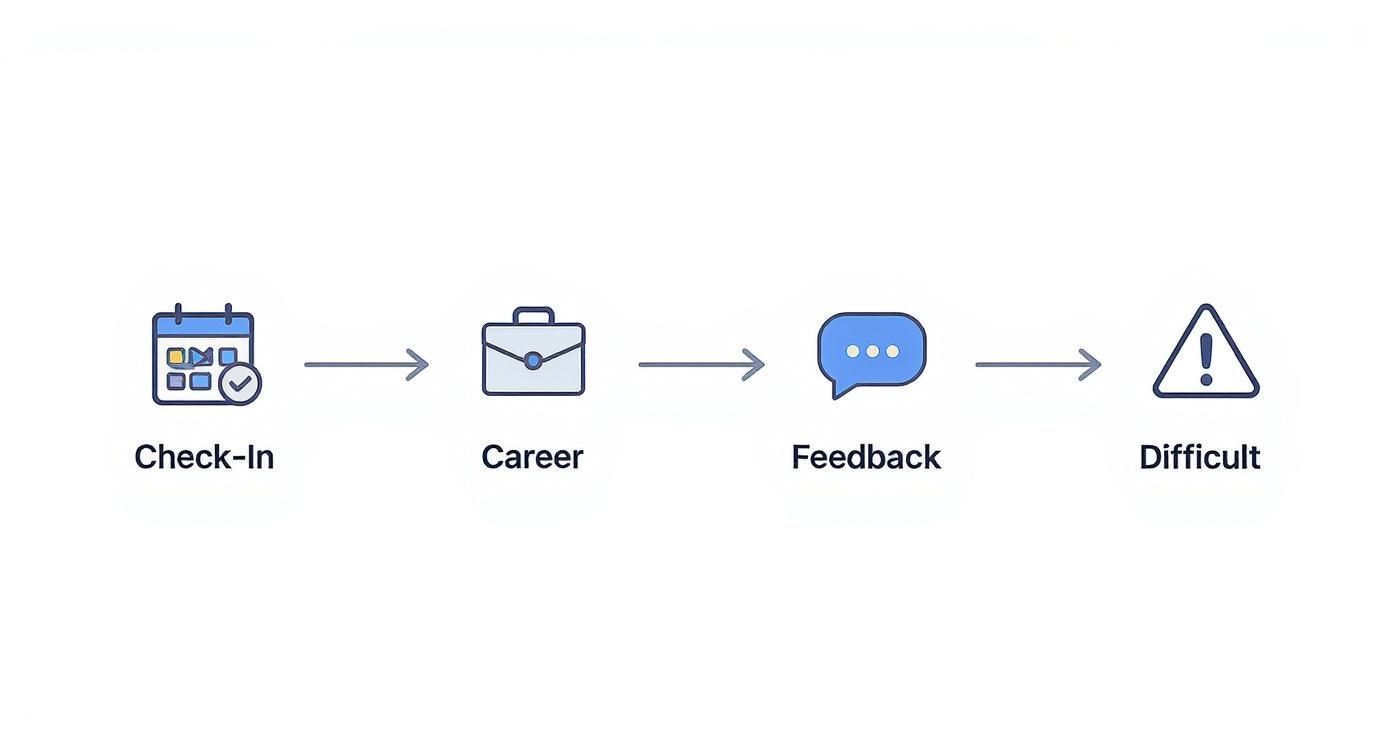
This flow shows how you might move from a routine check-in to a more focused discussion about careers, feedback, or something difficult. Each of these requires a different kind of agenda and a different mindset. A weekly sync can be loose and fluid, but a feedback session needs more structure to be effective. If you want to get better at those tougher talks, our guide on how to give constructive feedback to employees is a great place to start.
After the Meeting and in Virtual Settings
The work is not over when you hang up the call or leave the room. Right after you finish, take two minutes to summarize the key decisions and action items in your shared document. For every task, assign an owner and a due date. This step is non-negotiable. It creates accountability and gives you a clear starting point for your next one-on-one.
These habits are even more crucial in remote or hybrid teams. The numbers are staggering: virtual one-on-one meetings increased by 1,230% in 2020. With remote employees now attending 50% more meetings overall, a tight agenda is your best defense against Zoom fatigue and disengagement. Without in-person cues, structure is everything.
A disciplined approach to agenda management creates consistency. When your employee knows what to expect, they feel more comfortable and prepared to engage in honest, productive dialogue, whether in person or on a screen.
This system of preparing, executing flexibly, and following up diligently makes your one-on-one agenda a reliable tool for tracking work and for building stronger relationships and driving real growth.
Common Agenda Mistakes and How to Fix Them
Even the best agenda template can fall flat if you fall into a few common traps. A great one-on-one is more than filling in blanks. It is about avoiding the pitfalls that turn a dialogue into a monologue or a productive session into a box-ticking exercise.
One of the most frequent mistakes is the manager doing all the talking. This happens when you treat the agenda as your personal to-do list. The meeting becomes a status report where your employee answers your questions, which undermines the goal of building trust.
Letting the Employee Lead
The fix is simple: structure your agenda so the employee’s topics always come first. This small shift transfers ownership and sends a clear signal that this meeting is for them. A good rule of thumb is to let them speak for at least 70% of the time.
Your job is to listen, ask clarifying questions, and offer support. If they are quiet, do not jump in and take over. Instead, prompt them with good, open-ended questions.
- "What is taking up most of your headspace this week?"
- "What is one obstacle I can help you remove?"
- "What part of your work is giving you the most energy right now?"
Being Flexible, Not Rigid
Another common problem is treating the agenda like a rigid script. When a conversation feels too structured, it chokes out organic, honest discussion. You miss chances for real connection when you are rushing to get through every bullet point.
Use the agenda as a guide, not a contract. If an important issue comes up, give it the space it deserves. It is better to have a deep conversation about one critical topic than to skim the surface of five minor ones.
Even when things seem fine, it is easy to make mistakes that derail the conversation. We have all been there. Here is a quick look at some common missteps and how to steer back on course.
Avoiding Common Agenda Pitfalls
| Common Mistake | Why It Happens | How to Fix It |
|---|---|---|
| "The Status Update" | Managers are busy and default to getting a project update. | Start the meeting with a personal check-in. Ask, "How are you doing?" before asking, "What are you doing?" |
| "The Interrogation" | You come with a list of questions and ask them one by one. | Ask one open-ended question, then listen actively. Use follow-up questions based on their answers, not your list. |
| "The Agenda Veto" | An employee adds a tough topic, and you "table it for later." | Acknowledge the topic's importance immediately. If you cannot discuss it now, schedule a dedicated time before the meeting ends. |
| "The One-Sided Build" | The manager creates the whole agenda without any input. | Use a shared document like a PeakPerf workspace. Ask them to add their items at least 24 hours in advance. |
These shifts are small but effective. They help turn a routine meeting into a meaningful touchpoint that both you and your direct report will look forward to.
Focusing on Action and Follow-Up
Finally, a classic mistake is failing to document and follow up on action items. A great discussion without clear next steps is a nice chat. When commitments are forgotten, it tells your employee that the meeting did not have substance and slowly erodes accountability.
Make this your non-negotiable end-of-meeting habit: quickly summarize the action items. In your shared document, assign an owner and a deadline to each one. This creates a clear record of your agreements and gives you a natural starting point for your next one-on-one, ensuring your conversations always lead to progress.
Answering Your Top Questions About Meeting Agendas
Even the best-laid plans come with questions. When you are rolling out a new system for your one-on-ones, getting the small details right builds consistency and trust.
Let's walk through the most common questions managers have about creating and using agendas. These answers will help you navigate tricky spots with confidence, making sure your agenda becomes the reliable tool you need it to be.
How Far in Advance Should I Share The Agenda?
You will want to share the agenda at least 24 hours before the meeting. This gives your direct report enough time to read your topics, add their own items, and gather their thoughts. If you send it two business days in advance, that is even better.
The goal here is to make the agenda a collaborative document, not a last-minute surprise. When your employee contributes, they take co-ownership of the conversation. This simple habit changes the dynamic from a manager-led status report to a shared dialogue about what matters.
What If My Employee Does Not Add Anything to The Agenda?
This happens. If you notice an employee consistently shows up with an empty agenda, it is time to address it constructively. The meeting is primarily for their benefit, so a lack of input is a signal you need to explore. Do not assume they are disengaged. They might not feel comfortable yet, or they might not understand the expectation.
Try asking a few clarifying questions to gently encourage participation:
- "I want to make sure this meeting is valuable for you. Is our current agenda format working?"
- "What is one obstacle you are facing right now that I can help you remove?"
- "Tell me about something you were proud of this week so we can talk about it."
These kinds of prompts reinforce that this is their time and their voice is essential. You are building the psychological safety they need to open up.
The most effective one-on-ones are employee-led. When they drive the conversation, they are more likely to bring up the topics that are important to their success and well-being. The agenda is the tool that makes this possible.
How Long Should a One-on-One Meeting Be?
The sweet spot for a standard one-on-one is 30 minutes weekly or 60 minutes bi-weekly. Whatever you choose, your agenda needs to be realistic for the time you have scheduled. Nothing kills momentum like rushing through important topics or having to cut a great conversation short.
For a 30-minute meeting, aim for three to five key topics. If you have scheduled a 60-minute session, you can cover more ground and do deeper dives into things like career development or project strategy. The agenda is your best friend for respecting the clock and keeping the conversation focused.
Great managers use every tool they can to support their team. With PeakPerf, you can stop worrying about what to say and start having more impactful conversations. Prepare for feedback sessions, development planning, and difficult one-on-ones in minutes with guided workflows and proven frameworks. Start for free and lead your next meeting with confidence.


