Annual performance review template: A guide to fair evaluations and growth
An annual performance review template is the blueprint for one of the most important conversations you will have with your team members. It creates a consistent, fair framework. This framework guides the discussion away from vague feelings and toward concrete contributions, goals, and growth.
When done right, this document is the foundation for a productive, clear, and legally sound performance discussion.
Building a Foundation for Fair and Clear Reviews
A strong review process starts with a solid structure. The annual performance review template is your most important tool. A well-designed template transforms the conversation from a simple ratings exercise into a genuine dialogue about an employee's journey and future. It sets a professional, constructive tone.
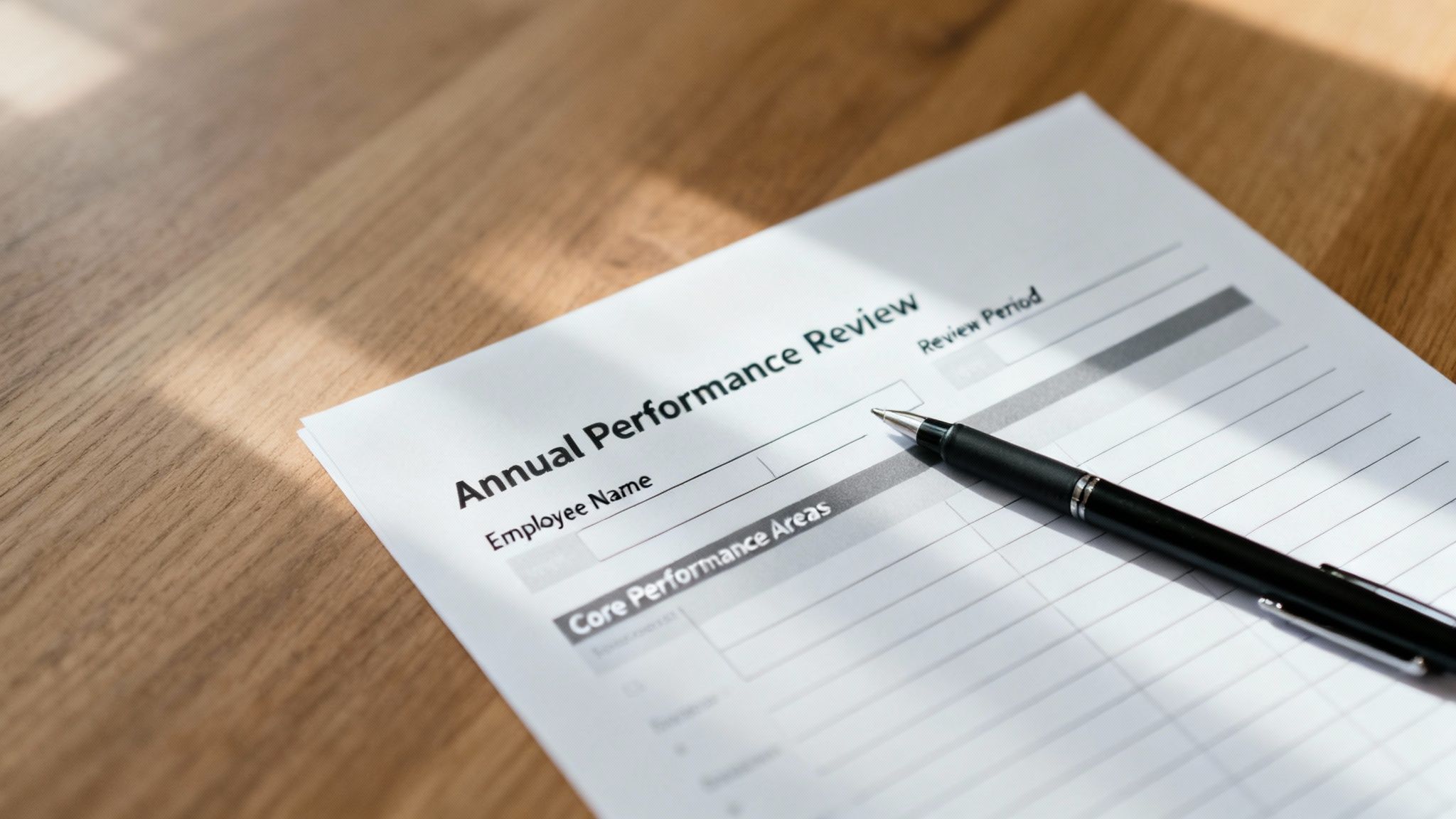
Think of it as more than paperwork. It is a record of an employee’s challenges, wins, and growth over the past 12 months. A thoughtful template guides managers to deliver objective feedback. It helps employees see how their work connects to the bigger company goals.
Despite a trend toward more frequent check-ins, the annual review is still a cornerstone of performance management for most companies. In fact, 71% of organizations still rely on an annual review cycle. The problem is that only 5% of HR leaders are happy with their current process. This shows how critical a better template is. You can read more performance management statistics on selectsoftwarereviews.com.
Your template’s structure directly shapes the quality of the conversation. A clear, logical layout encourages managers to be thorough and objective. It prevents them from skipping important sections or falling back on gut feelings.
Core Components of a Performance Review Template
To get started, let's lay out the essential building blocks. Think of these as the non-negotiables that give your review context, clarity, and professionalism.
| Component | Purpose | Example Fields |
|---|---|---|
| Employee & Reviewer Details | Establishes a clear record of who is involved. | Employee Name, Job Title, Department, Manager Name, Reviewer Title. |
| Review Period & Date | Defines the specific timeframe being assessed and when the discussion occurred. | "Review Period: Jan 1, 2024 - Dec 31, 2024," "Date of Review." |
| Purpose of the Review | Aligns both parties on the conversation's goal right from the start. | "To assess performance against 2024 goals, celebrate achievements, and define objectives for 2025." |
Securing these administrative details upfront makes the document professional and easy to reference later. It removes ambiguity and creates an official record for both the employee and the company. These basics are a key part of the larger strategy we cover in our guide to the best practices for performance management.
Setting the Stage for a Productive Conversation
Before the feedback itself, the introduction of your template should set clear expectations. This is where you outline the key areas of evaluation. It gives both the manager and the employee a roadmap for the entire discussion.
Think of it as an agenda. It tells the employee what is coming and gives the manager a structure to follow. This helps keep the conversation focused and ensures all critical topics are covered.
For instance, you might list the main sections of the review:
- Review of Past Goals: How did we do on the objectives set during the last review?
- Core Competencies: Evaluating skills and behaviors tied to company values and role-specific functions.
- Key Accomplishments: A space to highlight significant wins and contributions from the past year.
- Areas for Development: Identifying opportunities for skill-building and professional growth.
- Future Goals: Collaboratively setting new objectives for the upcoming year.
By sharing this outline at the top, you make the process transparent. Everyone walks into the meeting with a shared understanding. This helps lower anxiety and fosters a more collaborative, forward-looking discussion.
Tracking Goals and Highlighting Key Accomplishments
A great performance review is more than a report card. It is a story of an employee’s journey over the past year. It connects the dots between their daily tasks and the company's mission. Your template needs a dedicated space for tracking goals and celebrating the big wins.

The best templates prompt for the goals set at the beginning of the year. This simple step anchors the conversation in reality. It grounds the evaluation in clear, agreed-upon expectations. It keeps the focus objective and prevents "recency bias," where only the last few weeks of work are remembered.
Building SMART Goals Right into Your Template
We have all heard of SMART goals, but they often get lost in translation. The framework: Specific, Measurable, Achievable, Relevant, and Time-bound, is your best tool for turning vague ambitions into concrete action plans.
When people know what they are aiming for, their engagement and productivity increase. A template that guides them through the SMART process is a tool for driving results.
Here’s how to structure this section in your template. Use clear prompts to get the details you need.
- Goal Description: What was the employee specifically trying to achieve?
- Key Metrics for Success: How did you measure progress? (Think numbers: increase sales by 15%, cut customer support tickets by 10%).
- Timeline: What was the deadline for this goal?
- Outcome and Results: What happened? Get specific with the data.
This setup helps managers and employees have a conversation based on facts, not feelings. If you need inspiration, our guide has many performance goals examples you can adapt.
Don't Forget to Shine a Light on Key Accomplishments
Formal goals are important, but they do not always capture the full picture. What about those moments when an employee went above and beyond, embodied a company value, or single-handedly saved a project? The "Key Accomplishments" section addresses this.
This part of the review gives employees a chance to highlight their wins and prompts managers to give credit. Focusing on strengths is a strong motivator. It helps build a culture where people feel seen and appreciated.
An effective annual performance review template does not just measure performance. It creates a documented history of an employee's growth, contributions, and impact on the business.
To get the best out of this section, ask open-ended questions that demand specific examples. This pushes both the manager and the employee to reflect on the entire year.
Sample Prompts for Your Accomplishments Section
- Describe your most significant accomplishment this year and explain its impact on the team or company.
- Tell me about a time you lived one of our core company values.
- What project from this past year are you most proud of, and why?
- Walk me through a challenge you overcame and what you learned from it.
These kinds of questions encourage storytelling backed by evidence. An employee might share how they automated a report, saving their team five hours every week. That is a story that links a specific action to a real business outcome.
By designing your template to capture both goal attainment and standout achievements, you get a more balanced and complete view of performance. The review becomes less of a backward-looking judgment and more of a forward-looking conversation about growth. The final document becomes an invaluable tool for career planning, spotting future leaders, and celebrating the people who make your company successful.
How to Structure Your Template for Feedback That Helps
Feedback is the whole point. Without it, a performance review is just a bureaucratic exercise. Your template needs to pull specific, constructive feedback out of managers. This turns a potentially tense meeting into a real opportunity for growth.
The goal is to get beyond generic comments like "good job" or "needs improvement." An effective template forces managers to deliver feedback tied to actual behaviors. It is clear and points toward the future. This structure shows an employee what they should keep doing and where they can develop.

This is not just a feel-good exercise. It directly impacts your bottom line. Teams that get feedback focused on their strengths are 8.9% more profitable and see a 12.5% jump in productivity. Also, the trend is clear: 22% of organizations are now shifting focus to evaluate individual behaviors over just the outcomes. For more data, check out these performance management insights at selectsoftwarereviews.com.
Use the SBI Framework to Keep Feedback Clear and Objective
To make sure your feedback is actionable and fair, you need a system. I build templates around the Situation, Behavior, Impact (SBI) model. It is a simple framework that forces managers to ground their comments in specific events, not vague opinions or generalizations.
Here’s how it breaks down:
- Situation: Pinpoint the specific context. When and where did this happen?
- Behavior: Describe the exact, observable actions the employee took. What did they do?
- Impact: Explain the result of that behavior. How did it affect the team, the project, or the company?
By building your prompts around these three elements, you cut down on vague, biased, or unhelpful comments. The focus shifts from judging the person to describing their actions and the real-world results.
Designing Prompts That Highlight Strengths
Nothing motivates an employee more than knowing what they do well. Your template needs dedicated prompts that guide managers to give detailed, positive reinforcement using the SBI model.
Sample Prompts for Documenting Strengths:
- Situation: "Describe a specific project or meeting where this employee excelled."
- Behavior: "What specific actions did they take that stood out as exceptional?"
- Impact: "What was the positive result of their behavior on team morale or the project's success?"
Let’s see it in action for a project manager. A weak comment is, "You're a great communicator." An SBI-based comment gives them something they can use.
Situation: During the Q3 product launch planning meeting...
Behavior: ...you clearly laid out the project risks and drew up a detailed mitigation plan on the whiteboard for everyone to see.
Impact: That action got the entire team aligned, cut down on confusion, and helped us hit our launch deadline without major issues.
See the difference? Now that project manager knows what "great communication" looks like in their role and has a blueprint for what to do next time.
How to Address Areas for Improvement Constructively
Talking about where someone needs to improve is the trickiest part of any review. The SBI framework is your best friend here too. It keeps the feedback objective and centered on behaviors, which can be changed, instead of personality traits, which cannot. This prevents the employee from feeling personally attacked.
Your template should guide the manager toward developmental coaching, not just criticism.
Sample Prompts for Areas for Improvement:
- Situation: "Recall a specific time when a project or task did not go as planned."
- Behavior: "What specific behaviors or actions contributed to that outcome?"
- Impact: "What was the effect on the project timeline, the budget, or the team's workflow?"
Imagine you are talking to a junior analyst who struggles with deadlines. "You need to manage your time better" is useless advice. An SBI comment is actionable.
Situation: On the monthly financial report that was due last Friday...
Behavior: ...the data was submitted three hours past the deadline, and there was no warning that it was going to be late.
Impact: This meant the finance director had to stay late to finalize her summary for the executive team, which delayed its distribution to leadership.
The feedback is direct, but it is not personal. It identifies a specific behavior and its consequences. It creates a non-confrontational starting point for a chat about time management strategies and communication protocols.
Tying It All Together with a Forward-Looking Development Plan
The final piece is the development plan. This is where the review pivots from looking back to looking forward. It is a collaborative space where the manager and employee set goals based on everything you have just discussed.
This section should prompt them to set SMART goals for new skills, training opportunities, or different responsibilities.
- Development Goal: What specific skill or competency will you focus on improving?
- Action Steps: What are the concrete steps to get there? (e.g., take an online course, shadow a senior team member).
- Support Needed: What resources do you need from me or the company to succeed?
- Timeline: When will we check in on your progress?
When you structure your feedback sections this way, the annual review transforms into a catalyst for growth. The template stops being a form to fill out. It becomes a framework for a conversation that is fair, balanced, and focused on helping every employee win in the year ahead.
Adapting Your Template for Different Roles
A one-size-fits-all annual performance review template is a recipe for poor results. The way you measure success for a software developer is different from how you evaluate a graphic designer. Using a generic form makes the review feel impersonal, irrelevant, and misses the unique contributions of each person.
You must adapt your core template. The trick is tailoring it for different departments, specific roles, and even seniority levels. This ensures the criteria you are using are specific, the language makes sense for the role, and the goals you set are appropriate.
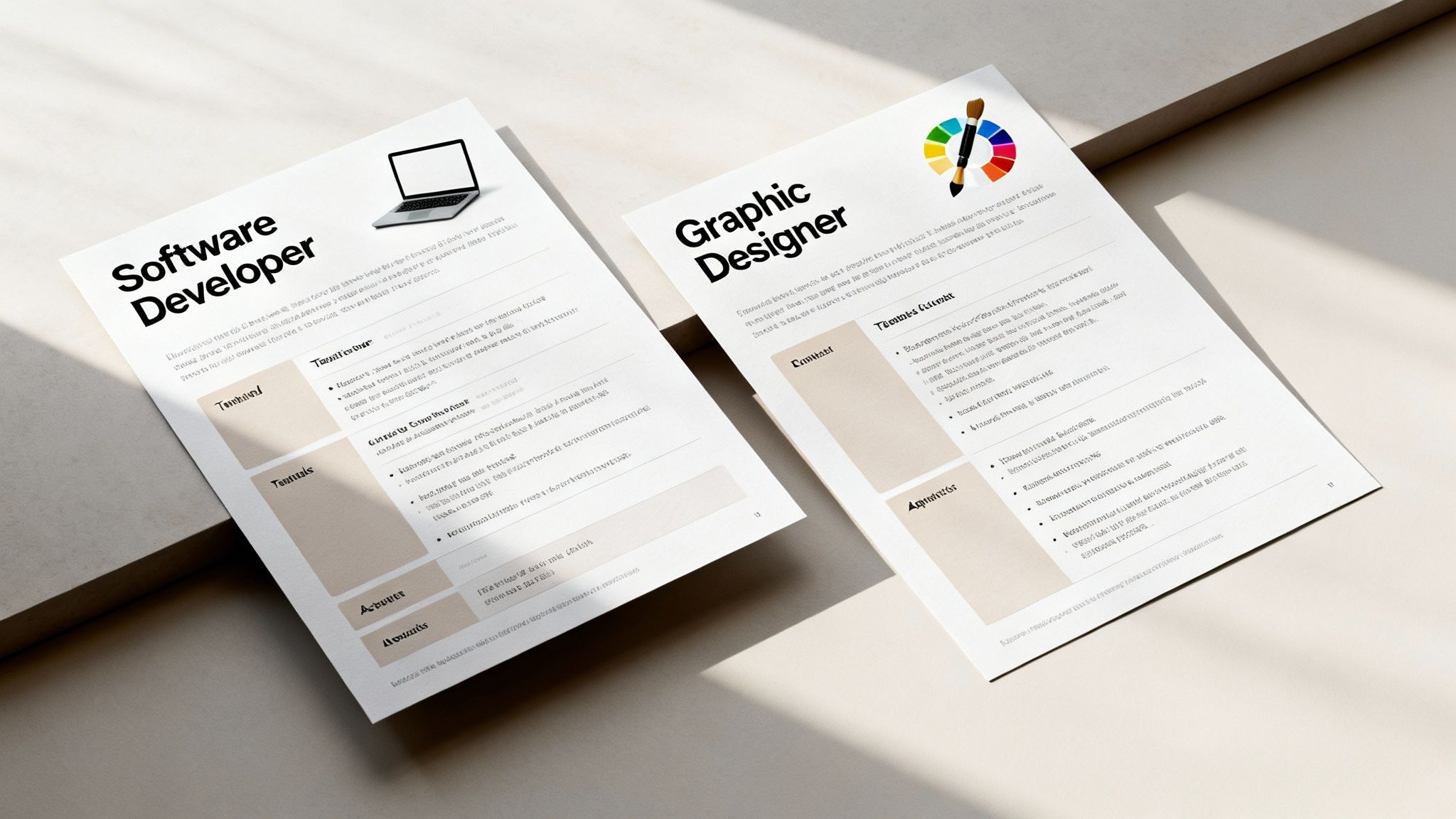
This is not busywork. When an employee sees that their review reflects their day-to-day job, they are more likely to accept the feedback and see the process as fair. It transforms the conversation.
Customizing for Technical vs. Creative Roles
Technical and creative people operate in different worlds, so their evaluation criteria should also differ. A generic template might ask about "innovation," which sounds fine, but what does that look like for a coder versus a designer? Your template needs to guide the manager to look for the right evidence.
For a Software Developer, you need to get into the details of their technical output and how they work with the team.
- Code Quality: How clean, efficient, and maintainable is their code? Can someone else pick it up without difficulty?
- Project Delivery: Are they hitting deadlines and reliably contributing to project milestones?
- Problem-Solving: When things break, how good are they at digging in, debugging, and finding smart technical solutions?
Now, for a Graphic Designer, the focus shifts to creative execution and stakeholder happiness.
- Creative Execution: Is the work high-quality and original? Does it align with the established brand guidelines?
- Client or Stakeholder Feedback: How well do their designs meet the project brief and satisfy the people paying for it?
- Conceptual Thinking: Can they take an abstract idea and turn it into a visual concept that works?
By tweaking the competency sections of your template, you are giving managers the right tools to provide specific and helpful feedback.
Adjusting the Tone for Seniority Levels
The conversation you have with a junior employee should feel different from a review with a senior leader. Experience matters, and the focus of the review needs to evolve.
For a Junior Employee, the entire conversation should be framed around learning and growth.
The template should prompt discussions about picking up new skills, mastering the basics, and building solid professional habits. The tone is more supportive and instructional. You are coaching them for the long term.
For a Senior Leader, the discussion elevates to strategic impact and influence.
- Strategic Contribution: How did their work and decisions affect department or company-wide goals?
- Team Leadership and Mentorship: Are they developing the people on their team? Are they fostering a culture where people can do their best work?
- Business Acumen: Do they understand the market, the competition, and the financial implications of their decisions?
Your template for leaders needs prompts that go beyond their personal tasks and get at their impact on others. This is how you evaluate the full scope of their role.
Maintaining Core Consistency
You are customizing all these sections. Some things must stay the same across the board. This consistency is non-negotiable for fairness and keeping everyone aligned.
Here are the key areas to keep uniform:
- Company Values: Every employee, from the intern to the CEO, should be evaluated on how their behavior reflects the company’s core values.
- Overall Rating Scale: Use the same system (e.g., a 1-5 scale) for everyone. This is the only way you can compare performance data across teams and identify broader trends.
- Goal-Setting Framework: Whether you use SMART goals or another system, the fundamental framework for setting future objectives has to be consistent.
This balanced approach, customization where it matters and consistency where it counts, turns your annual review template from a rigid form into a flexible tool for driving meaningful conversations.
Navigating Common Pitfalls and Legal Risks
Executing performance reviews comes with a lot of responsibility. A well-designed annual performance review template is your first line of defense against common mistakes that lower morale and can create legal risks. The structure of your template has a direct impact on the fairness and consistency of the entire process.
When reviews are inconsistent or poorly documented, they create risk. If one manager offers vague praise while another provides detailed examples for a different employee, people will see the process as unfair. This is not just bad for morale. It becomes a liability if you need to take disciplinary action.
Your template fixes this by providing a standardized framework. It prompts every manager to evaluate performance using the same criteria. This creates a more equitable system where evaluations are tied to job-related factors, not personal feelings.
Preventing Bias with Structured Prompts
We all have unconscious biases. They are one of the biggest challenges in performance reviews. Things like the recency effect (only remembering what happened last month) or the halo effect (letting one great trait overshadow other issues) can skew an evaluation. A thoughtfully designed template is your best tool to mitigate these biases.
By including sections that require managers to pull specific examples from the entire review period, you force a more balanced assessment. Prompts grounded in frameworks like SBI (Situation, Behavior, Impact) push managers to focus on observable actions instead of subjective feelings.
A great template does not just ask what an employee did. It asks for specific evidence of how they did it and what the result was. This shift from judgment to documentation is critical for fairness.
This detailed record-keeping becomes your objective history of performance. It is essential for making defensible decisions about promotions, pay, and development plans.
Ensuring Consistency and Proper Documentation
Inconsistency is a massive legal risk. If two employees with similar performance gaps receive different reviews, you are opening the door to claims of discrimination or favoritism. Your annual performance review template is the key to ensuring every employee is measured against the same standards.
Here’s how a structured template helps create consistency and defensible documentation:
- Standardized Criteria: It uses the same core competencies and rating scales for everyone in a similar role.
- Mandatory Sections: It ensures managers cannot skip important parts of the evaluation, like goal-setting or career development.
- A Clear Written Record: It creates a formal, signed document that serves as the official record of the performance discussion.
This documentation is not just about compliance. It is invaluable for tracking an employee's progress over time. For tough situations that require formal intervention, these records are the foundation. To see how to handle those next steps, check out our guide on creating a performance improvement plan at work.
Proper documentation protects everyone: the employee and the organization. It proves that decisions are based on a clear, consistent, and well-documented history of performance. It makes the entire process transparent and easier to defend.
Common Review Mistakes and Template Solutions
A well-built template is a proactive tool. It anticipates common review errors and builds in safeguards to prevent them. The table below shows how a few structural elements can solve some of the most frequent mistakes managers make.
| Common Mistake | How the Template Helps | Example Prompt or Section |
|---|---|---|
| Vague, Subjective Feedback | Forces managers to provide concrete, behavioral examples. | "Describe a situation where the employee demonstrated this skill and the impact it had." |
| Inconsistent Evaluations | Applies the same rating scale and criteria to all employees in similar roles. | A "Core Competencies" section with a consistent 1-5 rating scale. |
| Recency Bias | Prompts for examples from the entire review period. | "List three key accomplishments from Q1-Q2 and three from Q3-Q4." |
| Poor Documentation | Creates a formal, signed record of the conversation and agreed upon goals. | "Employee Signature" and "Manager Signature" fields with a date. |
By building these solutions directly into your template, you are architecting a fairer, more effective, and legally sound performance management process from the ground up.
A Few Common Questions About Performance Reviews
Let's tackle some of the most common questions that pop up when building and using an annual performance review template. Getting these details right helps create a process that feels transparent and effective for everyone.
How Often Should We Update Our Performance Review Template?
Think of your review template as a living document. It needs a check-up at least once a year. Business goals change, roles evolve, and what worked last year might feel disconnected from reality this year.
The best time for this review is a few months before your main review cycle kicks off. This gives you time to gather feedback from managers and employees on what worked and what felt clumsy. Ask them direct questions like, "Did the rating scale feel fair?" or "Were the prompts for the development plan helpful?"
Certain events should be immediate triggers for an update:
- A major strategy shift. If your company pivots to a new market, your template must reflect the new skills and behaviors that now define success.
- Introducing new company values. Your review template is one of the best tools you have to reinforce those values and measure how your team is living them.
- Consistent feedback that a section is confusing. If you hear from multiple managers that they are all getting stuck on the same part of the form, that is a red flag. It is time for a redesign.
How Do We Best Prepare Managers for These Conversations?
Training is non-negotiable. Handing a manager a new template and wishing them luck is a recipe for poor outcomes. Good preparation is about building both their competence and their confidence.
Start with a hands-on workshop focused on the practical skill of delivering feedback. Role-playing is effective here. Give managers a few common scenarios, a filled-out template, and let them practice delivering both positive and constructive feedback. It helps them find the right words before they are in a real, high-stakes conversation.
Your goal is to equip managers to use the template not as a script, but as a guide for a meaningful conversation. The form provides the structure. The manager provides the empathy and context.
It is also a good idea to give them a simple checklist or job aid. This can be a one-pager with key points to cover, examples of open-ended questions to ask ("What’s one thing you would like to do differently next quarter?"), and reminders on how to sidestep common biases. This simple tool can be a manager's best friend before they walk into a review meeting.
How Does This Template Connect to Pay and Promotions?
Transparency is everything here. There should be zero mystery for your employees about how this process works. While the annual performance review template is a critical piece of the puzzle, it should not be the only piece.
The final performance rating on the review should be one of several data points. You should also be looking at things like goal attainment data from your project management software, 360-degree feedback, and an employee's consistency throughout the entire year.
Make sure your template has a final summary section that clearly justifies the overall rating. This is where the manager synthesizes all the feedback into a concise narrative. For instance: "Based on exceeding sales targets by 20% and successfully mentoring two junior team members, Sarah's performance is rated as 'Exceeds Expectations,' making her eligible for the senior promotion track."
That statement directly links specific achievements documented in the review to a tangible career outcome. That kind of clarity removes the perception of unfairness. It helps people see a direct path between their performance and their growth in the company.
Stop dreading performance reviews and start having conversations that matter. PeakPerf gives you the tools to prepare for tough leadership moments in minutes. Get structured, professional drafts for feedback, reviews, and development plans, all built on proven frameworks like SBI and SMART goals. Build your confidence and lead your team with clarity. Get started for free at PeakPerf.


