A Manager’s Guide to Effective 1 on 1 Meetings
Effective 1 on 1 meetings are dedicated, private conversations between you and your direct report. They are your best forum for coaching, mentoring, and building trust with your team.
These meetings are not for running through a task list. A great meeting shifts the conversation from project updates to strategic discussions about your employee’s growth, challenges, and well-being. When you commit to this, you build a high-performance engine for your team.
Why Your 1 on 1 Meetings Matter More Than You Think

Managers often treat 1 on 1s as informal status updates or another box to check on a to-do list. This is a missed opportunity. These sessions are your most useful tool for building a strong, productive, and resilient team.
Think of it as an investment in your people, not an administrative chore.
When you get these conversations right, you directly tap into the core drivers of employee motivation. You move beyond talking about what your team member is doing and start to understand how they are doing. This shift is the bedrock of modern, effective management.
The Impact on Engagement and Retention
Data shows consistent, meaningful 1 on 1s have a direct link to higher employee engagement and lower turnover. Employees who have regular one on ones with their manager are almost three times more likely to be engaged than those who do not.
This focused attention shows you value their contribution as an individual and are invested in their career.
The numbers tell a compelling story. Strong weekly meetings can increase team productivity by as much as 18% and slash voluntary turnover by 67%. These are hard business results that prove dedicating time to coaching is a core strategic practice. You can read more about the findings on manager best practices.
The purpose of a one on one is to serve the employee. When you reframe it as their time, not yours, the entire dynamic changes from a transactional report to a developmental partnership.
From Status Update to Strategic Conversation
The difference between a low-value 1 on 1 and a high-value one is its focus. Most ineffective meetings revolve around a list of tasks. An effective one explores growth, removes obstacles, and builds human connection.
The table below breaks down the fundamental shift you need to make.
Ineffective vs Effective 1 on 1 Meetings
| Characteristic | Ineffective 1 on 1 (Status Update) | Effective 1 on 1 (Developmental Conversation) |
|---|---|---|
| Primary Focus | The past (what was done) | The future (what is next, what is possible) |
| Who Leads? | Manager-driven | Employee-led |
| Core Topic | Project status and tasks | Growth, career, challenges, well-being |
| Tone | Transactional and directive | Coaching and collaborative |
| Outcome | A checklist of completed items | A clear path forward, increased trust |
One feels like an interrogation. The other feels like a partnership.
This approach creates a safe space for your direct reports to bring up the challenges they face without feeling like they are admitting to failure. It becomes a collaborative problem-solving session, not a report card.
You start identifying small issues before they become major problems and can offer support where it is needed most. This transforms the 1 on 1 from another meeting on your calendar into the cornerstone of your leadership strategy.
How to Prepare for a Productive 1 on 1
Solid preparation separates a routine check-in from a conversation that moves the needle. Winging it is a recipe for a surface-level talk that does not help anyone. The goal is to create a focused space where your direct report feels heard, supported, and clear on their priorities.
This does not have to take your entire morning. A focused 15-minute effort before each meeting can completely change its outcome, making the time valuable for both of you. You move from reacting to what is happening to proactively guiding their growth.
Build a Shared Agenda
If you do only one thing, create a shared agenda. This simple document transforms the meeting from a manager monologue into a two-way conversation. A shared Google Doc, a page in Notion, or a task in your project management software works perfectly.
Invite your employee to add their topics first. This small act signals that the meeting is for them. It empowers them to bring up their challenges, ideas, and questions without waiting for you to ask the "right" question.
A low-effort agenda has three simple sections:
- Topics for Discussion: A spot for both of you to add bullet points as they come up during the week.
- Action Items: A running list of commitments from past meetings. You review these at the start of every chat to ensure things get done.
- Long-Term Goals: A dedicated space to track progress on career development and bigger-picture objectives.
This collaborative approach makes sure you talk about what matters most to your team member, not just what is on your mind. It is a simple way to build accountability and ownership.
Review Key Information Beforehand
Walking into a 1 on 1 cold means you waste the first ten minutes catching up on basic context. Before you meet, spend a few minutes reviewing the right information to ground your conversation in facts and history.
Look through the notes from your last one or two meetings. What were the key takeaways? Did you both follow through on your action items? This quick review establishes continuity and shows you are paying attention to their progress over time.
Also, quickly check in on their current projects or any relevant performance data. This equips you with the context to ask better questions and provide more specific, helpful feedback. You might spot a trend or a potential roadblock before your employee mentions it.
The most productive 1 on 1s are forward-looking conversations built on a foundation of past context. Reviewing prior notes prevents you from having the same frustrating conversation over and over again.
Send Prompts to Guide Their Thinking
To make sure your direct report comes ready for a real discussion, send them a few thought-provoking questions a day in advance. These prompts encourage them to reflect on their work, challenges, and goals, which leads to a richer conversation. Good prompts are open-ended and focus on their experience.
Try a few of these:
- What was a win for you last week?
- What is one thing that is slowing you down right now?
- Do you have any feedback for me or the team?
- What is one area of your work you would like to grow in?
This structured prep is important. With overflowing calendars, every meeting needs to count. Recent data shows a 500% increase in one on one meetings since before the pandemic, with professionals now averaging 5.6 per week. You can learn more about this shift by reading the full productivity report. With so many conversations happening, it is critical to make each one focused and productive.
A Practical Framework for Your Meeting Agenda
A structured agenda turns a casual chat into a productive, forward-moving conversation. While you want to leave room for flexibility, having a reliable framework ensures you cover the essentials without making the meeting feel stiff or robotic.
For a typical 30-minute session, a simple three-part structure works well. It respects both your time and your employee’s, creating a rhythm that helps them know what to expect and how to prepare. The goal is to establish a clear flow that still lets your direct report lead the discussion.
This simple preparation flow sets the stage for a great meeting.
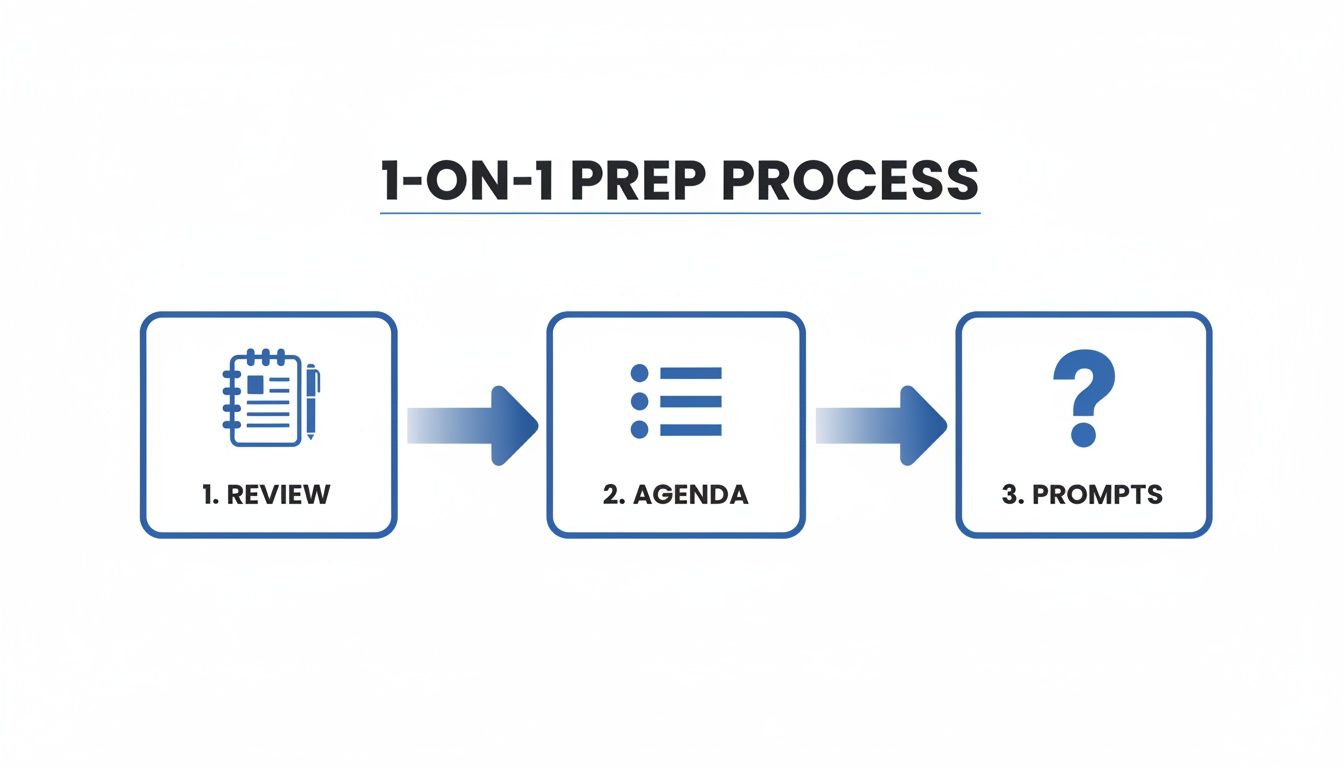
As the visual shows, reviewing past notes, building a shared agenda, and sending prompts build on each other to create a foundation for a successful meeting.
Here is how a typical 30-minute 1:1 can be broken down.
Sample 30-Minute 1 on 1 Agenda
| Time Allotment | Segment Focus | Example Questions and Topics |
|---|---|---|
| First 5 Minutes | Personal Check-In | "How was your weekend?" "How are things outside of work?" |
| Next 20 Minutes | Main Discussion | Employee's agenda items, project roadblocks, career goals, feedback. |
| Last 5 Minutes | Wrap-Up & Action Items | "So, what are our takeaways?" "Who is handling what by when?" |
This structure provides a reliable template but is flexible enough to adapt to whatever needs to be discussed that week.
The Personal Check-In (First 5 Minutes)
Always start with a genuine personal check-in. This is not small talk. It is how you build rapport and acknowledge your employee as a whole person. It creates a sense of psychological safety that makes it easier for them to open up about work challenges later.
Keep this part of the conversation light and focused on them.
- Ask about their weekend, a recent vacation, or a hobby they have mentioned.
- Reference something personal from a previous chat to show you were listening.
- Use a simple, open-ended question like, “How are things going?”
Resist the urge to dive straight into business. These first few minutes of connection are a small investment that sets a collaborative, trusting tone for the entire meeting.
The Main Discussion (Next 20 Minutes)
This is the heart of the meeting, and your employee’s topics should drive it. When you review the shared agenda beforehand, you get a clear look at their priorities. This is their time to talk through roadblocks, discuss career growth, celebrate wins, and get your feedback.
Let them speak first. Go through the items they added to the agenda, as these are what is top of mind for them. If you want to build a more detailed schedule, our guide on creating an effective agenda for one on one meetings offers more templates and ideas. This employee-led approach is critical because it ensures the meeting serves their needs.
A huge part of this discussion is giving clear, constructive feedback. Vague statements like "good job" or "be more proactive" do not help anyone. Instead, use a simple model like the Situation-Behavior-Impact (SBI) framework to ground your feedback in specific observations.
- Situation: Describe the specific context. "During yesterday's team presentation..."
- Behavior: Detail the observable action. "...you clearly explained the project data and answered every question with confidence."
- Impact: Explain the result of their behavior. "...this helped the entire team understand why the project was a success and boosted their confidence in our direction."
This structure works for positive reinforcement and for developmental feedback. It removes judgment and focuses on actionable information, which is more useful for your employee’s growth.
The Wrap-Up and Action Items (Last 5 Minutes)
The last few minutes are crucial for turning your conversation into action. Do not let a great discussion fade away. Use this time to summarize the key takeaways and agree on clear, actionable next steps. This ensures your meeting translates into real progress.
Confirm who is responsible for each item and set a realistic deadline.
For example, you might say, “Okay, to recap: you are going to draft the project proposal by Thursday, and I will get you feedback by Monday. Sound right?” Getting verbal confirmation is key to preventing misunderstandings. Jot these action items down in your shared notes right after the meeting, creating a clear record to review next time.
Navigating Difficult Conversations with Confidence
Difficult conversations are part of the job. You might need to address underperformance, mediate a team conflict, or realign mismatched career goals. These moments are inevitable.
You do not have to wing it. Approaching these conversations with a clear plan can turn a tense interaction into a productive one.
The work starts before you sit down. Your first step is to gather specific, observable examples related to the issue. Generalizations like "you have been slacking" will put someone on the defensive. Your goal is not to be a critic. Your goal is to be a coach and problem-solver.
Setting the Right Tone from the Start
How you open the conversation is everything. Kicking things off with a direct but calm, non-confrontational tone makes it safe for your employee to engage. Blindsiding them with harsh criticism is the fastest way to shut down any hope of a dialogue.
Frame the conversation around collaboration. Instead of leading with, “Your performance is slipping,” try something like, “I wanted to chat about the X project and brainstorm how we can get it back on track together.” This simple shift reframes the issue as a shared challenge, not a personal failing.
Navigating these talks requires strong active listening skills. You have to hear their side of the story before you expect them to hear yours.
Focus on Facts, Not Feelings
When it is time to talk, stick to what you saw or heard. This is where your prep work pays off. Instead of saying, “You have been disengaged lately,” you can ground the conversation in a real moment.
Give this a try:
- Observation: "I noticed in Tuesday's team meeting that you did not contribute during the brainstorming session."
- Question: "That is not like you. Is everything okay?"
This is not an accusation. It is a factual observation followed by a genuine question. It invites them to share their perspective and helps you get to the root of the problem without pointing fingers. For more on this, check out our guide on how to provide constructive feedback.
When you treat a difficult conversation as an opportunity for realignment, you transform it from a confrontation into a collaborative effort. Your employee is more likely to buy into a solution they helped create.
Mastering these conversations improves your leadership. Data shows a link between quality one-on-ones and team success. When managers consistently hold effective meetings, there is an 80 percent probability their employees will report being on a high-performance team.
By handling these tough moments with care and a clear plan, you build trust. Your team members learn they can rely on you for direct, supportive guidance, which makes your entire working relationship stronger.
Adapting Your 1 on 1s for Remote Teams

When your team goes remote, your 1 on 1s have to change. Without the natural connection of seeing each other in the office, these check-ins become your primary tool for building rapport and spotting the early signs of burnout or disengagement. You have to be more intentional.
These virtual meetings carry more weight than in-person ones because you lose casual "water cooler" moments. They need to be structured to deliberately create a personal connection, not just professional alignment. Treating them like any other video call is a mistake that leaves people feeling isolated over time.
Creating Connection Through a Screen
The biggest hurdle with remote 1 on 1s is the human element. You miss out on small, non-verbal cues that build relationships, so you have to consciously create them. I recommend starting every meeting with a few minutes of non-work chat.
This is not idle chit-chat. Think of it as a deliberate strategy to build trust and psychological safety.
- Ask specific questions about their weekend, a hobby, or something they mentioned last time.
- Always turn your camera on to encourage real face-to-face interaction.
- Listen actively. Show you remember details from previous conversations. It proves you are present.
This small investment in personal connection makes it easier for employees to be candid when it is time to talk about work challenges. If you are looking for more on this, our guide on managing remote employees offers best practices that can strengthen your team's bonds.
Reading Virtual Body Language
Nonverbal cues are limited and harder to read on a video call. This means you have to pay close attention to what you can see and hear. Notice their tone of voice, facial expressions, and general energy level.
Is their tone consistently flat? Are they avoiding eye contact? These might be signs something is off. It requires you to be more observant than you need to be in an office.
In a remote setting, your 1 on 1 is often the only clear window you have into an employee's well-being. Look for changes in their normal behavior, as these are often the first indicators of stress or disengagement.
Using Technology to Your Advantage
Technology should make your remote meetings easier, not more complicated. For remote teams, a shared digital agenda is non-negotiable. It keeps both of you aligned on what to discuss and what the action items are, which cuts down on misunderstandings.
A simple shared document is all you need. Both of you can add notes before and during the meeting, creating a single source of truth to reference between check-ins. For 1 on 1s on platforms like Zoom, you can summarize Zoom recordings with AI to keep accurate records without frantically typing notes. This frees you up to focus on the conversation.
Your Top 1-on-1 Questions, Answered
Even with a solid game plan, you will run into tricky situations. What happens when your direct report shows up with nothing to say? How often should you be meeting?
Let's tackle some of the most common questions managers have when they start taking their 1-on-1s seriously. Think of this as your go-to troubleshooting guide.
How Often Should We Be Having These Meetings?
There is no magic number, but the standard advice, weekly or bi-weekly, holds up for a reason. It is about creating a consistent rhythm of communication that keeps small issues from becoming big problems.
The right cadence depends on the individual.
- Weekly meetings are non-negotiable for new hires, anyone stepping into a new role, or when you are in the middle of a high-stakes project. These frequent check-ins provide the guidance and support people need to get up to speed and stay aligned.
- Bi-weekly meetings usually work for your more experienced, self-sufficient team members. It gives them the autonomy they have earned while still making sure you are connected on priorities, roadblocks, and their long-term career goals.
What about monthly? I would strongly advise against it. A month is a long time in a fast-moving company. It is nearly impossible to maintain momentum or solve problems in a timely way.
The most important rule? Consistency. A meeting that gets cancelled repeatedly sends a clear message: "You are not a priority." Pick a schedule you can stick to.
What Do I Do When My Employee Comes Unprepared?
This is a classic problem. If your employee consistently shows up with nothing to talk about, it is usually a symptom of one of two things: they do not understand the purpose of the meeting, or they do not feel safe enough to be candid.
Your first move is to reset expectations. Gently remind them that this is their time, not a status report for you. It is their dedicated space to get your help, bounce ideas around, and talk about what is getting in their way.
Make sure you are using a shared agenda and prompting them with a few questions a day or so in advance. This is not about micromanaging. It is about giving them a gentle nudge to get their thoughts organized.
If the silence persists, you need to pull the conversation out of them with open-ended questions.
Try something like, “Walk me through one win from last week, and one thing that felt like a real challenge,” or “If you could wave a magic wand and remove one roadblock, what would it be?” These questions cannot be answered with a simple 'yes' or 'no' and are great for opening the conversation.
This is not about calling them out. It is about teaching them how to use this time effectively, showing them their input is not welcome, but essential.
How Can I Make Sure Action Items Actually Get Done?
A great 1-on-1 that ends with zero follow-through is a nice chat. The value comes from turning those conversations into concrete actions. This creates a feedback loop of accountability that fuels progress.
It all starts in the last five minutes of your meeting.
Before you both run to your next call, pause and summarize the action items out loud. This is your chance to make sure you are both on the same page. Get clear on who owns what, and by when.
For instance, you could say, "Okay, so the plan is: you're going to draft the new proposal by Friday, and I'll get you my feedback by next Tuesday."
Right after the meeting, drop those notes into your shared document. This is not bureaucracy. It is creating a single source of truth you can both rely on. Then, make it a non-negotiable habit to start every 1-on-1 by reviewing the action items from the last one. This simple ritual proves that these meetings lead to real outcomes and are a critical part of how your team gets things done.
Stop dreading difficult conversations. PeakPerf is a lightweight management toolbox that helps you prepare for your toughest leadership moments, from feedback to performance reviews. Go from a blank page to a professional draft in minutes, using proven frameworks to ensure your message is clear, fair, and effective. Start for free at https://peakperf.co and lead with confidence.


