A Practical Employee Performance Review Template and Guide
An effective employee performance review template does more than check a box for HR. It provides a consistent, structured way to discuss performance, celebrate wins, and map out future steps. When you use templates correctly, they bring fairness and objectivity to the process, making reviews less stressful for everyone.
Moving Beyond The Traditional Annual Review
The annual review is becoming a relic. In today's fast work environment, waiting a full year to give meaningful feedback is ineffective. Small issues that you could have solved quickly are left to grow for months. Huge accomplishments can get lost by the time review season arrives. This model often creates more anxiety than alignment and fails to give your people the real-time support they need.
The move toward continuous feedback is a fundamental shift in how great teams operate. Instead of one high-stakes, formal meeting each year, this modern approach builds on ongoing dialogue.
These conversations are more fluid and tuned into current events. Think of it as a series of smaller, more focused check-ins:
- Regular one-on-one meetings
- Quick quarterly progress reviews
- Project-specific debriefs
This rhythm of frequent dialogue builds stronger, more trusting relationships. It also keeps performance conversations relevant and forward-looking, rather than feeling like a history lesson. A great place to start is by building a more productive one-on-one meeting agenda.
The data supports this shift. In 2016, 82% of companies still used the old annual review system. By 2019, that number dropped to 54%. The results speak for themselves. Organizations that embrace continuous feedback have seen a 40% increase in employee engagement and a 26% increase in overall performance.
Why Modern Templates Are Different
Today’s performance review templates support this continuous feedback loop. They are more flexible and better suited for remote and hybrid teams, where you cannot rely on casual chats in the hallway.
The focus has shifted from rating past performance to identifying an employee's strengths and development opportunities. These templates are conversation starters, not report cards.
A modern review process is a conversation, not a verdict. It should feel like a collaborative planning session for an employee's future growth, helping them see a clear path forward.
To fully embrace this modern approach, you should explore the latest best practices for performance management. Understanding how the process has changed is the first step to using any review template effectively.
Annual Review vs Continuous Feedback At A Glance
It is helpful to see the two approaches side-by-side to understand the difference. The old way was about documentation and ranking. The new way is all about development and dialogue.
| Feature | Annual Review | Continuous Feedback |
|---|---|---|
| Frequency | Once per year | Ongoing (weekly, monthly, quarterly) |
| Focus | Past performance, rating, and ranking | Future growth, development, and coaching |
| Tone | Formal, one-way, often stressful | Collaborative, two-way, supportive |
| Timing | Recency bias is common. Events from months ago are often forgotten | Timely and relevant to current work and challenges |
| Outcome | A grade and a salary decision | Actionable goals, stronger relationships, and improved agility |
This table makes it clear. One system is designed to judge the past. The other is built to shape a better future. Moving toward continuous feedback is an investment in your people's potential.
The Performance Review Templates You Need
A solid performance review template creates structure and consistency. When everyone is measured against the same clear standards, you reduce bias and make expectations clear for the whole team.
Think of templates as the starting point for different kinds of feedback conversations. Below, we break down three essential types you can adapt for your organization. These cover everything from the big annual review to the quick weekly check-in.
This flowchart shows how critical the right review cadence is.
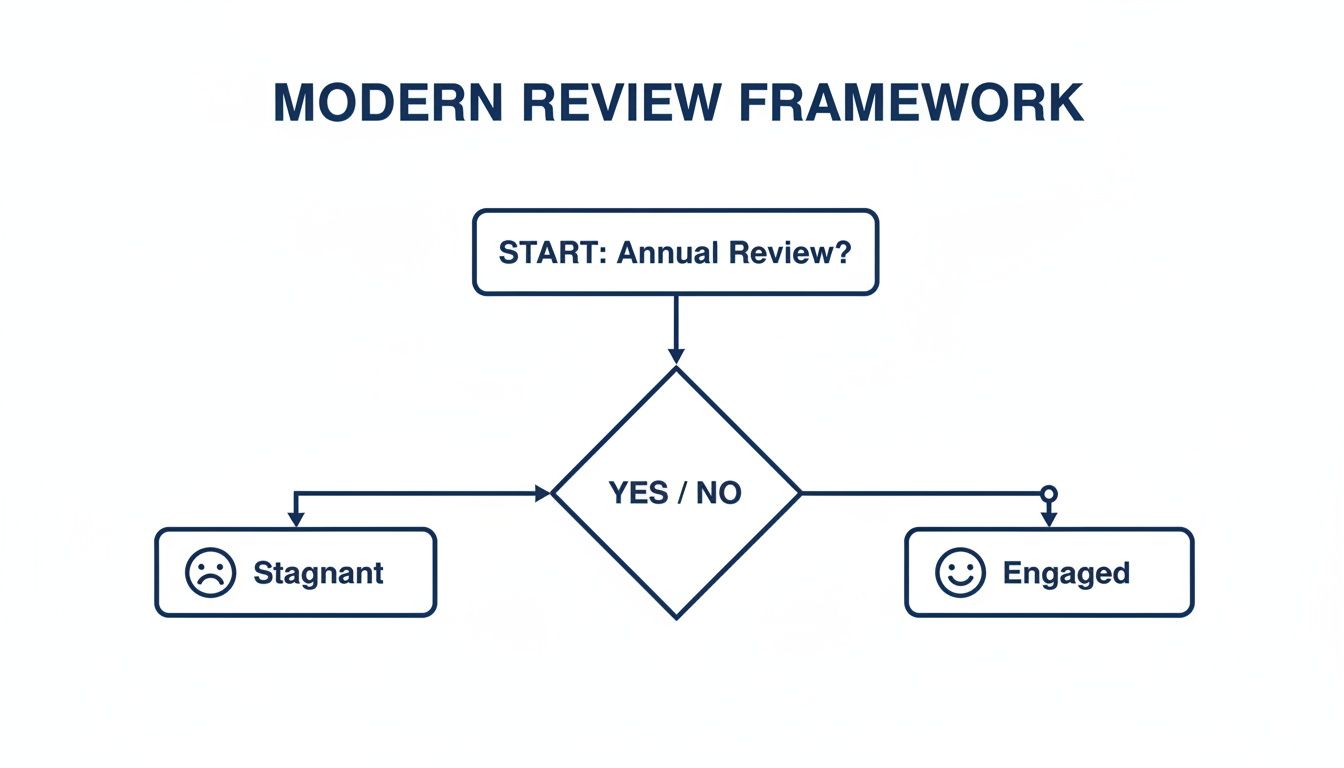
As you can see, sticking with old-school annual reviews is often a recipe for stagnation. Real progress happens when you build a habit of frequent, ongoing feedback.
The Manager-Led Review Template
This is the classic template, your go-to for the formal annual or semi-annual review. A manager leads a deep-dive conversation covering past performance, goal attainment, and what is next for the employee's development. It is structured to make sure you cover all the important bases in a formal setting.
A good manager-led template will have sections for:
- The Basics: Employee and reviewer names, roles, and the review period. This is simple but necessary.
- Performance vs. Goals: A look back at the goals set last time and a clear assessment of what was accomplished.
- Core Competencies: How the employee is doing on the key skills and behaviors for their role and your company culture. Think communication, teamwork, and problem-solving.
- Big Wins: A dedicated spot to call out major accomplishments and contributions.
- Growth Opportunities: Specific areas for development, supported with real examples, not vague suggestions.
- What's Next: Setting clear, collaborative goals for the upcoming review cycle.
- Employee's Voice: A space for the employee to add their own perspective and reflections on the period.
- Sign-Offs: Simple confirmation from both manager and employee that the conversation happened.
This template is your cornerstone for formal performance documentation. It creates the official record you need to support decisions about raises, promotions, and targeted development plans.
For more ideas on structuring this, find the best fit for your team.
The Peer Review Template
Peer reviews offer a 360-degree view that a manager alone cannot provide. This is where you get real insight into an employee's collaboration, teamwork, and interpersonal skills. These are things a manager does not always see day-to-day.
To get honest, constructive feedback from colleagues, the template needs to be simple and focused. The best ones include:
- Anonymity Clause: Be upfront about whether feedback is anonymous or attributed. This is crucial for building trust.
- Reviewer's Relationship: Ask how they work with the person they're reviewing. For example, on the same team or as a cross-functional partner.
- Open-Ended Questions: Avoid yes/no questions. Prompt for specific examples.
- What is one thing this person does that helps the team?
- Can you share an example of when they were a great collaborator?
- What is one area where they could grow to make a bigger impact?
This kind of feedback adds depth. It helps uncover blind spots and highlights how an employee contributes to the team’s dynamic.
The 1-on-1 Check-In Template
This template is for continuous performance management. It is built for those quick weekly or bi-weekly meetings. It keeps conversations focused, productive, and forward-looking. Forget the formality of annual reviews. This is about staying aligned, clearing roadblocks in real-time, and building a stronger relationship.
A great 1-on-1 template keeps things brief and action-oriented:
- Top Priorities This Week: What are the employee’s top three focus areas? This keeps everyone aligned and helps you gauge workload.
- Progress Update: A quick recap of what has moved forward since your last chat. It builds accountability and momentum.
- Roadblocks & Challenges: An open door for the employee to bring up anything getting in their way. This is your cue to step in and help.
- "How Can I Help?": Directly ask, "What do you need from me?" This empowers your direct report to ask for exactly what they need to succeed.
- Action Items: A quick summary of next steps for both of you before the next meeting.
Using this format turns a routine status update into a coaching session. It makes feedback a normal, low-stress part of the weekly rhythm.
For a great resource on weaving these different review types into a cohesive strategy, this Performance Handbook Template is helpful. By combining formal reviews, peer insights, and frequent 1-on-1s, you build a performance management system that helps people grow.
A productive performance review does not happen by accident. It is the direct result of thoughtful prep work from both the manager and the employee. When you both show up ready to talk, the meeting transforms from a one-sided lecture into a genuine conversation about growth and future steps.
Without this groundwork, reviews become stressful and useless. Managers scramble to recall specific examples. Employees feel ambushed, unable to speak thoughtfully about their own wins. This lack of readiness kills the meeting’s value before it even starts. It turns what should be a growth opportunity into a frustrating formality for everyone.
Why do so many people dread reviews? It often comes down to a lack of trust. A Deloitte study found that 61% of managers and 72% of workers distrust the process. The only way to rebuild that trust is through preparation grounded in fairness and actual data. The effort is worth it. Engaged teams, which result from fair processes, have 81% lower absenteeism and 43% lower turnover. You can read more of these performance management findings on Deloitte's website.
Preparation Tips For Managers
As the manager, your preparation sets the tone. Your job is to steer a constructive, forward-looking conversation based on balanced evidence, not what you remember from last week.
Start by collecting specific, concrete examples of your employee’s work from the entire review period. Do not focus on the last month. Dig back through your 1-on-1 notes, project wrap-ups, and any peer feedback you have gathered.
This single habit helps you avoid the most common review traps. For example:
- Recency Bias: This is our brain’s tendency to overvalue recent events. Documenting performance all year gives you a much more accurate and fair picture.
- The Halo Effect: This is when one great trait, like being a fantastic presenter, blinds you to other areas that need work. Using a structured employee performance review template forces you to assess different skills separately.
The best managers walk into a review with a clear purpose. They know the key message they need to deliver, the questions they want to ask, and the outcome they are aiming for.
Before you sit down with your employee, write down three clear objectives for the meeting. Are you trying to align on new goals for the next quarter? Do you need to address a specific performance gap? Is the focus on mapping out a career development plan? A clear agenda keeps the discussion on track and ensures you cover all the important points.
How Employees Should Prepare
Think of your performance review as your dedicated time to champion your own growth and get on the same page with your manager about your future. When you show up prepared, you shift from being a passive listener to an active participant. This makes sure your voice is heard and your work gets the recognition it deserves.
Your first move is a thorough self-assessment. Pull up your job description and the goals from your last review cycle to guide you.
Jot down a list of your biggest accomplishments. For each one, be ready to walk your manager through it:
- The Specific Task: What was the project or responsibility?
- The Action You Took: What exactly did you do to get it done?
- The Measurable Result: How did your work affect the team or company? Get specific with numbers. Think percentages, revenue figures, or time saved.
Doing this homework helps you communicate your value with confidence. It also gives your manager a fuller picture of your contributions, especially on projects they were not involved in day-to-day.
Finally, come with a few thoughtful questions. This shows you are engaged in your own career path. You could ask about the team’s biggest priorities for the next six months, what skills you should focus on building, or how your role can better support the company's big-picture goals. A few good questions can turn the meeting into a true two-way dialogue.
Writing Effective Feedback With Proven Frameworks

The written comments are the heart of any performance review. Vague feedback like "great job this quarter" or "needs more initiative" is a dead end. It feels good to write, but it gives your employee nothing to work with.
To make feedback stick, you need a system. Proven frameworks like SMART and SBI take the guesswork out of the equation. They help you shift from offering opinions to describing facts. This is the key to feedback that helps people grow.
These are not corporate acronyms. They are simple formulas that anchor your comments in reality. By focusing on observable behaviors and their actual results, you make the conversation objective and easier for your team members to hear and act on.
Set Clear Expectations With SMART Goals
You have probably heard of SMART goals. Their true value appears when you bake them directly into your performance reviews. This framework turns a fuzzy aspiration into a concrete plan. Every goal should be Specific, Measurable, Achievable, Relevant, and Time-bound.
Using this structure creates a shared, objective standard for what "good" looks like. It answers the critical questions: "What are we trying to do?" and "How will we know when we have done it?" That clarity is your best defense against misunderstandings later.
Let us see how it works with a common goal.
Example SMART Goal:
- Vague Goal: "Improve customer satisfaction."
- SMART Goal: "Increase the average customer satisfaction (CSAT) score for your support tickets from 85% to 90% by the end of Q3. You will achieve this by completing the advanced communication training by July 31st and implementing two new follow-up macros by August 15th."
This works because it hits all five points. The goal is specific (increase CSAT), measurable (85% to 90%), achievable (with clear steps like training), relevant (to a support role), and time-bound (end of Q3). Dropping goals like this into your review template makes every objective actionable.
Deliver Objective Feedback With The SBI Model
The SBI model is your go-to tool for giving feedback that is direct, fair, and less likely to put someone on the defensive. It stands for Situation, Behavior, and Impact. The value of this framework is that it forces you to stick to the facts. You focus on what you saw and what happened as a result.
When you use SBI, feedback feels less like a personal judgment and more like a helpful observation. It strips out loaded language and focuses the conversation on a specific event and its outcome. It is a foundational skill for building a culture of trust.
Here is the breakdown:
- Situation: First, ground the feedback in a specific moment. When and where did this happen?
- Behavior: Next, describe the exact, observable action the person took. Describe what you saw or heard, not interpretations.
- Impact: Finally, explain the tangible result of that behavior. How did it affect the team, the project, a customer, or you?
This is not theory. Companies that build a culture around strengths-based feedback see 12.5% higher productivity and 8.9% higher profitability. Frameworks like SBI get you there. You can see the data on how strength-based feedback drives performance on Deloitte's website.
Putting The SBI Framework Into Practice
The easiest way to get comfortable with SBI is to see it in action. Here is a quick before-and-after look at how you can use the model to turn fuzzy feedback into something useful.
SBI Framework Examples For Performance Feedback
This table shows how to apply the Situation-Behavior-Impact model to transform vague comments into actionable feedback, whether you are giving praise or suggesting an improvement.
| Scenario | Vague Feedback | Effective SBI Feedback |
|---|---|---|
| Positive | "You're a great team player." | Situation: "In the project kickoff meeting on Tuesday," Behavior: "you noticed a junior team member was hesitant to speak and you specifically asked for their input." Impact: "This made them feel included and helped us identify a key risk we had overlooked." |
| Constructive | "Your reports are always late." | Situation: "For the last three weekly reports," Behavior: "you submitted them after the Friday 5 PM deadline." Impact: "This delayed our weekend data sync, which meant the leadership team did not have the latest numbers for their Monday morning meeting." |
As you can see, the SBI versions give the employee a crystal-clear picture of what to stop, start, or continue doing.
The value of the SBI model is its simplicity. It gives you a script to follow that keeps the conversation focused on facts, not feelings. This makes tough conversations more productive and less emotional.
By mastering frameworks like SMART and SBI, you can turn your performance review templates from a source of anxiety into a tool for growth. For more practical tips, check out our guide on how to provide constructive feedback that helps your team get better.
Making Your Templates Fit: How to Adapt for Different Roles and Teams
A one-size-fits-all performance review template is a recipe for problems. The skills that make a junior developer succeed are different from what makes a sales director a top performer. If you want feedback to be relevant, fair, and useful, you must customize your templates.
When you do not customize, you judge people against criteria that make no sense for their job. A generic template might focus on teamwork for a role that is mostly independent work. It might miss the strategic thinking you expect from a senior leader. This kind of mismatch leads to unproductive meetings.
Adjusting for Job Function
Every department has its own language for success. Your review templates need to speak that language. To do that, you must get clear on the core responsibilities and key metrics for each team.
Think about what matters for different groups:
- Engineering: You are focused on things like code quality, problem-solving skills, and hitting project deadlines. Their goals would be tied to metrics like bug resolution rates or how quickly they ship features.
- Marketing: Here, it is all about creativity, campaign ROI, and lead generation. You might set a goal to increase website traffic by 15% or improve email open rates.
- Customer Support: This is where you focus on skills like empathy, deep product knowledge, and first-call resolution. The numbers that matter are customer satisfaction (CSAT) scores and average ticket response times.
This focused approach makes sure you are measuring what drives success in each role, not just checking a box.
Tailoring for Seniority and Experience
An entry-level hire and a seasoned leader need different things from a review. Your template’s tone, focus, and questions must change to match where they are in their career.
Customizing reviews for seniority is not about going easy on people. It is about aligning expectations with their current scope of influence and their potential for growth.
For an entry-level employee, the review should feel more like a coaching session. The tone is supportive, with a heavy emphasis on learning and building skills. You are focused on helping them master the core parts of their job and get comfortable in the company culture.
A review for a senior leader must be strategic. The conversation should zoom out to their impact on business goals, their leadership, and how they are shaping the company's future. You are talking less about daily tasks and more about their influence and vision.
Take a software engineer, for example. The review evolves with experience:
- Junior Engineer: The conversation centers on their coding proficiency, how well they are learning the tech stack, and if they are collaborating effectively on smaller tasks.
- Senior Engineer: Now you are assessing their ability to architect complex systems, mentor junior developers, and drive technical decisions that affect the whole organization.
Making these tweaks turns your employee performance review template from a generic form into a tool that helps every person on your team grow.
Common Performance Review Mistakes To Avoid
Even with a perfect template, the performance review process can get derailed. We are all human, and our natural biases can appear. This leads to reviews that feel unfair or are inaccurate. Spotting these common traps is the first step to making your reviews productive.
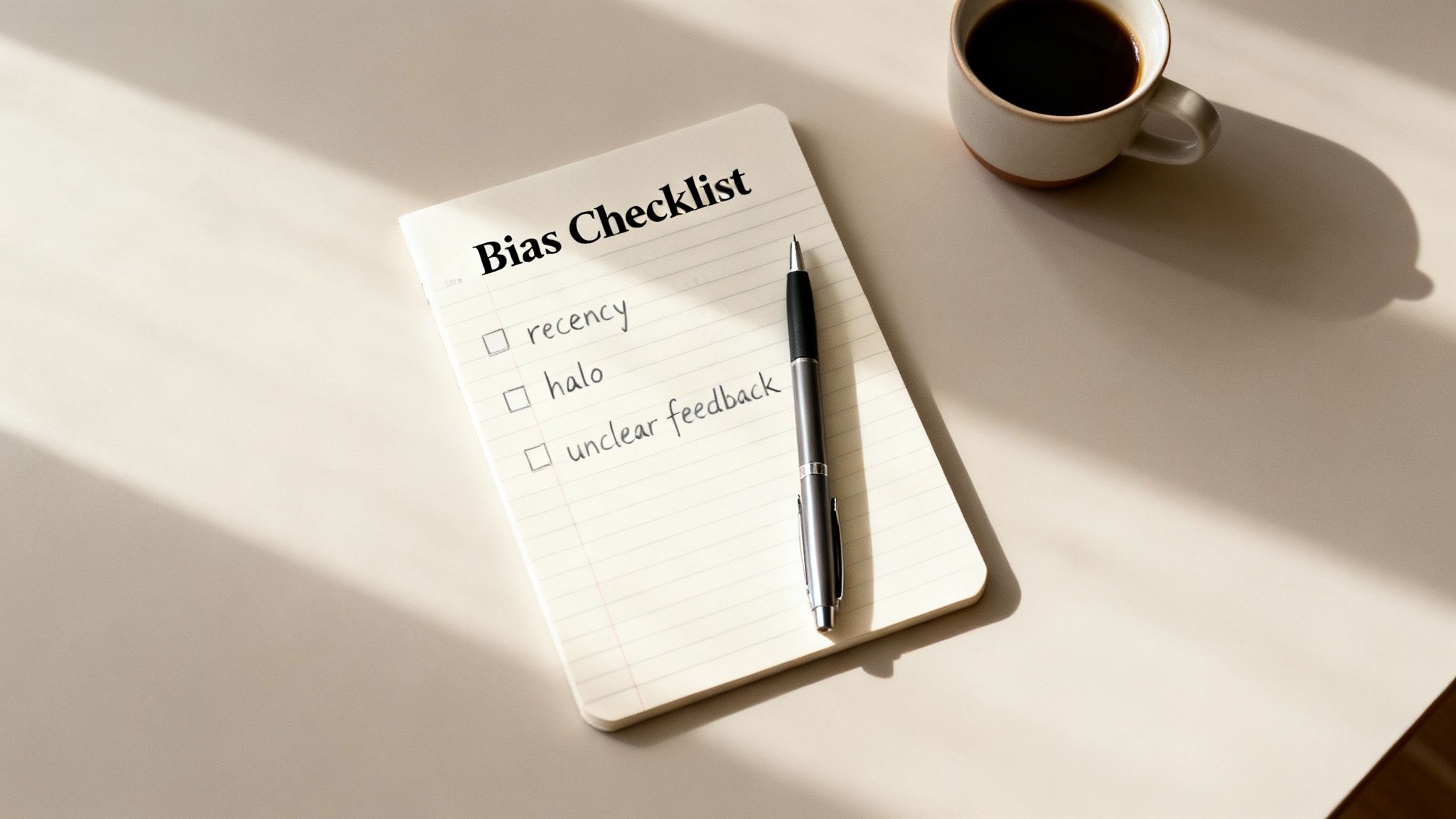
One of the biggest culprits is recency bias. This is when we focus almost entirely on what an employee did in the last few weeks. We forget all the consistent work they put in months ago. It gives you a skewed picture and undervalues long-term contributions.
Then there is the halo effect. This happens when one standout positive trait, like a fantastic attitude, blinds you to other areas that need work, like consistently missing deadlines. The flip side is the horn effect, where one negative trait unfairly poisons your perception of their entire performance.
How to Keep Your Reviews Fair and Objective
You cannot hope for objectivity. You must build it into your process. One of the simplest and most effective ways to beat recency bias is to keep a running log of performance notes all year. This small habit ensures you walk into the review with concrete examples from the entire period, not just last month.
To strip out personal biases like the halo or horn effects, follow these steps:
- Bring in more voices. Do not make your opinion the only one that matters. Incorporating peer feedback gives you a more rounded view of how an employee collaborates and contributes to the team.
- Trust the template. A well-designed template is your best defense. It forces you to evaluate different skills and competencies one by one. This stops that "halo" from one area from bleeding into another.
- Anchor everything in facts. Do not say, "You need to be more proactive." Ground your feedback in what you saw. Using a framework like SBI forces you to stick to observable behaviors and removes vague, unhelpful judgments.
Avoiding bias is not just about being fair. It is about making smarter business decisions. When your reviews are objective, you get accurate data to guide everything from promotions and development plans to compensation.
The fact that 71% of companies still rely on biased annual reviews tells you this is a widespread problem. You can learn more about these systemic issues from these performance management statistics on passivesecrets.com. By actively working to avoid these common mistakes, you can build a review process that people trust. This is one that helps them grow.
Got Questions About Performance Reviews? We Have Answers.
Running performance reviews always brings up a few common questions. Let's tackle some of the ones managers ask most often, so you can handle the process with confidence.
How Often Should We Be Doing These?
The old-school annual review is not effective anymore. It is a relic from a different era.
For most teams, a formal review either quarterly or semi-annually works well. It is frequent enough that the feedback is still fresh and relevant. It is not so often that it feels like a burden.
Think of these as the bigger check-ins. They should not replace your regular weekly or bi-weekly 1-on-1s. The goal is a continuous conversation, so nothing in the formal review ever comes as a surprise.
What's the Best Way to Deliver Tough Feedback?
Delivering difficult feedback is all about preparation. Walking in unprepared is a recipe for a conversation that goes poorly.
You can lean on a framework like SBI (Situation, Behavior, Impact) to keep things objective. It forces you to stick to the facts, what happened and what the result was, instead of letting feelings or interpretations affect the conversation.
Get straight to the point and state the purpose of the meeting. Lay out your specific examples using that framework. Explain the impact, and then stop talking and listen. Your employee’s perspective is a critical piece of the puzzle. The point is to solve a problem together, not to point fingers.
Should We Tie Reviews Directly to Raises?
This is a common question. Linking reviews to compensation is standard practice. It is a high-wire act that demands total transparency. If a raise is on the table, the criteria for earning it must be crystal clear in your employee performance review template and communicated long before the review itself.
Because this direct link instantly raises the stakes, you should split the conversation.
Hold two separate meetings. Use the first one to dig into performance, share feedback, and set development goals. Then, schedule a second, much shorter meeting to go over the numbers. This includes the salary, the bonus, or the title change. This gives each conversation the space it needs.
When you separate the two, you keep the review focused on growth. The conversation stays developmental and collaborative. It does not turn into a negotiation right from the start. It makes for a healthier, more productive process for everyone involved.
PeakPerf is the lightweight management toolbox that helps you prepare for your toughest people-leadership moments. Go from a blank page to a structured, professional draft for any feedback conversation in minutes. See how it works at https://peakperf.co.


