How to Delegate Tasks Effectively: A Practical Guide

To delegate well, you cannot just assign tasks and hope for a positive outcome. It is a structured, seven-step process: pick the right tasks, match them to the right person, be clear on the outcome, define their authority, give them what they need, check in, and follow up with feedback.
When you master this, delegation becomes a tool for growing your team and your business.
Why Delegation Is a Necessary Leadership Skill
Delegation is more than clearing your to-do list. It is a direct investment in your team's talent and your company's future. When you delegate correctly, you give your people a chance to learn new skills, accept responsibility, and become more invested in their work. This is how you build a strong team over time.
For any leader looking to increase productivity without burning out, smart delegation is essential. Your job shifts from doing all the work to empowering others to do it well. This frees you to focus on high-level, strategic work that only you handle, such as planning the next move, mentoring your rising stars, and driving innovation.
The Bottom-Line Impact of Great Delegation
The link between delegation and business success is supported by data. A Gallup analysis of 143 CEOs found that leaders rated highly for their delegation skills saw an average three-year growth rate of 1,751%.
The same research showed that CEOs who delegate effectively generate about 33% more revenue than their counterparts who keep everything on their own plate. The data makes it clear: your ability to delegate is directly tied to your company's financial health.
Getting Past Common Hurdles
Why do so many leaders struggle with delegation? I see the same patterns. Some fear losing control, convinced that no one can do the job as well as they can. Others fall into the "it's faster to do it myself" trap. While that might feel true in the moment, it is short-term thinking that creates a bottleneck for the entire team.
Effective delegation multiplies your impact. You are not just getting a task done; you are building a person’s capacity to handle future tasks on their own.
Here are the most common reasons I hear for not delegating:
- The fear of losing control: A belief that you must be in every detail to guarantee quality.
- A lack of trust in the team: Doubting a team member's skills, commitment, or ability to see it through.
- The "it's faster myself" mindset: Prioritizing today's task over tomorrow's team development.
- Guilt about adding more work: A reluctance to load up a team member, even when it is a growth opportunity.
Recognizing these barriers is the first step. The framework below is designed to help you push past them with confidence. By taking a structured approach, you minimize risks and set everyone up for a bigger win.
For a quick overview, here is a summary of the seven steps we will break down.
A Quick Guide to the 7 Steps of Effective Delegation
| Step | Key Action |
|---|---|
| 1. Prepare to Delegate | Adopt the right mindset and identify tasks ready to be handed off. |
| 2. Choose the Right Person | Match the task to the person with the right skills, interest, and capacity. |
| 3. Clarify Outcomes | Define what "done" looks like with absolute clarity. Focus on the "what," not the "how." |
| 4. Define Authority | Set clear boundaries on their decision-making power and autonomy. |
| 5. Give Instructions | Provide all the necessary context, resources, and information they need to succeed. |
| 6. Monitor Progress | Establish a check-in cadence that provides support without micromanaging. |
| 7. Give Feedback & Follow-Up | Close the loop with constructive feedback and acknowledge their work. |
This table gives you the high-level view. Now, let's examine the details of each step so you can start delegating like a professional.
Preparing to Delegate: What to Give Away and to Whom
Great delegation does not start with handing off a task. It starts before that, with a hard look at your own responsibilities and a clear assessment of your team. If you skip this preparation, you are hoping the right task lands with the right person. That approach leads to frustration.
The first move is to understand everything you do. Write it all down, from the big projects to the small recurring admin tasks. This is not just about making a list. It is about gaining the clarity to see what truly needs your unique attention and what you can hand off to help someone else on your team grow.
This process comes down to a few key decisions. The flowchart below maps it out: figure out the task, pick the person, and then make the handoff clear.
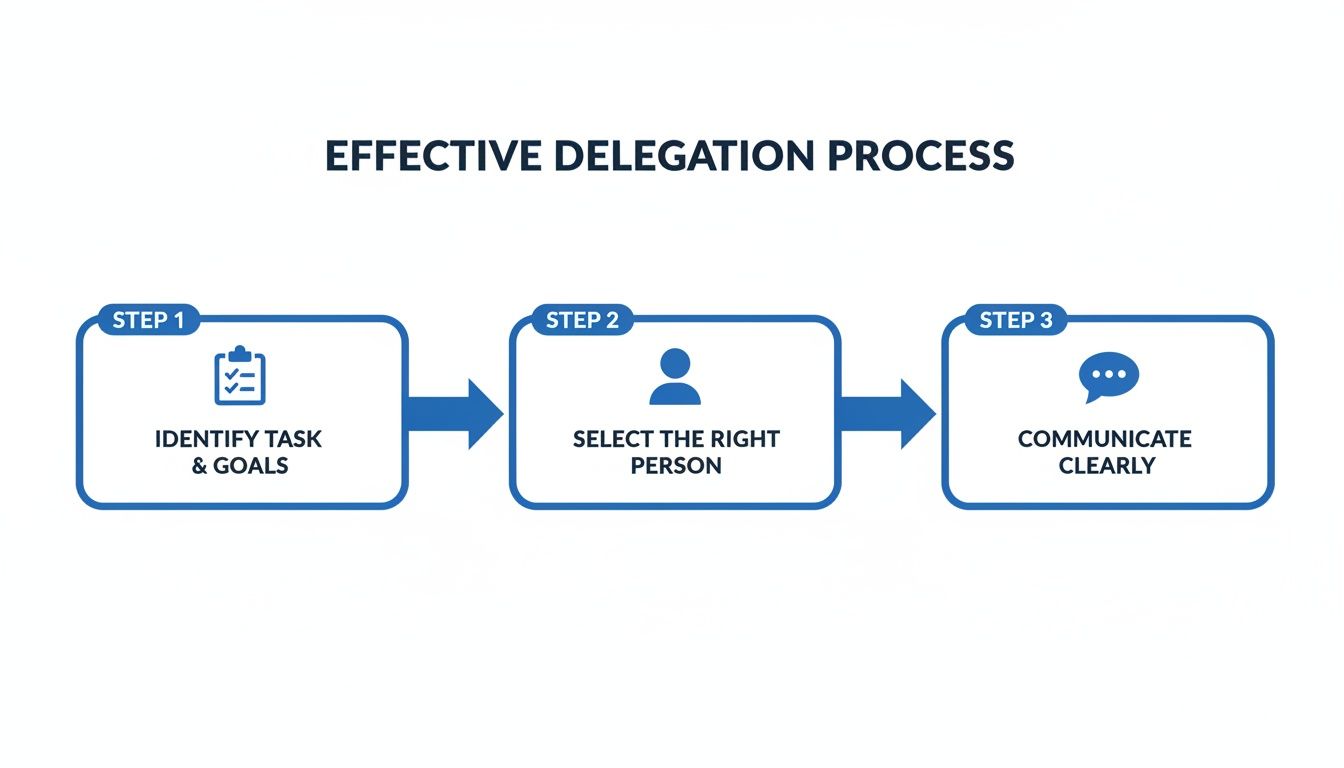
Think of it as a deliberate sequence. Each step is a foundation for the next, setting you up for a win instead of a messy cleanup later.
Use a Framework to Sort Your Tasks
One of the best tools for this is the Eisenhower Matrix. It is a simple way to sort your workload into four buckets based on urgency and importance. It gives you an instant visual of what to do with everything on your list.
- Urgent and Important: These are your fires. Do them yourself, and do them now.
- Important but Not Urgent: This is where strategy lives. Schedule these and handle them personally.
- Urgent but Not Important: This is your delegation sweet spot. These items need to get done, but they do not need you.
- Not Urgent and Not Important: Be ruthless. You should eliminate these tasks.
Sorting your to-do list this way stops you from living in constant reaction mode. You can focus your energy where it creates the most value and cleanly identify what is ready to be delegated. It is the difference between being a reactive manager and a proactive leader.
Finding the Right Person for the Job
You have a task ready to go. Now, who gets it? The answer is almost never "whoever has the most free time." A smarter approach is the Skill/Will Matrix. This helps you think about team members based on their capability (skill) and their motivation (will) for a specific task.
Your goal is to match the task to the person who is both able and willing. Giving a high-skill, high-will employee a challenging assignment is an investment in their development and your team's strength.
Before you make the assignment, run through these questions:
- Do they have the skills? If not, are they close? Could they get there with some guidance from you?
- Does this task fit their career goals? A task that helps someone grow is a motivator. A task that feels like busywork is not. You can connect this better using SMART goals for performance management.
- What is their workload like? Piling a new task onto someone who is already overloaded is setting them up to fail. You have to have an honest conversation about their capacity first.
- Have they shown any interest in this area before? When you tap into someone’s natural curiosity, you almost always get a better result and a more engaged employee.
Sometimes, the right person is not on your team. When you need specialized support, looking into the best virtual assistant agencies can help with administrative, creative, or technical work.
By putting this much thought into both the what and the who, delegation becomes a leadership tool. You get your time back, you empower your people, and you build a more capable team. This is the prep work that makes delegation work.
The Delegation Framework: How to Communicate for Total Clarity
Once you have picked the right task and the right person, the entire process depends on how you communicate. Ambiguity is the enemy of good delegation. A vague request like, “Can you handle the monthly report?” will likely lead to a disappointing result.
You need a clear communication framework. This is not about memorizing scripts. It is about making sure you cover all the bases so your team member has everything they need to succeed. Your goal is to hand off ownership of the outcome, not just a checklist of tasks.

This starts by defining what a "win" looks like. Instead of dictating the exact steps, focus on the result you want. This gives them the room to apply their own skills and problem-solving, which is where ownership and engagement begin.
Define the Desired Outcome, Not Just the Steps
Your first job in any delegation conversation is to paint a clear picture of the finish line. What does "done" look like? What specific results will tell you this was a success?
For instance, do not say, “Please research our top three competitors.” That is too vague.
Try this instead: “I need a one-page summary of our top three competitors' marketing strategies from last quarter. Please focus on their key campaigns, primary messaging, and include links to their top-performing social posts. The goal is to find one or two tactics we might adapt for our upcoming launch.”
See the difference? This approach gives the task purpose and a clear standard for success. It connects their work to a bigger company goal, which makes the work feel more meaningful.
Set Clear Deadlines and Milestones
Every delegated task needs a firm deadline. A task without a due date is a vague wish that will sink to the bottom of their to-do list. Get specific with dates, and if it is time-sensitive, specify a time of day.
For bigger projects, you should break them down into smaller chunks with their own deadlines. These milestones are useful for two reasons:
- They make a large project feel less intimidating for your employee.
- They create natural check-in points for you to monitor progress without hovering.
A well-defined deadline is not about adding pressure. It is about creating clarity and alignment. It ensures everyone is on the same page and working toward the same timeline.
This simple structure keeps projects moving and helps you catch potential roadblocks early, when they are still easy to clear. These check-ins are also a perfect time to offer support. To make those conversations more effective, use a structured one on one meeting agenda to guide the discussion.
Clarify the Level of Authority
One of the biggest problems in delegation is failing to define exactly how much authority you are handing over. A simple model like the Five Levels of Delegation is helpful here. It gives you a shared language to explain the level of autonomy someone has for a specific task.
Being explicit about the level of authority empowers your team member to move forward with confidence. They know exactly where the boundaries are, which stops them from overstepping or constantly asking you for approval.
Before you delegate, think about which of these five levels makes the most sense for the person and the project.
The Five Levels of Delegation
This simple framework helps you match the right amount of autonomy to the person and the project, eliminating guesswork for everyone.
| Level | Description of Authority |
|---|---|
| Level 1 | Wait to be told. This is pure instruction. You make all the decisions. |
| Level 2 | Ask what to do. The person gathers info and presents options, but you make the final call. |
| Level 3 | Recommend, then act. They do the research, propose a plan, and move forward once you approve. |
| Level 4 | Act, but report immediately. They have the autonomy to act on their own, but they must let you know what they did right away. |
| Level 5 | Act independently. They have full ownership and only need to report on the results during regular check-ins. |
Communicating the right level from the start cuts through potential confusion. It tells your team member exactly how to engage with you throughout the task, leading to a smoother and more efficient process for both of you.
Keeping an Eye on Progress and Giving Feedback That Helps

Handing off a task is not the finish line. Your work continues through monitoring and feedback, which turns a simple hand-off into a growth opportunity for your team member. The goal is to stay in the loop without hovering over their shoulder.
You need a simple follow-up system that offers support but also demands accountability. This is how you build trust. It gives your employee the confidence to own their work, knowing you will support them if they encounter a problem. Great delegation is a balance between autonomy and support.
Setting Up a Check-in System
Before the work begins, you and your team member need to agree on how and when you will connect for updates. This small amount of planning removes guesswork and saves you from the urge to ask, "So, how's it going?" A set schedule respects everyone's time and lets them focus.
The method you choose depends on the project's size and your employee's experience level.
- Regular Meetings: For larger projects, quick 15-minute syncs once or twice a week are perfect. This gives you dedicated time to discuss progress, address roadblocks, and align on next steps.
- Written Updates: A short daily or weekly email summary can be all you need for more straightforward tasks. This creates a running log of progress and keeps you informed with minimal disruption.
- Project Management Tools: If you use platforms like Asana, Trello, or Jira, you already have real-time visibility. You can see how things are progressing without having to ask for a direct update.
The most important part is that you both agree on it. Ask your team member what rhythm works best for them. When you approach it as a partnership, it reinforces that you are working together, not just supervising from a distance.
Giving Feedback That Fuels Growth
Feedback is essential. After a delegated task is done, your job is to close the loop with observations that help your team member improve next time. If you skip this, you are wasting an opportunity to build your team's skills.
The best feedback is always specific and tied to behavior. Instead of a generic "Good job on the report," try something like, "The way you organized the data in the competitor report made the key takeaways clear. That was excellent."
That level of detail shows you were paying attention and tells them exactly what they should repeat in the future. For a deeper analysis, see our guide on how to provide constructive feedback to sharpen your skills.
Always focus feedback on the work, not the person. Frame the conversation around specific actions and their results. This keeps things objective and centered on professional growth, not personal criticism.
A Quick Script for When Things Go Sideways
Even with the best planning, projects can go off course. When you see something heading in the wrong direction, you need to step in early and constructively. Your role here is to be a coach, not a critic.
Here is a simple script you can adapt:
- Start with an observation: "Hi [Name], I was looking at the project timeline and noticed we're a bit behind on the client presentation milestone. Do you have a minute to chat about it?"
- Ask for their perspective: "Can you walk me through where you are and any challenges you've encountered so far?"
- Problem-solve together: "Thanks for sharing that. Based on what you've said, what are one or two things we could do right now to get this back on track?"
This approach empowers your employee to find their own solutions and own the course correction. It proves you are there to support them, not to take the work back at the first sign of trouble.
This skill is directly tied to preventing burnout. Research from Development Dimensions International found that leaders experiencing burnout are 3.5 times more likely to quit their jobs, and they identified effective delegation as a key preventative measure. You can find more of DDI’s insights on their site.
Common Delegation Mistakes and How to Avoid Them
Even when you have a solid plan, delegation can still fail. Knowing where the potential problems are is the first step to avoiding them.
Even well-intentioned leaders make mistakes that sabotage their own efforts. By getting familiar with these common traps, you can spot them early, correct your course, and build a delegation process that works.
The biggest and most frequent mistake is micromanagement. You hand off a task, but then you hover, constantly checking in and second-guessing every move. This defeats the purpose of delegating. It communicates "I don't trust you," kills your team member's creativity, and stops them from taking ownership.
Sidestepping the Micromanagement Trap
Micromanagement usually comes from a good place: a fear of losing control or a belief that you are the only one who can get it done right. The fix is not to stop checking in, but to change how you do it.
Instead of demanding constant updates, agree on a schedule for structured progress reports. Perhaps a 15-minute sync every Tuesday and Thursday morning. This simple rhythm gives them the space to do the work while giving you a predictable time to get updates and offer support. It respects their autonomy and calms your anxiety.
Another classic mistake is delegating responsibility but not authority. Imagine asking a team member to lead a small project but forcing them to get your approval for every small decision. You have just created a bottleneck and made your employee feel powerless. They have the burden of the task but no power to move it forward efficiently.
To empower someone, you must delegate authority alongside responsibility. If you have chosen the right person and been clear on the desired outcome, trust them to make decisions within the scope you have both agreed on.
This does not just speed things up; it is an effective way to develop your team member's decision-making skills.
Avoiding Unclear Instructions and Lack of Support
Ambiguity kills effective delegation. Assigning a task with a vague instruction like "handle the client communications" is a recipe for failure. Your employee is left guessing what you want, which leads to anxiety, wasted time, and work that misses the mark.
Equally damaging is delegating a task without providing the necessary support or resources. You cannot expect someone to bake a cake without giving them flour and eggs. Before you hand off the next task, run through a quick mental checklist:
- What critical information does this person need to get started?
- Do they have access to the right software, files, or key contacts?
- Is there any specific training they need for this?
Failing to provide these things is setting your employee up to fail. This is a common problem. A study of professional services firms found that 81% of North American firms and 78% of UK firms still rely on manual, often unclear, delegation processes. Managers spend about 14% of their time redoing tasks, a problem often stemming from a poor handoff. You can find more details in these findings on task delegation effectiveness.
Preventing "Upward Delegation"
Finally, you have to watch out for a problem called "upward delegation." This is when an employee hits a roadblock and hands the task right back to you to solve it. It might feel faster to fix it yourself in the moment, but you are creating a dependency that stunts their growth.
When a team member brings you a problem, fight the urge to provide the answer. Turn it into a coaching opportunity. Ask questions that force them to think critically:
- "Interesting problem. What solutions have you already considered?"
- "What do you think the best next step is here?"
- "What information are you missing that would help you make a decision?"
This approach teaches your team to come to you with potential solutions, not just problems. By avoiding these common mistakes, you turn delegation from a simple hand-off into an engine for developing your team and getting more done.
Your Toughest Delegation Questions, Answered
Even with a solid plan for delegating tasks, you will encounter tricky real-world situations. Questions always come up when you start putting these principles into practice.
This section addresses the most common challenges I have seen managers face when they start to delegate more. Think of it as your guide for handling the nuances with confidence.
How Do I Delegate to Someone Who Is Already Busy?
Handing a task to a high-performer who already has a full plate is a conversation. The first step is to acknowledge their current workload. Do not just drop another thing on their desk and walk away.
Sit down with them and look at their priorities together. This simple act shows respect for their time and helps you both spot any existing tasks that could be shifted, delayed, or dropped to make room. It is a collaboration.
When you introduce the new task, frame it as an opportunity that speaks directly to their skills or career goals. For example, you might say, "I'm asking you to lead this analysis because your attention to detail is the best on the team, and I know you wanted more exposure to our product strategy."
This context makes it feel like recognition, not just another assignment. Be ready to offer extra support and stay flexible on the deadline. The key is to ask, not just assign.
What Should I Do If a Delegated Task Is Not Done Correctly?
When a task comes back wrong, your first instinct needs to be coaching, not criticism. This is a learning moment for your team member and a diagnostic tool for your own communication process.
Start by asking for their perspective. Use open-ended questions like, "Can you walk me through your process for putting this together?" This helps you understand their thinking and see where the disconnect happened without putting them on the defensive.
Next, review your original instructions together. Was something ambiguous? Did you forget to provide a key piece of information or a critical resource? A poor outcome is often a symptom of a communication gap.
Once you find the issue, build a plan together to fix the work. This reinforces that you are a team and that mistakes are opportunities to improve.
A failed task is not just a mistake to be fixed. It is a chance to refine your delegation skills and build a team member's problem-solving abilities for the future.
This approach builds resilience and trust. It shows your employee you are invested in their development, even when things do not go perfectly.
How Can I Overcome the Feeling That It Is Faster to Do It Myself?
The "it's faster if I do it" mindset is the biggest hurdle to effective delegation, and you have to get past it. The trick is to shift your thinking from short-term speed to long-term capacity building. It is a time investment.
Doing that familiar task yourself will be faster this one time. But it will take you just as long the next time, and every time after. When you invest a few hours in training someone else, you are buying back all those future hours for yourself.
Let's do the math. A task that takes you one hour every week costs you 52 hours per year. If you spend four hours training someone to do it, you gain back 48 hours in the first year alone. That is more than a full work week you can now spend on high-value, strategic work that only you can do.
Start small. Delegate a few lower-risk tasks to build your confidence and see the payoff for yourself.
Is It Appropriate to Delegate Tasks to a More Senior Colleague?
Delegating to a peer or someone more senior is different from delegating to a direct report. This is not about assigning work. It is about requesting collaboration based on their unique expertise. You cannot use the same approach.
You have to frame the request with respect for their position and their time. Be clear about why you are asking them specifically.
Here is how to approach it:
- Explain the Context: Briefly outline the project you are on and why it matters.
- Highlight Their Expertise: Pinpoint the specific skill or knowledge they have that is crucial for what you need. Make it clear this is not random.
- Frame it as a Request: Use language like, "I was hoping I could get your help with..." or "Your expertise in this area would be invaluable for a piece of this."
- Be Flexible: Acknowledge their packed schedule and be ready to work around their priorities. It is a good move to offer to help them with something in return.
This approach transforms the interaction from a directive to a partnership. It respects their seniority while allowing you to tap into their valuable skills to get a better outcome for everyone.
Every conversation about delegation is an opportunity to lead better. PeakPerf provides managers with structured guides and proven frameworks for tough conversations, from giving feedback to setting development goals. Turn difficult management moments into opportunities for growth. Get started for free at https://peakperf.co.


