
How to give constructive feedback to employees that works
Giving constructive feedback is not about pointing out flaws. It is about coaching someone toward growth. When you deliver clear, actionable, and supportive input, you are not correcting behavior. You are fostering a person's development by focusing on specific actions and their impact in a way that encourages positive change.
Why Most Employee Feedback Fails

Delivering tough feedback is a core part of being a leader. It directly shapes your team's performance, their engagement, and the culture you build. Get it right, and you build trust and potential. Get it wrong, and you get defensiveness, demotivation, and damaged relationships.
Many managers dread these conversations. So, they either avoid them or deliver the feedback poorly. This approach almost never works. Instead of inspiring improvement, it makes an employee feel undervalued and shut down.
The goal is to shift from correcting errors to developing your people. That mindset is everything. It transforms feedback from a negative event into a genuine opportunity for growth.
The Big Disconnect in Feedback
One of the biggest reasons feedback falls flat is the gap between what managers think they are doing and what their teams experience. You might feel you are giving regular input, but your employees see it differently. This disconnect leaves people feeling unsupported and guessing where they stand.
The numbers show this disconnect. Only about 20% of employees say they get feedback from their manager weekly. But nearly half of managers think they provide it that often. That is a breakdown in communication. You can look at employee feedback statistics to see how wide this gap is.
What happens when feedback is a rare event?
- Uncertainty increases. Employees are left to wonder how they are doing and what they should focus on.
- Small problems fester. Minor issues that were a quick fix snowball into bigger challenges.
- Trust disappears. Without regular, honest communication, employees feel disconnected from their manager and the company's mission.
Many employees are starved for guidance. Roughly one-third of employees wait more than three months to get real feedback from their manager. You cannot keep a team aligned and motivated that way.
Constructive Guidance vs. Simple Criticism
Knowing the difference between constructive feedback and criticism is non-negotiable for a leader. They seem similar, but their outcomes are different. Criticism fixates on past mistakes. Constructive guidance focuses on future improvement.
Criticism is vague and feels personal. A manager saying, "You need to be more proactive," is criticizing. It points out a flaw but offers zero solutions. It leaves the employee feeling attacked and wondering, "What am I supposed to do with that?"
Constructive feedback is about specifics. Instead of that vague comment, you say, "During our last project meeting, I noticed you waited for tasks to be assigned. For our next one, I want you to come prepared to identify two or three upcoming needs and propose a plan for them." See the difference? It highlights a specific, observable behavior and gives a clear, actionable next step. It guides the employee toward the goal without judgment.
Your job is to build skills, not to assign blame.
Prepare for a Productive Feedback Conversation
A great feedback session starts before you and your employee talk. If you walk into these meetings cold, you set yourself up for vague statements, emotional flare-ups, and a missed opportunity for growth. Preparation makes a difference. It cuts through confusion and guides the conversation toward a solution.
The point of preparing is to walk in feeling confident, clear, and focused on a positive outcome. This means you need to bring facts, not feelings. Without concrete examples, your feedback sounds like a personal opinion, which is a fast track to a defensive conversation.
Collect Specific Examples
The foundation of effective feedback is specificity. A general comment like, “You need to be more organized,” is unhelpful. It gives your employee nothing to work with. There is no context and no clear path to get better. Instead, you need to find specific, observable examples of a behavior and its result.
Before your meeting, take a few minutes to look through your notes, project management tools, or other data. Find clear instances that illustrate the point you need to make.
- Behavior: What did the employee do or say?
- Impact: What was the result of that action on the project, the team, or the business?
For instance, instead of saying, "Your reports are sloppy," you say, "The Q3 report you sent last Tuesday was missing the data from the marketing team. We had to push our presentation to leadership back a day while we corrected it." See the difference? It is factual, unemotional, and ties the behavior to a business outcome.
Good preparation means you focus on what happened, not on your interpretation of why it happened. This approach sidesteps defensiveness and keeps the conversation grounded in reality.
Define Your Desired Outcome
What is the end goal? Pointing out a flaw is not enough. You need to have a clear, desired outcome in your mind before you send the meeting invite. This goal will anchor the discussion and stop it from becoming a complaint session.
Your objective should be constructive and forward-looking. Are you trying to shift a behavior, help them build a new skill, or align their work with team standards? Figure this out first.
A solid, well-defined outcome has three parts:
- Acknowledge the Issue: Make sure the employee understands the behavior and its impact.
- Collaborate on a Solution: Work together to create a practical plan for improvement.
- Confirm Next Steps: Agree on what success looks like and set a timeline for a follow-up.
Having a clear goal helps structure this conversation. It is a key ingredient for better meetings. To learn more, check our guide on creating an effective agenda for one on one meetings.
Anticipate Employee Reactions
Feedback conversations get emotional. A huge part of your preparation is thinking through how your employee might react and having a plan for how you will respond. This is not about watering down your message. It is about delivering it with empathy and skill.
Think about the employee’s personality and how they have responded to feedback in the past. You will likely encounter one of these common reactions:
- Defensiveness: They might deny the issue or blame other people or outside factors.
- Silence: They might shut down and refuse to engage in the conversation.
- Quick Agreement: They might agree to everything you say to end the uncomfortable discussion, with no commitment.
For each of these possibilities, think about how you will steer the conversation back on track. If you expect defensiveness, come with multiple factual examples. If you anticipate silence, have open-ended questions ready to encourage dialogue. Planning for these moments helps you stay calm and professional. The conversation remains productive. This preparation builds the confidence you need to handle these leadership moments well.
Use Feedback Models for Clearer Communication
Giving feedback without a plan can feel like you are fumbling in the dark. A good framework helps. It provides a simple, repeatable structure that strips away personal opinions and focuses the conversation on what happened. Instead of trying to find the right words on the fly, you have a path to follow that keeps the discussion productive and on track.
These models are your prep tool. They force you to organize your thoughts beforehand so you cover all your bases without an emotional back-and-forth. When feedback is delivered this way, people are less likely to get defensive. They can hear the issue and understand its consequences.
The prep work you do before the conversation is as important as the conversation itself. This visual breaks down those early steps.
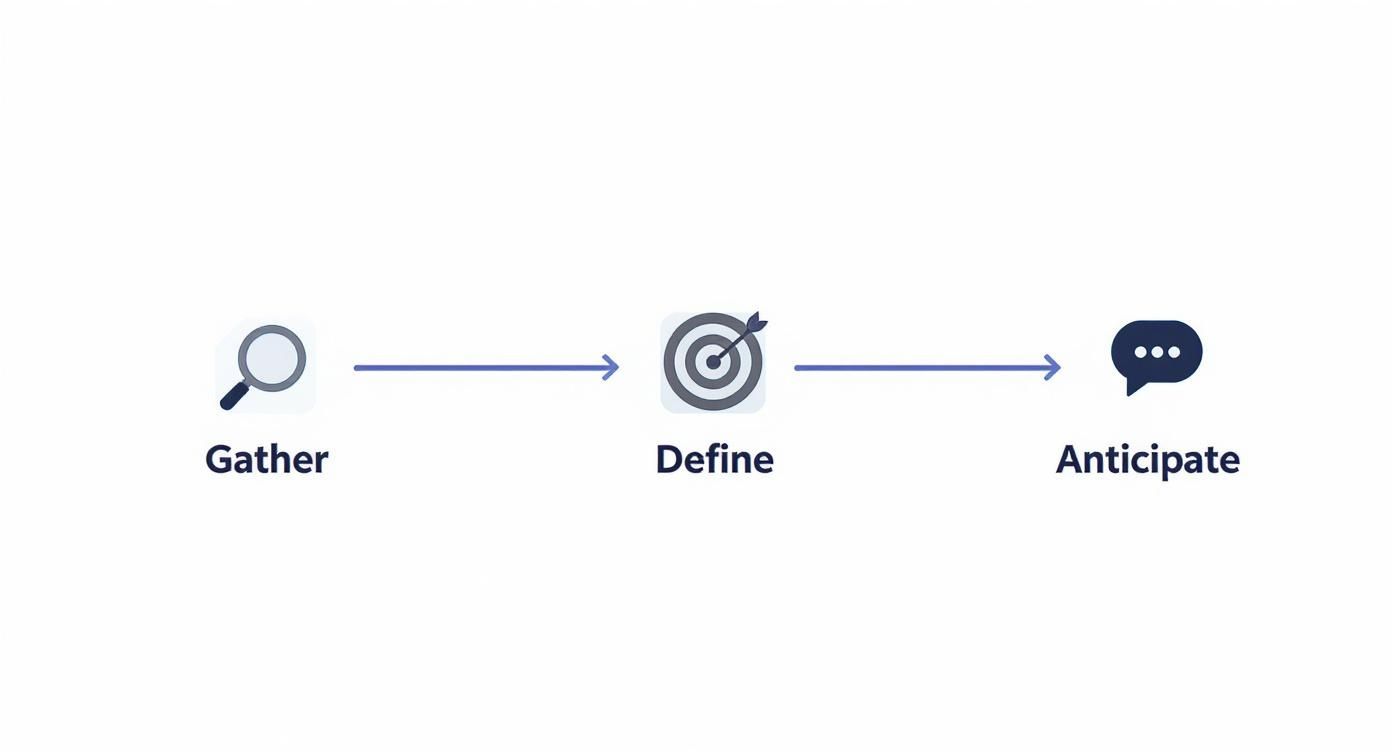
Great feedback starts with gathering facts, knowing your goal, and thinking through how the other person might react. All of this groundwork feeds into the two models we are about to cover.
The SBI Model: Situation-Behavior-Impact
The SBI model, developed by the Center for Creative Leadership, is a simple tool for delivering direct, clear feedback. It breaks the conversation down into three parts. This helps you stick to the facts and show the real-world consequences of an employee's actions.
Here’s how it works:
- Situation: First, you set the scene. Pinpoint the "where and when" of the event.
- Behavior: Next, you describe the "what." This is about the specific, observable actions the person took. You state facts, not interpretations.
- Impact: Finally, you connect the dots with the "so what." You explain the result of that behavior on you, the team, or the business.
By separating the behavior from its impact, you draw a straight line from the employee's action to an outcome. That connection makes the feedback stick. It turns it from a complaint into something important and actionable.
Let’s say a team member, Alex, interrupts people during brainstorming sessions.
Situation: "In our team meeting this morning when we were brainstorming ideas for the Q4 launch..."
Behavior: "...I noticed you spoke over Sarah and Jen a few times while they were sharing their initial thoughts."
Impact: "...The impact was their ideas got cut short, and the team missed the chance to explore them fully. It also killed the creative flow of the conversation."
See how that works? It is direct and factual, with zero judgmental language. You are not calling Alex rude. You are describing a behavior and its consequence, which is a healthier way to start a conversation.
The COIN Model: Context-Observation-Impact-Next Steps
The COIN model is another framework. It builds on the foundation of SBI but adds a fourth step that makes it effective. This model is useful because it is collaborative. It turns the feedback into a two-way, solution-focused discussion.
COIN guides you through four phases:
- Context: You start by establishing the circumstances, like the "Situation" in SBI.
- Observation: You share what you saw or heard. You stick to observable behaviors.
- Impact: You explain the effects of that behavior.
- Next Steps: You work together to agree on what will happen next.
That last step changes everything. It transforms the feedback from a monologue into a problem-solving session. This reinforces your role as a coach who is invested in their improvement. This is where strong coaching skills for managers shine, as you guide the employee toward a solution they help build.
Imagine an employee, Maria, has been missing deadlines on a project.
Context: "I wanted to talk about the workflow for the Apex project."
Observation: "I've noticed that the last two deadlines for your tasks were missed by a couple of days."
Impact: "The impact is the design team is now blocked, and our whole project timeline is at risk of being delayed."
Next Steps: "What are your thoughts on this? Let's talk about what's getting in the way and figure out a plan to get us back on track."
This structure opens the door for a real discussion. Maria might share that her workload is overwhelming or that she's stuck waiting on another team. The "Next Steps" part lets you uncover the root cause and work together on a practical solution.
Comparing SBI and COIN Feedback Frameworks
Both SBI and COIN are excellent, but they shine in different scenarios. Think of them as two tools in your leadership toolkit. Choosing the right one depends on the situation and what you want to achieve with the conversation.
| Framework Element | SBI (Situation-Behavior-Impact) | COIN (Context-Observation-Impact-Next Steps) |
|---|---|---|
| Primary Goal | Deliver clear, concise, and direct feedback on a specific action. | Facilitate a collaborative discussion to solve a problem and agree on future actions. |
| Best For | In-the-moment corrections, addressing recent and straightforward behaviors. Quick, informal check-ins. | More complex or recurring issues that may have underlying causes. Formal 1:1s or performance reviews. |
| Structure | A three-step monologue that states the facts and consequences. | A four-step dialogue that invites collaboration and shared problem-solving. |
| Manager's Role | To observe and report. The focus is on delivering a clear message. | To coach and facilitate. The focus is on guiding the employee to a solution. |
SBI is your go-to for quick, direct course corrections. It is perfect for addressing something specific that happened. COIN is built for deeper dives. When an issue might have hidden causes or requires a multi-step solution, COIN’s collaborative "Next Steps" phase is invaluable.
Whichever model you lean on, practice makes it feel natural. The more you use these frameworks, the more confident you'll become in having clear, constructive conversations that help your people grow.
Lead the Conversation and Manage Reactions

How you deliver your feedback matters as much as what you say. Your tone, body language, and the words you choose decide if an employee feels attacked or supported. A well-led conversation turns a tough moment into a productive dialogue. It leaves the employee feeling capable and clear on what to do next.
The setting sends a message. Always hold these conversations in a private, neutral space where you will not be interrupted. Public feedback, even mild feedback, feels like a reprimand and puts people on the defensive. Choosing a confidential setting shows respect for the individual and the conversation.
Starting the Conversation Constructively
The first few moments set the tone. Do not launch into negative points. Start with a calm, neutral opening that eases both of you into the discussion.
This is not about the "feedback sandwich" (praise-criticism-praise). It is about creating psychological safety so the other person is open to hearing you.
A good way to begin is by stating the conversation's purpose clearly and calmly.
- "Thanks for meeting with me. I wanted to talk about our workflow on the recent project and explore how we can make the next one even smoother."
- "I appreciate you taking the time. I want to discuss your role in team meetings and hear your thoughts on how we can improve our brainstorming sessions."
These openers are direct without being alarming. They frame the discussion around improvement and collaboration from the start.
Fostering a Two-Way Dialogue
Remember, this is a conversation, not a lecture. After you share your observations using a framework like SBI or COIN, you must shift into listening mode. Your goal is to understand the employee’s perspective. Active listening is your most important tool here.
This means you are not waiting for your turn to talk. You are hearing what they have to say, acknowledging their points, and asking questions to clarify.
Using open-ended questions is key to a real dialogue. Questions that start with "What," "How," or "Tell me about" invite detailed responses instead of a simple "yes" or "no."
For example, after presenting your feedback, you ask:
- "What are your thoughts on that?"
- "Tell me about your experience during that part of the project."
- "How did you see the situation?"
These questions show you value their input and are open to information you might be missing. This collaborative spirit is essential. Global employee engagement has dropped to just 21%. This slump costs the global economy an estimated $438 billion in lost productivity. Effective managers who build strong feedback cultures see up to a 22% jump in engagement. You can explore the full report on the connection between managers and engagement.
Managing Common Emotional Reactions
Even with the best preparation, critical feedback can trigger strong emotions. Your ability to stay calm and steer the conversation forward separates a good manager from a great one. Anticipating these reactions helps you respond productively instead of getting emotional yourself.
Handling Defensiveness
This is the big one. Defensiveness is the most common reaction you will encounter. An employee might make excuses, deny the issue, or point fingers at others.
- Your Response: Do not argue. Acknowledge their perspective calmly with a phrase like, "I understand that's how you see it." Then, gently bring the focus back to the observable facts and their impact. For example: "Let’s set aside the 'why' for a moment and look at the impact this had on the project timeline."
Addressing Silence or Withdrawal
Sometimes, an employee will shut down and offer nothing. The silence can be uncomfortable. It is important to give them a moment to process.
- Your Response: Resist the urge to fill the silence immediately. After a beat, ask a gentle, open-ended question to re-engage them. You say, "I can see you're thinking about this. What's on your mind?" or "It's okay to take a minute. I'm here to listen when you're ready."
Responding to Disagreement
An employee may disagree with your assessment. That is their right, and handling it respectfully is critical for maintaining trust.
- Your Response: Hear them out completely. Ask for specific examples or data that supports their viewpoint. The goal is not to win an argument. It is to find common ground or agree on a path forward. You might say, "Thank you for sharing that. It sounds like we have different views on what happened. Let's focus on what we can agree on for our next steps."
Leading these conversations with empathy and a clear structure helps turn a negative experience into a genuine opportunity for growth. Your composure and commitment to a real dialogue reinforce your goal is to help them succeed.
Create a Follow-Up Plan to Ensure Progress
Giving the feedback is the first step. The real change happens in the follow-up.
Without a solid plan for what comes next, a productive discussion can fade into memory, leaving old habits unchanged. Your follow-up shows you are committed to your employee's growth. It transforms a single conversation into a continuous cycle of development and holds you both accountable for making progress.
The goal here is simple: make sure the feedback sticks and creates lasting, positive change. This means working together to set clear goals, agreeing on a timeline for check-ins, and consistently tracking how things are going. A little structure removes ambiguity and reinforces that you are a partner in their success.
Document the Conversation and Action Items
Right after your meeting, take five minutes to jot down what you discussed. This is not about creating a formal record for HR. It is about ensuring you and your employee are aligned on the conversation and the path forward.
Think of it as a shared source of truth you can both reference.
Keep your summary simple and focused. You need to capture the key points and the specific action items you both agreed on.
Your notes should cover:
- The specific behavior or performance area you talked about.
- The key examples you reviewed together.
- The agreed-upon next steps and what success looks like.
- The timeline for your next check-in.
Tools like PeakPerf are built for this. You can log these conversations, track the action items, and set reminders for your follow-ups. It keeps everything organized in one place, which is invaluable for seeing progress and prepping for future performance reviews.
Set Clear and Measurable Goals
The best follow-up plans are built around goals you can measure. Vague commitments like "be more proactive" are impossible to track and unhelpful. You need to work with your employee to define what success looks like in concrete, observable terms.
Goal-setting frameworks are your best friend. They provide the structure needed to turn intentions into specific, actionable objectives. For instance, instead of "be more proactive," a better goal would be: "By the next team project, identify and volunteer for two unassigned tasks before the kickoff meeting." See the difference? It is clear, you can see it happen, and it is easy to measure.
When an employee helps build their own development plan, their commitment to it increases significantly. Your role is to guide this process, ensuring the goals are realistic, relevant, and tied to the feedback you provided.
We have a guide on this topic. Check out these SMART goals examples for employees that you can adapt for your team.
Establish a Cadence for Check-ins
Regular, supportive check-ins are the engine that drives your follow-up plan. Do not set a goal and wait for the next formal review to see what happened. Schedule short, informal chats to see how things are going, offer support, and provide extra coaching they might need.
The right frequency depends on the situation. For a minor adjustment, a quick check-in a week later might be enough. For a bigger development area, you might schedule brief 15-minute catch-ups every two weeks. The key is consistency, not length.
These meetings signal that you are invested in their success. They also create a low-pressure space for your employee to ask questions, share small wins, and talk about any roadblocks they are hitting. This continuous dialogue makes development a normal part of the work week, not a one-time correction.
Many companies now use 360-degree feedback systems to gather continuous input. This makes these check-ins more effective. 92% of managers globally find these systems useful for employee development. Employees who get consistent feedback are 69% more likely to feel their work is acknowledged. You can dig into the impact of consistent feedback on employee engagement to see the difference it makes.
Answering the Tough Questions: Your Feedback FAQ
Even with a solid game plan and the best frameworks, some feedback situations feel tricky. Let's walk through a few common "what if" scenarios that managers run into. Think of this as your field guide for navigating those conversations with confidence.
What if the Feedback Is About... Attitude?
This is a big one. When you feel the issue is someone's "attitude," you are on shaky ground. "Attitude" is an interpretation, not a behavior. It puts people on the defensive because it feels like a personal attack.
The key is to translate that vague feeling into a specific, observable action.
So, instead of saying, "You have a negative attitude in meetings," you pinpoint what you saw. Try something like, "During our team meeting yesterday, I noticed you sighed when another team member was presenting their idea. The impact was that it came across as dismissive of their contribution." See the difference? You are talking about a concrete action they can change.
How Should I Handle Remote Feedback?
Giving tough feedback to remote employees requires more intentionality. You lose non-verbal context when you are not in the same room. You have to be deliberate about creating a clear and supportive environment.
First rule: Always use a video call. A chat message or email is a terrible medium for this. You need to see their reactions and show empathy through your expressions.
Before you get on the call, check your connection and make sure you are in a private, quiet spot. It is helpful to acknowledge the potential for awkwardness up front. Be prepared to ask more open-ended questions and consciously pause more often than you would in person. This gives them the space they need to process and respond without feeling rushed.
A study found that only about a third of people believe the feedback they receive is helpful. For remote teams, clarity and a supportive tone are non-negotiable if you want the feedback to land well.
What if an Employee Cries or Gets Upset?
It happens. Strong emotions are a natural human response, especially when someone cares about their work. If an employee gets visibly upset, your first job is to stay calm and anchor yourself in empathy.
Offer them a moment. A simple, "I can see this is difficult. Let's take a short break if you need one," makes a difference.
Acknowledge their feelings without retracting the feedback. You can say, "I understand this is hard to hear, and I appreciate you talking through it with me." This validates their emotional response while steering the conversation back toward the goal: their professional growth.
How Often Should I Give Constructive Feedback?
Feedback is not a twice-a-year event for performance reviews. Think of it as a constant current running through your management style. Engagement peaks when employees get some form of feedback at least weekly.
This does not mean every conversation needs to be a formal, structured sit-down.
- For minor issues: Address them right away. A quick, informal chat can correct a small misstep before it becomes a bad habit.
- For larger patterns: Weave these conversations into your regular one-on-one meetings. This normalizes feedback. It makes it another part of your ongoing dialogue rather than a big, scary event.
If you wait for a quarterly review, you have waited too long. By then, small problems have had time to fester. You have missed the window for a timely course correction. Frequent, consistent input keeps everyone aligned and moving forward.
Stop dreading difficult conversations and start leading them with confidence. PeakPerf gives you the tools and frameworks to prepare for feedback, reviews, and one-on-ones in minutes, not hours. Transform your management approach and build a high-performing team. Get started for free at PeakPerf.


