How to Handle Difficult Employees: A Practical Guide for Managers
Handling a difficult employee requires a clear, objective process. You must first identify the specific behaviors. Then, document every incident with factual detail. Finally, analyze the impact on the team.
This methodical approach removes emotion from the situation. It gives you a solid foundation for a productive, professional conversation.
Your First Move: Identifying and Documenting Behavior
Before you talk to the employee, you need to understand what is happening. The first step is to distinguish between a one-time performance slip and a consistent pattern of problematic actions.
Focus on observable behaviors. Do not get stuck on your personal feelings or assumptions about the employee's intentions.
For example, an employee missing one deadline might be an anomaly. An employee missing deadlines every week for a month is a pattern. An employee who is quiet in one meeting is different from an employee who consistently interrupts others or rejects every idea without offering a solution.
Pinpoint the Specific Actions
Vague complaints like "he has a bad attitude" are subjective and unhelpful. To be an effective manager, you need to be precise. Pinpoint the exact, observable actions that cause disruption.
You need to pay close attention.
Common difficult behaviors often fall into a few categories:
- Negativity: Constantly finding problems with new ideas but never offering solutions.
- Uncooperative Actions: Refusing to collaborate on team projects or withholding necessary information.
- Chronic Complaints: Frequently voicing dissatisfaction with workloads or company policies in a way that lowers team morale.
This decision tree gives you a visual for the first few steps you need to take when you spot a problematic behavior.
As you see, identifying the behavior, documenting it, and assessing its impact are the foundational actions you must take before any conversation happens.
Document Everything Objectively
Once you identify a recurring behavior, documentation becomes your most important tool. A factual, running record is essential for a productive conversation and for protecting the company.
Think of your documentation as a simple log of facts, completely stripped of emotional language or your personal interpretations.
A manager's role is not to judge character. It is to observe behavior and its consequences. Objective documentation ensures fairness and clarity. It turns a potential conflict into a structured, problem-solving discussion.
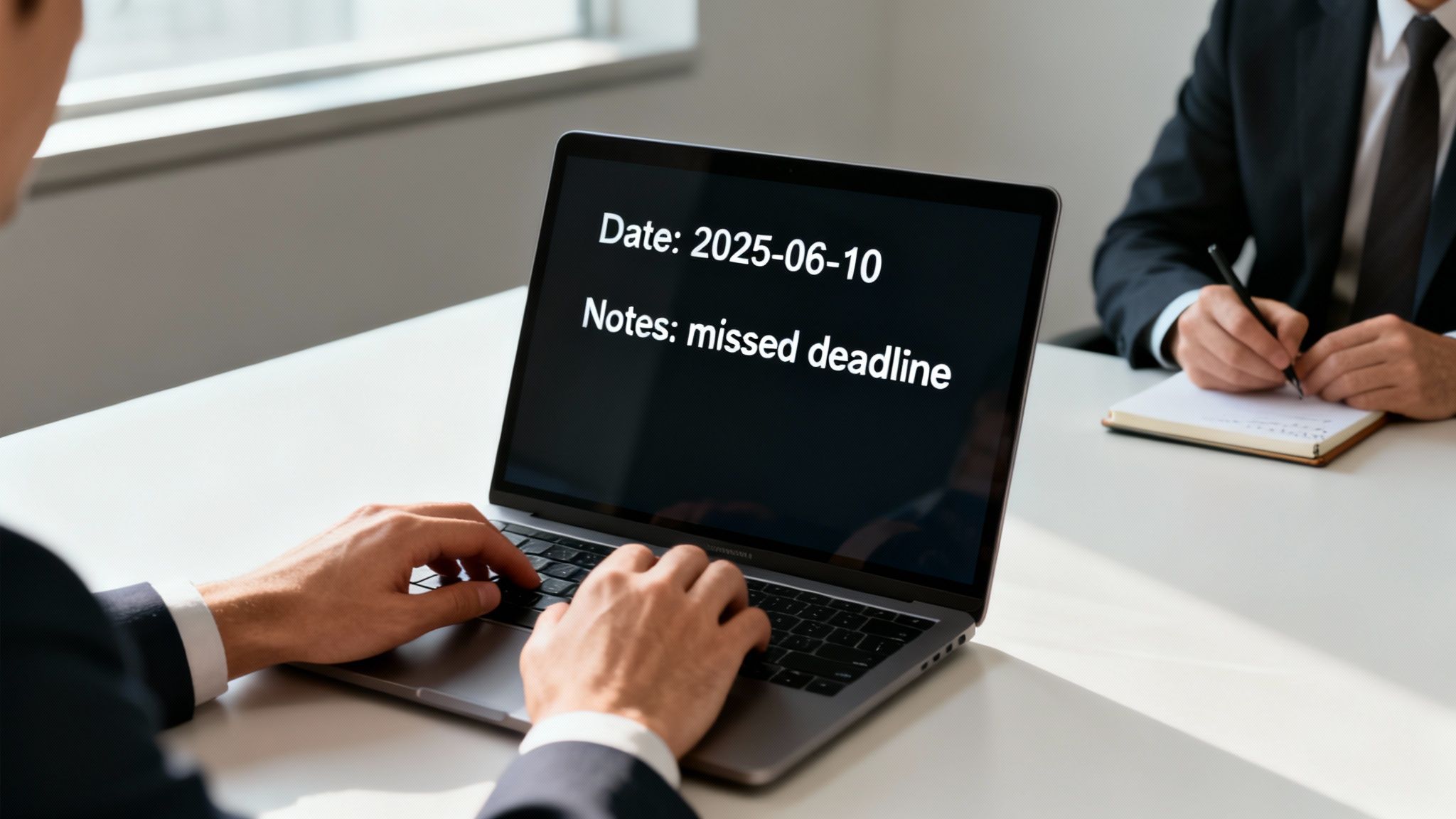
Every entry in your log should be specific. For each incident, you need to record the date, time, and location. Describe the behavior in concrete, objective terms. If you can, quote the exact language used.
Finally, note the direct impact the behavior had on the team’s productivity, morale, or project timelines.
Thorough records are non-negotiable. Our guide on how to write up an employee provides detailed steps for formal documentation if it becomes necessary. This process creates a clear record that supports your position and makes your expectations clear to the employee.
How to Prepare for a Constructive Conversation
A good conversation does not just happen. It is planned. The work you do before you sit down with your employee separates a discussion that drives change from one that ends in defensiveness.
Your goal is to walk into that meeting with clarity, objectivity, and a clear path forward.
You must move past vague feelings like "I'm frustrated" or "they have a bad attitude." You need to get specific and gather documented examples of the behavior. Without this groundwork, the conversation will get emotional, personal, and unproductive.
Use the SBI Model to Structure Your Feedback
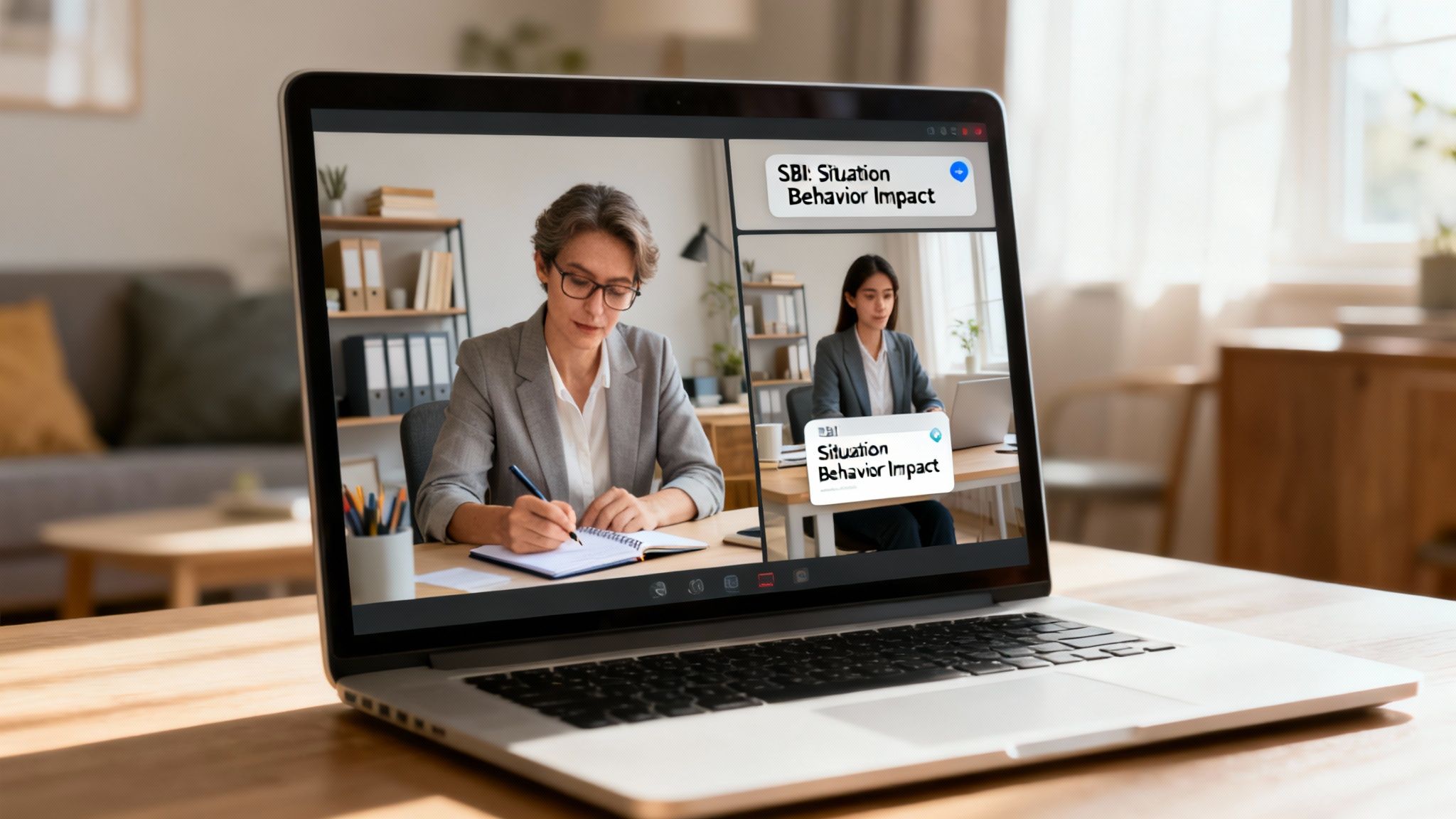
The Situation-Behavior-Impact (SBI) model is a straightforward tool for managers. It is a simple framework that strips judgment out of feedback. It focuses everyone on the facts: what happened and what the result was.
Using this structure keeps the conversation on track. It helps the employee hear what you are saying without feeling personally attacked.
Here is the breakdown:
- Situation: Get specific about the context. Pinpoint exactly when and where the behavior happened.
- Behavior: Detail the employee's observable actions. You must stick to what you saw or heard, not your guess about their motives.
- Impact: Explain the direct consequence of that behavior. This connects their specific action to a real-world outcome for the team, the project, or the business.
For example, you would not say, "You were unprofessional in the client meeting." Instead, using SBI sounds like this: "Yesterday, in the (S) project kickoff meeting with the client, you (B) interrupted the lead designer three times while she was presenting. The (I) impact was that the client seemed confused by the conflicting messages, and we had to spend extra time in a follow-up email clarifying our project plan."
This approach grounds the discussion in reality. The focus shifts from accusing the person to addressing a specific, solvable problem. It opens the door for a real dialogue instead of a confrontation.
Choose the Right Time and Place
The "where" and "when" of your conversation are as important as the "what."
Privacy is non-negotiable. Find a neutral space, like a conference room or an empty office, where you will not be interrupted. Never have this conversation at the employee’s desk or in the open.
Look at the schedule and find a time that allows for a full discussion without anyone feeling rushed. Meetings toward the end of the day work well. It gives the employee time to go home and process the conversation privately instead of sitting at their desk feeling exposed.
You might think your company is good at handling these things, but there is often a disconnect. A study on workplace conflict found that while 70% of employers felt their conflict resolution processes were effective, only 36% of employees who had been through a conflict said the issue was fully resolved.
That gap is why structured preparation and models like SBI are critical. They give managers a real process to follow, which makes a difference. You can read more of the data on workplace conflict resolution here.
Leading an Effective Feedback Session
You have done the prep work. Now it is time for the conversation. The goal here is not to deliver a monologue. It is to open a two-way dialogue where your employee feels heard. Your approach from the first sentence sets the tone for whether this will be a constructive coaching session or a painful confrontation.
Start with a calm, neutral opener. State the purpose of the meeting directly but without accusation. Something as simple as, "Thanks for making the time. I wanted to talk about some things I've noticed over the past few weeks and get your take on how things are going," works well. It is direct, respectful, and opens the door for discussion.
Presenting Your Observations and Listening Actively
Once you set the stage, it is time to share what you observed using the SBI framework you prepared. Stick to one or two of your strongest, clearest examples. Lay out the situation, describe the specific behavior you saw, and explain its impact. Knowing how to give constructive feedback effectively separates managers who get results from those who create resentment.
Then comes the most critical part: stop talking.
After you have presented your observation, pause and create a space for them to respond. Your job now is to listen and understand their side of the story. The behavior you observed is a symptom. You need to find the root cause, which could be anything from a misunderstanding of expectations to a personal issue they are dealing with outside of work.
To get them talking, use open-ended questions that cannot be answered with a simple "yes" or "no":
- "What was your perspective on that situation?"
- "How did you feel that project went from your end?"
- "What are some of the biggest challenges you're facing right now?"
These questions invite them to share their reality. This gives you the context you need to solve the problem. For a deeper look at this, check out our complete guide on how to provide constructive feedback.
Here are a few templates you can adapt to structure your opening statements.
Sample Feedback Scripts Using the SBI Model
Use these templates to structure your feedback for different common scenarios, focusing on objective language.
| Scenario | Situation (S) | Behavior (B) | Impact (I) |
|---|---|---|---|
| Missed Deadline | "During the Q3 project sprint..." | "...I noticed your tasks were marked as incomplete past the deadline, and I didn't get an update." | "...which meant the marketing team couldn't start their part, and we are now at risk of missing our launch date." |
| Dominating Meetings | "In this morning's team planning session..." | "...you spoke over Mark and Jen a couple of times when they were trying to share their ideas." | "...and the impact was that we didn't get to hear their perspectives, and I'm worried we might be missing some good ideas." |
| Poor Quality Work | "When I reviewed the client report you sent over yesterday..." | "...I saw that it was missing the data from the last two weeks and had several formatting errors." | "...so I had to spend two hours correcting it before it could be sent, which delayed my other work." |
Each one is about facts, not feelings. This approach makes it easier to have a productive conversation without putting the other person on the defensive.
Managing Defensive Reactions
No one loves getting critical feedback. Defensiveness is a normal human reaction. They might deny the behavior, blame someone else, or get visibly upset. Your job is to stay calm and professional. Steer the conversation back to the facts. Do not let yourself get pulled into a debate about their intentions or personality.
Keep the focus on observable behavior and its impact. Acknowledge their feelings by saying, "I understand this is difficult to hear," but gently guide the conversation back to the documented examples and the need for a solution.
When conflict is left to fester, it eats away at productivity. A CPP Global study revealed that employees lose an average of 2.8 hours per week to workplace conflict. The same study showed that 95% of employees who received training in conflict management reported it helped them find positive resolutions. By managing this conversation well, you are not just fixing one problem. You are protecting your entire team’s time and energy.
Building a Performance Improvement Plan That Works

When your initial coaching conversations do not spark the change you need to see, it is time to introduce a more formal tool: the Performance Improvement Plan, or PIP.
A PIP is not the first step toward firing someone. It is a structured, supportive roadmap designed to give an employee a clear, documented path back to success. Think of it as translating your verbal feedback into a written agreement that lays out specific gaps in performance and the concrete actions needed to close them.
This plan’s real value is in eliminating ambiguity. It creates a paper trail that holds both you and the employee accountable for the steps ahead.
Setting SMART Goals for Clear Expectations
A PIP without clear goals is a piece of paper. The foundation of an effective plan is the SMART goal framework. This helps you move past vague feedback like "be more proactive" and create specific, actionable targets that directly address the performance issues you documented.
- Specific: What, exactly, needs to change? Pinpoint the desired outcome with precision.
- Measurable: How will you know it is improving? Define success with numbers, percentages, or clear yes/no milestones.
- Achievable: Is this goal realistic given their role and current skills? You are aiming for improvement, not impossibility.
- Relevant: Does this goal matter? It should align directly with their core job duties and the team’s objectives.
- Time-bound: When does this need to happen? Set a firm deadline and schedule regular check-ins.
As you build these goals, it is worth considering if an employee's challenges might connect to neurodiversity. Looking into practical reasonable adjustments for neurodivergent employees is good practice. It can be the key to setting them up for genuine success and ensuring the plan is fair.
Here is a quick look at how you can transform a general problem into a concrete SMART goal within a PIP.
SMART Goal Framework for a PIP
| Goal Component | Example for Missed Deadlines | Description |
|---|---|---|
| Specific | For all projects in Q3, you will submit the final report by the agreed-upon deadline. | Clearly defines the task (submitting reports) and the scope (Q3 projects). |
| Measurable | Achieve a 100% on-time submission rate. We will track this weekly in our project management tool. | Success is easy to measure. Either the report was on time, or it was not. |
| Achievable | You will provide a status update 24 hours before each deadline to flag any potential blockers. | Provides a mechanism to make the goal realistic and proactively address issues. |
| Relevant | Meeting deadlines is a core requirement of your role and is critical for the team's workflow. | Connects the goal directly to the employee's job responsibilities and team impact. |
| Time-bound | This goal will be in effect for the next 90 days, with weekly check-ins every Friday. | Sets a clear start and end date for the evaluation period. |
A well-structured SMART goal removes guesswork and gives the employee a tangible target to aim for.
A well-constructed PIP protects everyone. It gives the employee a genuine opportunity to succeed while providing the company with the necessary documentation if the performance issues continue. It is a tool for clarity, not punishment.
Defining Support and Consequences
A PIP is a two-way street. Your plan must clearly state what support you are committing to provide. This is not just about accountability for them. It is about accountability for you. This could be anything from weekly check-in meetings, access to a specific training course, or a temporary adjustment to their workload to help them focus. Outlining your support shows you are invested in their success.
Letting difficult behavior slide has real costs. One study found that among employees dealing with workplace conflict, 56% reported stress or anxiety, 9% took sick leave, and 5% simply resigned. A PIP is a tool to stop that ripple effect before it gets worse.
Finally, the plan must spell out the consequences of not meeting the goals within the timeframe. This is not a threat. It is about providing total clarity on the seriousness of the situation. To see how all these pieces fit together, our complete guide on performance improvement plans for employees offers templates and detailed examples to help you build one from scratch.
Adapting Your Approach for Remote Employees
Managing a challenging employee you cannot see in person is different. When your team is remote, you lose the subtle, in-person cues that tip you off when something is wrong. A shift in posture or a tense mood in the breakroom is gone. Your entire strategy has to adapt to what you can see: their digital footprint.
Instead of reading body language, you analyze patterns in their digital communication. Are their responses in the team's Slack channel consistently short, negative, or dismissive? Are tasks in your project management tool always updated at the last possible second with minimal detail? These digital breadcrumbs are your new source of objective, documentable facts.
Observing Performance from a Distance
Without the ability to walk by someone's desk for a quick chat, you have to learn how to "manage by walking around" digitally. This means paying closer attention to the data points that signal how engaged and productive someone is.
- Project Management Tools: Keep an eye on task completion rates, the quality of their updates, and if they are hitting deadlines in tools like Asana or Jira. A pattern of missed dates or vague updates tells a story.
- Communication Platforms: Notice the tone and timing of their messages in Slack or Microsoft Teams. A sudden shift to one-word answers, long delays in responding, or consistently unhelpful replies is a clear behavioral signal.
- Meeting Engagement: Who is actively participating on video calls versus who consistently stays silent with their camera off? While not always a red flag on its own, a sudden change from active to passive can point to disengagement.
In a remote world, what is not said or done is as telling as what is. Consistent silence, missed deadlines without any heads-up, or a sudden drop-off in collaboration are all observable behaviors you need to track.
Conducting Feedback Conversations Over Video
Having a tough feedback conversation over a video call is awkward. It is harder to build rapport and create the psychological safety you get when you are in the same room. Because of that, you have to be much more intentional about how you set up and run the meeting.
First, set the stage for a private, focused talk. Ask the employee to find a space where they will not be interrupted and make sure you do the same. It is a good idea to start the call with a minute of small talk to ease the tension before you calmly and directly state the meeting's purpose.
During the conversation, you have to lean into the visual cues you have. Make a point to maintain eye contact by looking at your camera, not just at their face on your screen. It makes a huge difference in how connected they feel. Use active listening cues like nodding and saying things like, "I understand," or "Tell me more about that" to show you are fully tuned in.
Finally, you need to be crystal clear about your expectations moving forward, especially around communication and availability. Document new ground rules for things like response times, meeting attendance, and how you want status updates handled. When you are managing difficult situations remotely, that kind of clarity is your best friend. It removes any ambiguity and gives you a solid, objective way to measure improvement.
Your Toughest Questions Answered
You have done the hard work. You spotted the behavior, prepped for the talk, and built a performance plan. Some situations still leave seasoned managers wondering, "What now?" Here we tackle the tricky questions that pop up at the toughest stages of the process.
The goal is simple: to give you the confidence to handle these final, critical moments fairly and correctly.
What Legal Aspects Should I Consider Before Escalation?
Before you think about termination, you need to be sure your process is legally sound. The single most important thing is consistent and objective documentation. Your records need to tell a clear story of the behavior, your interventions, and the employee's response.
Get your HR department or legal counsel involved early. Do not wait until the last minute. They can be your best partners in reviewing your documentation, ensuring you have followed company policy, and confirming you are not accidentally creating legal risks.
When you connect with HR, make sure you cover these key bases:
- Consistent Policy Application: Have you treated this employee the same way you have treated others in similar situations?
- Absence of Discrimination: Are your actions based only on performance and behavior, with no connection to any protected class?
- Documentation Review: Get a second set of eyes on your notes to ensure they are factual, objective, and free of emotional or biased language.
This is not about bureaucracy. It is about making sure your decisions are based on a fair, established process, not frustration.
Think of HR as your strategic partner in risk management. Involving them is not a sign of failure. It is the mark of a smart manager who understands the importance of process and fairness.
How Do I Manage a Difficult High Performer?
This is the classic management dilemma: the brilliant but difficult employee. Their results are fantastic, but their behavior is toxic. It poisons team culture and drives away your other good people. If you tolerate their behavior because they hit their numbers, you send a clear message that results matter more than respect. That kills culture.
You have to be direct. When you sit down with them, start by acknowledging their contributions. Show them you see and appreciate their value.
Then, you pivot. Use the same SBI framework to address the behavior. Explain the specific, negative impact their actions have on team collaboration, morale, and psychological safety. Frame it as a conversation about their own potential. True high performance is not just about individual results. It is about positively influencing the entire team. Help them see that their behavior is what holds them back from being a true leader.
What if a PIP Shows No Improvement?
When an employee on a Performance Improvement Plan (PIP) does not meet the goals, you have hit a crossroads. The PIP was your structured, supportive, final effort to help them get back on track. If they have not shown the necessary improvement despite the clarity and support, termination is usually the next step.
Your final conversation needs to be direct, professional, and compassionate. Briefly review the PIP goals and the documented lack of progress. Then, state the decision clearly.
- Script your talking points with HR beforehand so you are prepared.
- Keep the meeting short and focused on delivering the decision.
- Do not get drawn into a debate. The decision has been made based on their failure to meet the PIP's terms.
This is the hardest part of being a manager, but it is essential. A study on workplace conflict found that 5% of employees have resigned because of unresolved issues with difficult coworkers. By taking decisive action, you are not just dealing with one employee. You are protecting your entire team's morale and productivity. You are upholding the standards that make your workplace a place where great people want to stay.
Preparing for these conversations is stressful and time-consuming. PeakPerf is a management toolbox that helps you generate structured, professional drafts for feedback, performance plans, and difficult 1-on-1s in minutes. Our guided workflows use proven frameworks like SBI and SMART goals to ensure your communication is clear, fair, and effective. Stop the Sunday night anxiety and walk into your next leadership moment with confidence. Start for free at PeakPerf.


