How to Motivate Underperforming Employees: Practical Steps
Before you motivate an underperforming employee, you must understand the situation. The work is not about demanding more. It is about understanding what is happening. Jumping to conclusions is the fastest way to get it wrong.
Finding the Real Reasons for Poor Performance
Where do you start? The first step is to find the "why" behind the performance gap. We are often tempted to make snap judgments. Acting on assumptions leads to solutions that miss the mark. A great manager knows the difference between an employee who cannot do the work and one who will not.
Poor performance is a symptom of a deeper issue. It could be a misunderstanding of expectations or a personal problem. A structured approach helps you find the cause without letting biases interfere.
The process is simple: observe behavior, confirm your expectations were clear, and then assess if the employee has what they need to succeed.
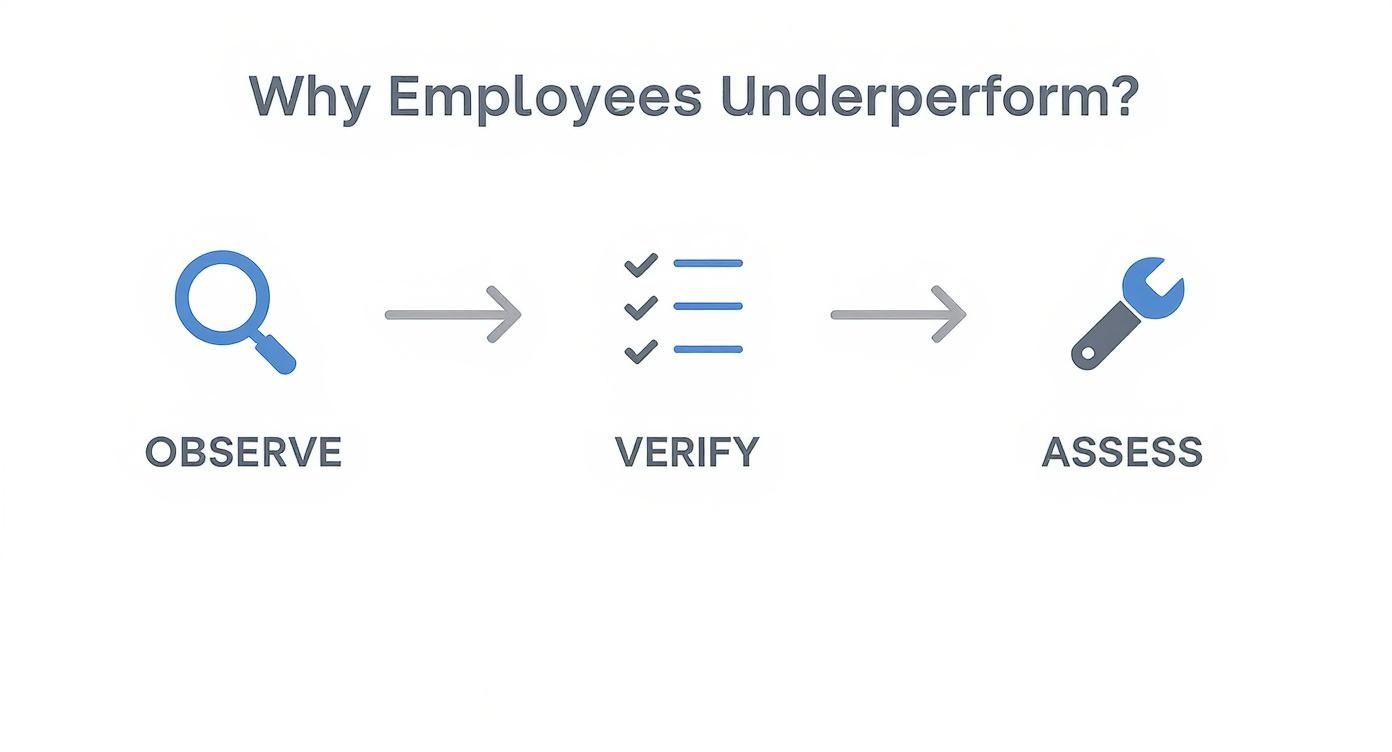
This flow shows your job starts with investigation, not accusation. Follow these steps to solve the right problem from the beginning.
Distinguish Between Ability and Attitude
Your first task is to determine if you are dealing with a skill problem or a will problem. An employee who lacks skills needs different support than one who is disengaged.
Think through these questions:
- Skill Gaps: Did they receive proper training for this part of their role? Have you introduced new software or processes they have not mastered?
- Unclear Expectations: Were the performance standards clearly defined? Do they know what a "good job" looks like for this project?
- Low Morale or Burnout: Are you seeing signs of burnout? Missed deadlines, a drop in quality, or withdrawing from team conversations are red flags.
- Personal Challenges: You must respect their privacy. Consider if something outside of work is draining their energy and focus.
Before forming conclusions, consider the most common reasons an employee's performance might dip.
Common Causes of Underperformance
This table summarizes frequent causes and gives you a starting point for your investigation.
| Cause Category | Potential Reason | Key Question for Manager |
|---|---|---|
| Skill/Knowledge | Inadequate training or obsolete skills. | "Has this person been given the right training to succeed in this task?" |
| Expectations | Vague goals or misunderstanding of priorities. | "Have I clearly and repeatedly communicated what success looks like?" |
| Resources/Tools | Lacking necessary equipment, software, or support. | "Does my employee have everything they need to do their job effectively?" |
| Motivation/Engagement | Burnout, boredom, or feeling undervalued. | "Is this person feeling connected to the team and the company's mission?" |
| Personal Issues | Health problems or external life stress. | "Could outside factors be impacting their ability to focus at work?" |
| Workload | Overwhelmed by an unsustainable amount of work. | "Is the current workload realistic for one person to handle well?" |
Thinking through these possibilities helps you approach the situation with empathy and a problem-solving mindset, not frustration.
Observe Workplace Behavior
Now, gather facts. You need specific, concrete examples of the performance issue. This is required. Vague feelings like "he is lazy" or "she is not a team player" are useless. They are judgments, not observations.
For instance, instead of thinking, "Alex is unreliable," your note should read, "Alex missed the project deadline on Tuesday and did not provide an update until I prompted him on Wednesday morning." One is an opinion; the other is a fact.
This fact-based approach removes emotion and gives you solid data for a conversation. Developing these foundational coaching skills for managers separates a good manager from a great one.
By focusing on observable actions, you shift the conversation from a personal critique to a professional discussion about performance standards. This helps the employee see the issue objectively and reduces defensiveness.
Giving Feedback That Inspires Action

You have done the diagnostic work and have a clearer picture of why the underperformance is happening. Now comes the part that challenges managers: the feedback conversation. The goal is to inspire change, not to make someone defensive.
The secret is to build your feedback on specific, fact-based examples.
Vague statements like "you need to be more proactive" are useless. They are open to interpretation and give the employee nothing concrete to work with.
Let us reframe that. Instead of saying, “Your communication needs work,” try this: “On the Q3 report, the team was blocked for two days because we were waiting for your data. In the future, I need you to communicate any delays at least 24 hours in advance.” You have shifted the focus from a fuzzy personal trait to a specific, correctable behavior. Preparation makes a difference in these conversations.
Preparing for the Conversation
Do not improvise. Rushing into this talk unprepared leads to a conversation that goes sideways fast. Your prep work ensures the dialogue stays on track, remains productive, and feels fair.
- Gather Specifics: Find at least three distinct, recent examples of the performance issue. Note the date, the project, and what happened.
- Define the Impact: For each example, be clear about its effect. How did it affect the team, a project, or a customer? This connects their actions to the bigger picture.
- Choose a Private Setting: Never give corrective feedback in public or in an open-plan office. Book a private room where you will not be interrupted.
- Plan Your Opening: Think for a minute about how you will start the meeting. A calm, direct opening sets a professional, non-confrontational tone from the start.
This preparation is not only for you. It shows the employee that you have taken their performance seriously enough to think through the issues carefully.
Structuring the Feedback Dialogue
How you structure the conversation is as important as what you say. Your goal is a collaborative dialogue, not a confrontation. Start by stating the purpose of the meeting clearly and calmly.
A simple opener works best: "Thanks for meeting with me. I want to talk about your work on the client onboarding project and discuss some areas for improvement." It is direct, professional, and gets to the point.
After you present your specific examples, pause and ask for their perspective. Use open-ended questions like, “What is your view of how that project went?” or “What challenges did you run into with that task?” You must listen to their side of the story. They might share information you were unaware of, like a process bottleneck or a lack of resources.
The most productive feedback sessions are two-way conversations. When an employee feels heard and respected, they are more likely to take ownership of the solution and commit to changing their behavior.
The frequency of these talks is a lever for motivation. Employees who receive frequent feedback are more likely to feel engaged and ready to improve. And with 65% of employees wanting more communication with their managers, this is a huge opportunity. This makes a case for turning feedback from a scary, annual event into a regular, supportive habit.
Building an Effective Improvement Plan Together
You have had the tough conversation. The feedback is on the table. Now what? The next move separates managers who see change from those who get stuck in a frustrating cycle.
Do not hand down a generic plan. That almost never works. The secret is to build the path forward with them, not for them.
This is not about being nice. It is about ownership. When an employee helps design their own comeback plan, they are more bought-in. It reframes a daunting Performance Improvement Plan (PIP) into a supportive, shared mission to get them back on track.
Your objective here is to land on concrete actions, define what success looks like, and set a timeline. This alignment is everything.
Use the SMART Goals Framework
The best tool for this job is the SMART goals framework. It is a classic for a reason. It strips out ambiguity and gives both you and your employee a clear, actionable roadmap.
Here is a quick refresher on what makes a goal SMART:
- Specific: No fuzzy language. Instead of "get better at communication," you need something like, "Send a weekly project status update email to the team every Friday by 4 PM."
- Measurable: How will you track it? For a salesperson, a measurable goal is to "increase outbound calls by 15% over the next 30 days."
- Achievable: Be realistic. Setting an ambitious goal is a recipe for failure and will crush their motivation.
- Relevant: Does this goal directly fix the performance gap? Does it matter to the team's bigger objectives? It must.
- Time-bound: Every goal needs a finish line. A deadline creates urgency and gives you both a clear date to review progress.
Using this structure turns a vague hope for improvement into a tangible target.
From Vague Goals to Clear Actions
Let us make this real. A lot of performance feedback starts out vague. Your job, in this collaborative session, is to sharpen it into something an employee can execute.
| Vague Goal | SMART Goal |
|---|---|
| "Be more of a team player." | "Volunteer to lead one agenda item in our weekly team meeting each month for the next quarter." |
| "Get better at managing your time." | "Complete all assigned tasks in our project management tool by their due date for the next 60 days, with zero overdue items." |
| "Pay more attention to detail." | "Reduce errors in client reports to less than 2% on average over the next 30 days, as measured by our peer review checklist." |
The SMART goals column gives the employee something they can do.
When you build a plan together, you move from being a manager who dictates terms to a coach who provides support. This partnership is often the missing ingredient in turning performance around.
Agree on Resources and Check-Ins
A plan without support is a wish list. You have to ask the critical question: "What do you need from me, or from the company, to hit these goals?"
Their answer might be access to a software tool, an online course, or more frequent one-on-one coaching with you. Agreeing on that support shows you are invested in their success, not in pointing out their failures.
Finally, before you wrap up, get the follow-up meetings on the calendar. Schedule short, weekly check-ins to review progress, celebrate small wins, and tackle any roadblocks. This steady rhythm of communication keeps a plan alive.
Using Recognition to Keep the Momentum Going

You have co-created an improvement plan, and your employee is starting to make progress. Your job is not over. Your focus is keeping that positive momentum alive.
Acknowledging progress is a way to motivate an employee who is turning things around. It reinforces the new behaviors you want to see and shows them their effort is not going unnoticed.
This is not about celebrating every minor win. It is about giving timely, specific praise that connects their improved actions to good outcomes. This creates a feedback loop where they see their hard work is valued, which helps rebuild their confidence and keeps them on track.
The Difference Between Empty Praise and Real Recognition
We have all heard a generic "great job this week." It is nice, but it does not drive performance because it lacks substance. Impactful recognition gets specific. It ties a particular action to a result.
Instead of a vague compliment, try something more concrete. For instance, "Sarah, I noticed you sent the project update email ahead of schedule this Friday. That gave the design team the extra time they needed to get ahead, which was a huge help." Now you show you are paying attention to the details.
This kind of specific feedback reinforces the exact behaviors you outlined in their development plan. It proves you are as invested in celebrating their progress as you were in addressing the initial problem. That balance builds trust and proves you are a supportive coach, not a critic.
When recognition is specific and linked to a positive business outcome, it moves from a simple compliment to a strategic tool for motivation. It clarifies what 'good' looks like and encourages the employee to repeat that behavior.
Data supports this. Research shows that employees who feel seen for their efforts are more likely to improve. According to some employee recognition and motivation statistics, organizations with structured recognition programs see a significant increase in employee engagement. What is more, many employees who get regular recognition say they feel more motivated to go above and beyond.
Practical Ways to Show Recognition
Recognition does not have to be a line item in your budget. Informal, sincere acknowledgment is often more meaningful than a formal award. The key is to be consistent and authentic. Find what feels natural for you and your team.
Here are a few simple ways to maintain that forward motion:
- Public Praise in Team Meetings: A quick, specific shout-out during a team huddle can be motivating. "I want to thank Ben for catching that data error in the Q3 report. His attention to detail saved us from sending incorrect information to the client."
- One-on-One Acknowledgment: Start your weekly check-ins by highlighting a specific win from the past week. It sets a positive tone and immediately reinforces their progress.
- A Simple Thank-You Note: A short email or even a handwritten note detailing a specific contribution can have a huge impact. It shows you took the time to stop, reflect, and appreciate their effort.
These small, consistent acts of recognition send a clear signal: their journey back to high performance is a shared priority. It helps them rebuild their professional reputation and solidifies their place as a valued member of the team.
Build an Environment Where People Want to Perform
An employee's motivation is tied to the environment you create. When performance dips, it is rarely because someone became lazy. The culprits are often burnout or a feeling that it is not safe to fail.
Building a supportive culture is not a "nice-to-have." It is the most proactive thing you can do to keep your entire team performing well.
Your job is more than assigning tasks and checking boxes. It is about creating a space where people feel secure, valued, and able to switch off. When you get that foundation right, engagement and high performance follow.
Champion a Real Work-Life Balance
You cannot expect sustained motivation from a team that is running on fumes. When people feel like they can never disconnect, their work will suffer. Your actions speak louder than any corporate wellness poster.
It starts with simple, consistent habits.
Avoid sending emails or messages after hours unless it is a true emergency. Publicly encourage your team to take their full lunch break away from their desks. Make it clear that vacation time is there to be used, not accumulated. When you lead by example, you give your team permission to do the same.
Make It Safe to Struggle
Psychological safety is the bedrock of a high-performing team. It is the shared belief that you will not be punished or humiliated for speaking up with ideas, questions, mistakes, or admitting you are struggling.
In a psychologically safe culture, an underperformer is more likely to raise their hand and say, "I am in over my head," giving you a chance to solve the problem before it grows.
How do you build it? Start by changing how you talk about mistakes. Frame them as learning opportunities, not failures. When a project goes sideways, your first question should not be, "Who is to blame?" but rather, "What can we learn from this?"
Creating a culture where it is okay to be vulnerable encourages people to take smart risks and be honest about what they can handle. That transparency is your best early-warning system for performance issues.
Offer Flexibility and Tangible Support
The data on this is clear. The 2025 Gallup State of the Global Workplace report found that a low percentage of employees feel actively engaged at work.
The upside is that companies that offer mental health support and flexible work see a boost in motivation and a drop in absenteeism. Those offering flexible schedules report a jump in employee satisfaction. You can find more employee motivation statistics that confirm these trends.
The message is simple: flexibility is a direct line to better morale and performance. Where you can, consider options like flexible start times or hybrid models. These are not perks. They are signals of trust. They show your team you respect them as adults who can manage their own time, which strengthens their commitment to you and their work.
Common Questions About Employee Motivation
Even with the best plan, you will face tricky situations when trying to turn an underperforming employee around. Knowing how to handle these common issues keeps the process fair, respectful, and on track.
Here is how to navigate some frequent questions from managers.
What if the Employee Denies There Is a Problem?
This is tough, and it happens often. The minute an employee disagrees with your assessment, a wall of defensiveness goes up. The conversation stops. Avoid getting pulled into a debate over feelings or perceptions.
Do not argue. Calmly bring it back to the objective, fact-based examples you prepared. Your job is not to win them over to your point of view. It is to state the observable gap between their work and the clear expectations of the role.
You might say, "I understand we are seeing this differently, but the data shows that three of your last five reports had significant errors. We need to focus on how we can get that error rate down to the team standard of one percent." This reframes the conversation. It is not about their denial anymore. It is about the undisputed facts and the shared goal of finding a solution.
When an employee pushes back, your best tool is objective evidence. It moves the discussion away from a personal disagreement and back to professional standards and measurable outcomes.
How Do I Manage the Impact on the Rest of the Team?
An underperformer does not work in a vacuum. Your top people usually spot the problem long before you address it. Their frustration builds as they feel they are picking up the slack. Left unchecked, this can tank team morale.
Your mission is to handle the situation discreetly while signaling to the rest of the team that you are on it. You should never discuss one person's performance with their colleagues. That is a breach of trust.
What you can do is address the team’s workload challenges more broadly. In a team meeting, you might acknowledge everyone's hard work on a tight deadline and then temporarily reassign a few critical tasks to ensure things get done. This shows you are aware of the pressure and are managing the workflow. It reassures your team that fairness and accountability matter.
When Is It Time to Consider if the Role Is a Good Fit?
Sometimes, despite your efforts, an employee keeps struggling. You have given clear feedback, you have coached them, you have run a fair improvement plan, and you see little to no progress. At this point, it is time to consider a different problem: a mismatch between the employee’s skills and what the job demands.
It is possible to have a talented professional who is in the wrong role. If you have exhausted all supportive options and performance has not hit the minimum standard you laid out in their PIP, it is time for a different conversation.
This talk is not about another warning. It is about exploring whether another role in the company is a better match for their strengths. Or, if not, it is about frankly discussing whether it might be best for them to find a position elsewhere that is a better long-term fit for their career.
Trying to script these tough conversations can be stressful. PeakPerf helps you prepare for critical leadership moments with guided workflows for feedback, performance plans, and difficult one-on-ones. Build clear, fair, and effective talking points in minutes, so you can lead with confidence. Learn more and get started for free.


