
How to Give Constructive Feedback That Inspires Growth

Giving constructive feedback can be difficult. Many managers avoid it. They worry they will demotivate someone or start a conflict.
That hesitation holds your team back. When people do not get clear guidance, they guess. They do not know if they are on the right track or what they need to do to improve.
Stop thinking of feedback as a confrontation. Start seeing it as a tool for growth. When you deliver feedback the right way, it clarifies expectations, builds confidence, and strengthens your relationship with your team member.
The Foundation of Effective Feedback
This is not about criticism. It is about coaching. Your goal is to help your people win. That shift in mindset changes the conversation.
Shift from Critic to Coach
What is the difference between criticism and constructive feedback? The difference is your intent and how you speak.
Criticism is personal and focuses on the past. It sounds like, "You are so disorganized." It is a dead end.
Constructive feedback is about specific actions and future steps. It sounds like, "I noticed a few deadlines slipped on the project last week. Let's map out a better way to track tasks for the next phase." This approach requires you to act as a coach. Improving your coaching skills for managers will make this feel natural.
When you take a coaching stance, you build psychological safety. Your team understands your goal is their development. This makes them more open to what you say. Feedback stops feeling like an attack and starts feeling like a resource.
Before explaining how to give feedback, let's define the core principles that separate helpful coaching from unhelpful criticism.
| Principle | What It Means | Why It Matters |
|---|---|---|
| Be Specific | Focus on observable behaviors, not personality traits. Use specific examples. | Vague feedback is confusing and impossible to act on. Specificity provides a clear target for improvement. |
| Stay Objective | Describe what you saw or heard, without adding judgment or assumptions about intent. | Objectivity lowers defensiveness. It keeps the conversation focused on facts, not feelings. |
| Make It Actionable | Offer clear, forward-looking suggestions or collaborate on next steps. | The goal is improvement. Actionable advice gives the employee a path forward. |
| Deliver with Empathy | Show you care about the person's growth and success. Your tone should be supportive. | Empathy builds trust and shows your intent is to help, not to blame. |
| Ensure It Is Timely | Provide feedback close to the event, when the details are fresh. | Timely feedback is more relevant and easier to learn from. It prevents small issues from growing. |
These principles are the pillars of a feedback culture that works. Keep them in mind to transform tough conversations into productive ones.
The Impact of Consistent Feedback
Infrequent feedback creates problems. If your team only hears from you during a formal performance review, you create an environment of anxiety. Minor issues grow into major problems.
Regular, consistent check-ins create a continuous improvement loop. You can make small course corrections, keeping everyone aligned and building momentum. This is more efficient and less stressful for everyone.
The most effective feedback is timely, specific, and forward-looking. It addresses a situation while it is still relevant. It gives the employee clear examples to understand the issue. It focuses on what they can do differently next time.
Data supports this, especially with younger workers who want guidance. A high number of Gen Z employees, 63%, say they want to receive timely, constructive feedback regularly. More than half of millennials want constant feedback. Only 1% say it is unimportant. Your team wants this from you more than you think.
When you commit to providing regular feedback, you send a clear message: you are invested in their careers. That investment builds loyalty, motivation, and a high-performing team.
Preparing for the Feedback Conversation
Great feedback requires preparation. A productive conversation starts with thoughtful planning before you meet with your employee.
If you improvise, you risk rambling, getting emotional, or missing the point. When you prepare, you send a clear message: "I respect you and I am invested in your success." That act can transform a tense talk into a focused, collaborative discussion about growth.
Gather Specific Examples
You need to focus on facts, not feelings. Vague feedback like "you need to be more proactive" is frustrating because it is impossible to act on. You need to anchor your conversation in specific, observable behaviors.
Spend time reviewing recent projects, performance data, or your own notes. The goal is to find specific, non-judgmental instances that illustrate your point.
- Vague: "Your communication needs work."
- Specific: "In Tuesday's project update email, the key deadlines were missing. This caused confusion for the design team."
- Vague: "You seem disengaged in meetings."
- Specific: "During the marketing sync yesterday, you were on your phone when your part of the presentation came up, and you were not ready to answer questions."
This is not about building a case against someone. It is about grounding the conversation in reality so you can solve a real problem, not debate personalities or intentions.
Clarify Your Intent
Before you schedule the meeting, clarify your own goal. Why are you having this conversation? Your primary intent should always be to help your employee grow and succeed, not to vent or assign blame.
Ask yourself these questions:
- What is the ideal outcome?
- How will this feedback help the employee, the team, and our goals?
- What specific positive behavior do I want to see in the future?
When your intention is helpful, your tone and body language will reflect it. Your employee is more likely to listen if they feel you support them. A clear goal keeps the conversation forward-looking and solutions-focused.
The most effective feedback is delivered with positive intent. Your employee should walk away feeling you are invested in their growth, not that you are looking for faults. This changes the dynamic from an accusation to a collaboration.
Plan the Logistics
The "where" and "when" of a feedback conversation are important. The right setting makes your team member feel safe and respected. The wrong one puts them on the defensive before you speak. Rushing the talk or holding it in a busy cafe sends the wrong message.
Your preparation should also include a clear structure for the conversation. Having a simple plan ensures you cover all your points without getting sidetracked. Consider using a clear agenda for a one-on-one meeting to keep the discussion on track and productive.
Here is a final checklist for logistics:
- Choose a Private Setting: Book a conference room or find a quiet space where you will not be interrupted. Do not give critical feedback in an open office.
- Schedule Enough Time: Block off at least 30 minutes. This prevents everyone from feeling rushed and leaves room for a real discussion.
- Anticipate Reactions: Think about how the employee might react. Will they be surprised? Defensive? Upset? Preparing for potential responses helps you stay calm and guide the conversation back to a productive place.
Proven Frameworks for Structuring Your Feedback
Giving feedback without a clear structure can become messy. It is easy to get off-track, make it personal, or leave the other person feeling confused and defensive. Using a proven framework is like having a map for the conversation. It keeps you focused, objective, and collaborative.
Think of these models as guardrails, not rigid rules. They help you turn an awkward chat into a productive dialogue, ensuring your message lands as intended.
The Situation Behavior Impact Model
The Situation-Behavior-Impact (SBI) model is a good choice for most feedback conversations. It is simple and effective because it forces you to separate the person from the problem.
It breaks the feedback into three parts:
- Situation: First, you ground the conversation in a specific time and place. This is not a vague generalization. It is about a real, shared moment.
- Behavior: Next, you describe exactly what you saw or heard, the observable action, without judgment or interpretation.
- Impact: Finally, you explain the consequence of that behavior on you, the team, or the business.
Say you have a team member who tends to talk over clients. Instead of the vague and accusatory, "You dominated the client meeting," SBI gives you a much better way to phrase it.
Situation: "During the client kickoff meeting this morning..."
Behavior: "...you spoke over the client a few times while they were describing their pain points."
Impact: "...and I noticed they became quiet and less engaged afterward. I am concerned we missed hearing some of their key concerns."
This feels different. It is non-confrontational. You are not guessing their intent. You are stating what happened and what the result was. This makes it easier for them to hear the feedback without becoming defensive, opening the door for a real conversation.
The Describe Express Specify Consequences Model
For more difficult issues or patterns of behavior, the Describe-Express-Specify-Consequences (DESC) model offers a more robust structure. It is useful when a recurring problem needs a clear resolution.
DESC guides you through four steps, moving from defining the problem to agreeing on a path forward.
- Describe: Start by objectively laying out the situation and the specific behavior you have observed. Stick to the facts.
- Express: Using "I" statements, explain the impact the behavior has on you or the team. This is about your perspective.
- Specify: Be direct and clear about the change you need to see. This must be an actionable request.
- Consequences: Frame the positive outcomes that will result from the change. This helps them see the "why."
Imagine a team member is consistently missing deadlines. Here is how you would use DESC to address it:
Describe: "Over the last month, you have missed three of the four project deadlines we agreed upon."
Express: "I feel concerned because when your tasks are late, it creates a bottleneck and puts the rest of the team under pressure to catch up."
Specify: "Moving forward, I need you to complete your assigned tasks by the deadlines we set in our project management tool. If you think you might be late, I need you to communicate that with me at least 48 hours in advance."
Consequences: "If we do that, our projects will run much more smoothly, and the team will feel less stressed. It will also show me that I can rely on you to manage your workload effectively."
This model removes all ambiguity. There is no room for misunderstanding the problem, the solution, or the benefits of getting it right.
Remember, none of these frameworks work if you start the conversation without preparation.
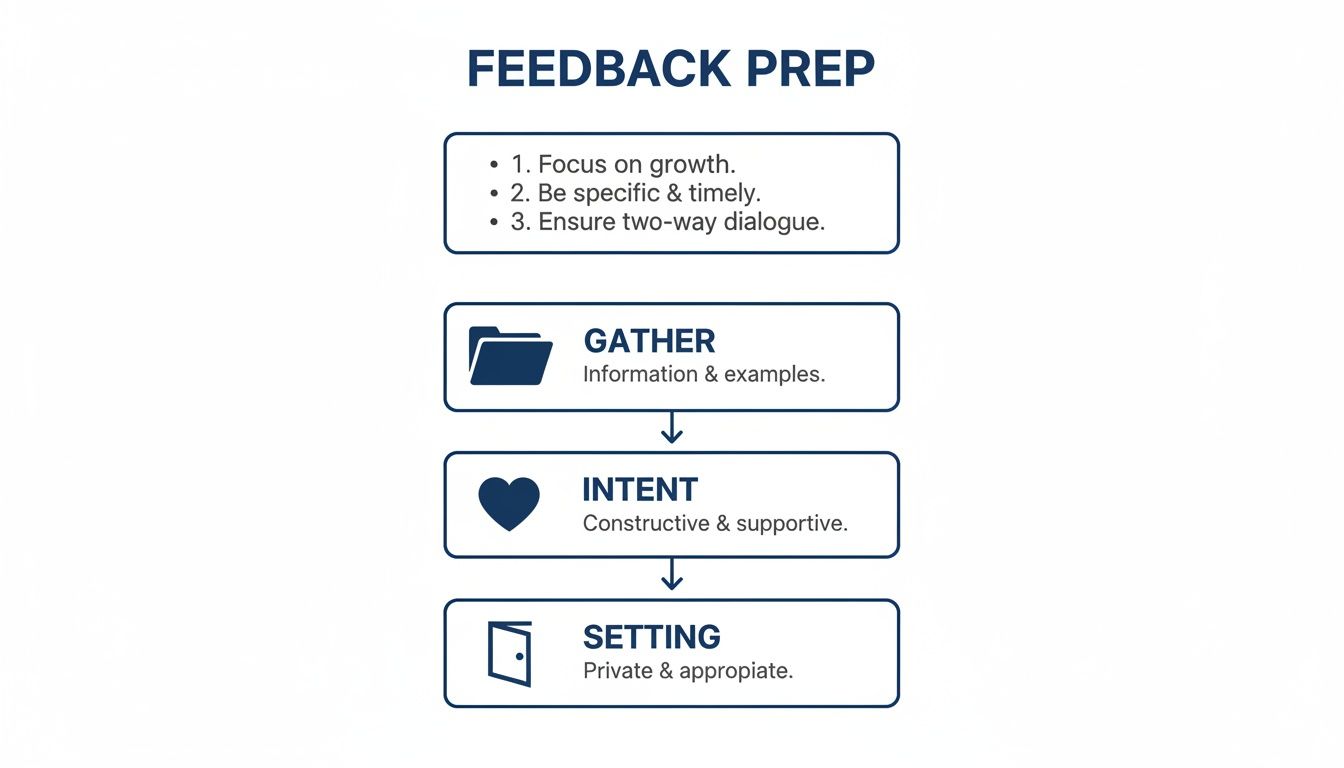
This preparation, gathering your facts, clarifying your intent, and picking the right time and place, is what makes the delivery successful.
The Feedforward Model
While SBI and DESC look back at what happened, Feedforward is about the future. It shifts the dynamic from critiquing the past to brainstorming for the future. This approach works well with high-performers who are eager to grow, or in situations where rehashing a mistake is not productive.
The core idea is simple: coach for what is next, do not dwell on what is done.
Let's say an employee gave a presentation that was fine, but you know it could have been better. Instead of finding fault, you can use Feedforward.
"That presentation was a great start. Thinking ahead to the all-hands meeting next quarter, what are two or three things we could do to make your presentation even more engaging for the audience?"
This question immediately makes it collaborative. You are not a critic. You are a partner in their success. Feedforward is a great tool for developmental coaching, helping your best people get even better.
Comparing Feedback Frameworks
Choosing the right framework depends on the situation and your goal for the conversation. Each model has its own strengths.
| Framework | Best For | Key Focus |
|---|---|---|
| SBI | Quick, in-the-moment corrections and recognizing specific positive behaviors. | Describing an observable event and its direct result without judgment. |
| DESC | Addressing more complex, recurring behavioral issues or setting clear expectations. | A structured dialogue that moves from problem to agreed-upon solution. |
| Feedforward | Coaching high-performers and focusing on future development rather than past mistakes. | Brainstorming future possibilities and solutions collaboratively. |
Having these frameworks in your toolkit gives you the flexibility to adapt your approach. You can pick the one that feels most natural for the conversation, ensuring your feedback is not only heard but also acted upon.
Navigating Difficult Reactions and Pushback
You can do everything right, prepare with care, choose the perfect words, deliver feedback with the best intentions, and still get a difficult reaction. It happens. The real test of your leadership is not in preventing pushback, but in how you handle it when it arrives.
When faced with defensiveness, denial, or tears, your instinct might be to argue back or end the conversation. Do not. Your primary job is to stay calm and steer the discussion back to solid ground. Your reaction in this critical moment will determine whether this conversation leads to growth or resentment.
This is not about winning an argument. It is about being heard, understanding their side, and charting a path forward together.
Stay Calm and Practice Active Listening
When an employee gets angry or upset, your first move is your most important one: listen. Resist the urge to jump in and defend your point.
Active listening is more than staying quiet. It is a tool for de-escalation. It signals that you respect their perspective, even if you do not agree with it. It shows you are engaged by summarizing what you are hearing and asking questions to make sure you understand. This simple act can make an employee feel seen, not criticized.
Here are a few ways to put it into practice:
- Paraphrase their feelings: "It sounds like you feel this feedback is unfair, especially since you were waiting on the marketing team for their input."
- Acknowledge their perspective: "I can see how it would look that way from your position."
- Ask open-ended questions: "Can you walk me through your thought process on that part of the project?"
These phrases are not concessions. They confirm you have heard them. And it works. A recent study found employees who feel heard are 4.6 times more likely to feel empowered to do their best work.
Use De-escalating Language
When emotions are high, your choice of words can either add fuel to the fire or put it out. Avoid accusatory phrases like "you always" or "you never," which will make someone defensive.
Instead, keep the focus on "I" statements and observable behaviors. This is not about judging their character. It is about discussing the facts of a situation and its consequences.
Your job is to acknowledge the employee's feelings without retracting the core message of the feedback. Stay firm on the "what" (the issue) but flexible on the "how" (the solution). This balance is critical for maintaining trust and authority.
Try some of these phrases to get the conversation back on a productive track:
- "I appreciate you sharing that with me. Let's focus on how we can address this moving forward."
- "My intention is not to place blame. My goal is for us to find a solution together."
- "Let's set the disagreement aside for a second and look at the impact this had on the project deadline."
This language validates their feelings while gently but firmly returning the focus to the problem you need to solve. It shifts the dynamic from a confrontation to a shared challenge.
Redirect to a Solutions Focus
Once you have listened and the initial emotion has subsided, it is time to pivot. Dwelling on the disagreement will not get you anywhere. The point of constructive feedback is to improve things for the future.
After an employee feels heard, they are usually much more open to problem-solving. You can guide them in that direction with collaborative, forward-looking questions. This shift helps them regain a sense of agency and shows you see them as a partner in the solution, not the source of the problem.
Here is how to make that pivot:
- Validate and Redirect: Start with something like, "Thanks for explaining your side. That helps me understand. Given the project goals, what is one thing we could do differently next time to make sure the client gets the updates on schedule?"
- Ask for Their Input: Follow up with, "What support do you need from me to make that happen?"
- Agree on a Next Step: Lock in a clear action. "Okay, so we agree that for the next phase, you'll send a draft of the client update to me for review 24 hours before it goes out. Is that right?"
By steering the conversation toward specific, actionable steps, you turn a difficult moment into a productive outcome. You have reinforced the feedback, and you have empowered your employee to own the solution. That is how you build people up, not tear them down.
Creating Actionable Follow-Up Plans

A feedback conversation without a follow-up plan is just a talk. If you want to see real change, you must close the loop with clear, agreed-upon next steps. This part of the discussion turns good intentions into concrete action and proves you are invested in their success.
The key is to make it a collaboration. Do not just hand down a plan. Co-create it with your team member. That simple shift builds ownership and accountability from the start.
Define Clear Next Steps Together
Once you have discussed the feedback and you are both on the same page about the issue, it is time to pivot toward the future. Your role here is not to have all the answers, but to guide the brainstorming.
A few simple questions can get the process started:
- "Based on our chat, what is one thing you could try doing differently next week?"
- "What kind of resources or support from me would help you make this shift?"
- "If we look ahead 30 days, what does a successful outcome look like to you?"
This approach makes the employee an active driver of their own development. It shows you respect their ability to problem-solve and empowers them to find solutions that will stick.
The goal here is not just to fix the immediate problem. It is to build your employee's capacity for solving their own problems. By asking questions instead of giving commands, you are coaching them to think critically about their performance and growth.
Use the SMART Goal Framework
Once you have a few ideas, give them structure with the SMART framework. This is how you make sure every action item is practical, clear, and easy to track. A fuzzy goal like "get better at communication" is useless. SMART goals give you a finish line.
Let's quickly break it down:
- Specific: What exactly needs to be done? Who is involved?
- Measurable: How will we track progress? What numbers or metrics tell us we have succeeded?
- Achievable: Is this goal realistic right now, given their skills and our resources?
- Relevant: Does this directly address the feedback and help us hit our team goals?
- Time-bound: What is the deadline?
For example, that employee who needs to improve project updates? Instead of "be more communicative," their SMART goal becomes: "By the end of each week, I will post a summary of my project's progress, risks, and next steps in our shared team channel." See the difference? There is no more ambiguity.
If you want to go deeper on this, we have a complete guide on how to write a development plan that builds on these principles.
Document and Schedule Check-ins
This final piece is non-negotiable. You have to document the plan and schedule your next conversation. Writing it down creates a shared record of your agreement and prevents any "I thought you meant..." confusion later.
Send a quick follow-up email summarizing the chat and the SMART goals you both agreed on. It reinforces your commitment and gives you both something to refer back to.
Most importantly, schedule your next check-in before you leave the room. Put it on the calendar. This single action sends a signal: this conversation is not over. It is the start of an ongoing process of support and accountability.
This consistency is important for engagement. Research shows that 80% of employees who got meaningful feedback in the past week are fully engaged. Consistent follow-up keeps the conversation alive and turns a one-time meeting into a cycle of continuous improvement.
Fielding the Tough Questions on Feedback
Even with the best frameworks, some feedback situations feel tricky. Knowing what to say often comes down to handling these unique moments with confidence. Let's walk through a few of the most common challenges managers face.
What if I Have No Positive Feedback to Give?
This is a tough spot, and it happens. When an employee’s performance is struggling across the board, forcing a compliment feels fake. It will kill your credibility.
Instead of manufacturing praise, pivot. Focus the conversation on your intent and the future.
Your opening can still be supportive without being dishonest. It is all about framing the conversation around a shared goal.
- Try starting with purpose: "Thanks for meeting with me. I wanted to talk about your role and how we can work together to get you on a path to success here."
- Or express your concern directly: "I am concerned about your performance in a few key areas, and my goal for our chat today is to create a clear plan to help you get back on track."
This approach keeps the tone positive and forward-looking but avoids the pitfall of false praise. You are framing the discussion around solutions, not a list of problems, which is critical for getting their buy-in.
How Do I Give Feedback to Someone More Senior Than Me?
Giving feedback to a senior employee, or even a peer with more experience, requires a different touch. The key here is to reposition yourself. You are not their manager. You are a colleague with a unique perspective.
Frame your feedback as an observation, and keep the focus on the impact on the team or the business. Drop any language that sounds like you are telling them what to do.
Think collaborative, not corrective.
- Focus on shared goals: "I wanted to get your thoughts on the client presentation. I noticed we seemed to lose some engagement in the second half, and I have an idea for how we might structure it next time to keep the momentum going."
- Ask for their perspective: "Could you walk me through the thinking behind the new project timeline? I want to make sure I fully understand it so I can support the team in the best way possible."
You are positioning yourself as a helpful observer, offering insights to reach a common goal. It is less about criticism and more about partnership.
What if the Feedback is About Something Personal?
The dreaded personal issue, body odor, unprofessional clothing, you name it. These conversations are high on the discomfort scale, but ignoring them is not an option. Your job is to be discreet, direct, and tie the issue directly back to the professional environment.
- Be Private and Direct: This is non-negotiable. Find a completely private space. State the issue calmly and as a simple fact. "I need to discuss something sensitive with you. I have noticed a strong body odor recently, and it is starting to impact those working nearby."
- Focus on Workplace Impact: Immediately connect it to professional expectations. "Our company policy requires a professional standard of hygiene for everyone, and it is important we all stick to that to maintain a comfortable environment."
- Offer Support: The goal is to help, not to shame. "I want to support you. If there is something going on that I should be aware of, I am here to listen."
Handle these moments with empathy, but do not avoid the topic. You are a manager, and you are also the steward of a respectful and professional workplace for everyone else.
Feedback about sensitive personal issues is not about judgment. It is about upholding professional standards and ensuring a comfortable work environment for the entire team. Your role is to be a direct, respectful messenger.
How Soon is Too Soon to Give Feedback to a New Hire?
You should start giving new hires feedback almost immediately. The key is that in the beginning, it is all about guidance and coaching, not correction.
In those first 30 to 90 days, your new team member is trying to figure out the rules. Your feedback is the GPS that helps them learn your team’s norms and expectations.
- Focus on clarification: "This is a great start on the report. For future ones, let's make sure to pull in the data from the main sales dashboard, too. Let me show you exactly where to find it."
- Reinforce the right behaviors: "I liked how you jumped in to help Alex with that ticket yesterday. That kind of teamwork is exactly what makes our team successful."
Think of it as frequent, low-stakes calibration. It helps new hires learn the ropes faster and prevents small misunderstandings from turning into bad habits.
Feeling a knot in your stomach before a tough conversation is normal. With PeakPerf, you can turn that anxiety into confidence. Our guided workflows help you prepare for any feedback session, performance review, or one-on-one in just a few minutes. We use proven models like SBI to make sure your message lands clearly, fairly, and effectively.
Stop staring at a blank page and start leading your most productive conversations. Check it out at https://peakperf.co.


