
A Manager’s Guide to Performance Improvement Plans for Employees
A Performance Improvement Plan, or PIP, is a formal document. It is a structured conversation designed to help a struggling employee succeed. A PIP is a clear roadmap that lays out specific performance problems. It defines what success looks like and details how you will help the employee improve.
A PIP is not the first step toward firing someone. It is a genuine effort to improve performance and keep the employee. You use a PIP when coaching sessions and informal chats have not worked. A PIP provides a more concrete plan of action.

What Is a Performance Improvement Plan For?
A PIP formalizes the improvement process. It changes the conversation from "I've noticed a few things" to "Here is the exact performance gap, and here is what we need to do about it." The process creates a documented, transparent framework to fix persistent performance issues.
The goal is genuine improvement, not building a paper trail for a future termination. When an employee does not meet the core expectations of their job despite your guidance, a PIP provides a structured opportunity for them to succeed. It benefits everyone. The employee gets clear guidance. You ensure the process is fair, consistent, and documented.
A well-written PIP serves critical functions:
- Defines the Gap: It clearly shows the difference between current performance and what is expected. It uses specific examples and data, not feelings.
- Sets Clear Expectations: It outlines measurable goals with a firm timeline, usually 30, 60, or 90 days. There is no ambiguity about what "improved" looks like.
- Provides Support: This is important. A PIP must commit to providing resources. These resources could be extra training, more frequent check-ins, or mentorship.
- Documents Everything: It creates an official record of the issues, the plan, and the results. This record is essential for HR compliance and legal protection.
When Is It Time for a PIP?
Knowing the right time to start a PIP is important. This tool is not for a one-off mistake or a minor slip-up. It is also not the right path for a major conduct issue that needs immediate disciplinary action.
A PIP is the right move when an employee shows a consistent pattern of underperformance. You should use a PIP when your informal coaching and feedback have not led to meaningful change.
Look for these common triggers:
- Consistently missing sales targets, project deadlines, or other KPIs.
- Delivering work that repeatedly fails to meet quality standards.
- Showing a skill gap that directly hurts their ability to do their job.
- Failing to adapt to new systems or responsibilities, even after you provided training.
Many people think a PIP is a polite way to fire someone. Termination is a possible outcome if nothing changes. A good PIP is an investment in an employee. It is a clear signal that you are giving them a legitimate, fair chance to turn things around.
The world of performance management has been shifting. In 2016, about one-third of U.S. companies were already dropping old appraisal methods. In fact, 6% of Fortune 500 companies had eliminated employee rankings. This move toward more developmental feedback should shape how you approach a modern PIP. You can read more about these performance management trends to see how things have evolved.
Deciding between a quick chat, a formal warning, and a full PIP is tricky. Each tool has its place. Using the right one at the right time is critical for effective management.
When to Use a PIP vs Other Feedback Methods
| Situation | Informal Feedback/Coaching | Formal Warning | Performance Improvement Plan |
|---|---|---|---|
| First-time, minor issue | ✅ Best for immediate, low-stakes correction. A quick chat is usually enough. | ❌ Too severe. | ❌ Overkill. Creates unnecessary anxiety. |
| Repeated minor issue | ✅ Still a good starting point, but with more explicit expectations. | ✅ Appropriate if coaching fails. Documents the pattern. | ❌ Still too early. Save this for more serious gaps. |
| Single, moderate violation | ❌ Not enough. The severity requires documentation. | ✅ The right tool. Formally records the incident and required change. | ❌ Not designed for one-off behavioral issues. |
| Consistent underperformance | ❌ Ineffective. The problem is past the point of informal chats. | ✅ A potential prerequisite, showing the issue was formally addressed. | ✅ The ideal tool. Provides a structured, long-term path for improvement. |
| Significant skill gap | ❌ Unlikely to solve a deep competency issue. | ❌ A warning does not teach a skill. | ✅ Perfect. Allows for a plan that includes training and support. |
Choosing the right method comes down to the severity, frequency, and nature of the performance issue. Use this table as a guide to make sure your response matches the situation.
How to Write a Clear and Actionable PIP
A vague performance improvement plan is worse than no plan. When you write a PIP, your goal is to create a clear roadmap that is direct and supportive. It should leave no room for an employee to say, "I did not know what you wanted from me."
The first rule is to stick to facts. Drop subjective language like "bad attitude" or "lacks motivation." Those phrases are impossible to measure and invite arguments. Instead, build your case on objective, observable behaviors and data. This process is not about emotion; it is about business outcomes.
For example, do not say an employee has poor time management. Be specific. You could write, "Over the last quarter, you missed seven critical project deadlines, with an average delay of three business days each." The difference is clear. This is a concrete problem you can solve.

Use SMART Goals to Define Success
The goals are the engine of a good PIP. This is where the SMART framework is your best friend. It is a simple tool to make sure every objective is Specific, Measurable, Achievable, Relevant, and Time-bound.
This structure turns a list of complaints into a genuine plan for success. It tells the employee what to do, how you will both know if they have done it, and when it needs to be done. Without it, you are pointing out problems without offering a path forward.
Here is a quick breakdown of how to apply the SMART framework to a PIP. This table turns a general concern into a concrete, measurable objective.
Anatomy of a SMART Goal for a PIP
| SMART Component | Description | Example |
|---|---|---|
| Specific | Clearly define the expected outcome. What exactly needs to improve? | Instead of: "Improve client communication." Use: "Respond to all client emails within 24 business hours." |
| Measurable | Include metrics to track progress and success. How will you know the goal is met? | "Achieve a minimum customer satisfaction score of 90% on all support tickets." |
| Achievable | Ensure the goal is realistic for the employee's role and the given timeframe. | "Increase sales quota from $50,000 to $55,000 per month, a 10% increase." |
| Relevant | The goal must align with the employee's job responsibilities and company objectives. | "Complete the advanced Excel certification to improve financial reporting accuracy." |
| Time-bound | Set a clear deadline. The PIP should have a defined start and end date. | "By the end of the 60-day PIP period, reduce report errors to less than 2%." |
Each component works together to create an objective that is fair, clear, and defensible.
Outline the Support and Resources You Will Provide
A PIP is not a one-way street. It is a commitment from you as the manager, just as much as it is from the employee. This section outlines what you will do to help them succeed. It shows you are invested in their improvement, not just building a paper trail.
Be as specific here as you were with the performance goals. Vague promises of "more support" are useless. List the tangible resources and actions you will take.
Here is what that might look like:
- Weekly Check-in Meetings: We will have a dedicated 30-minute meeting every Friday morning to review progress, talk through roadblocks, and provide direct feedback.
- Access to Training: I will enroll you in the company-sponsored project management course by the end of this week.
- Mentorship: I have arranged for you to be paired with Sarah, our senior team lead, for guidance on client communication strategies.
- New Tools: We will provide you with a license for a new task management tool to help you organize your workflow and track deadlines.
When you clearly define your part in this, you transform the PIP from a punitive document into a constructive partnership. For more ideas on framing these kinds of objectives, check out our guide on effective performance goals examples.
Define Clear Consequences for All Outcomes
This part of the conversation is difficult, but it is critical for the integrity of the process. The PIP must state what happens if the employee meets the goals and what happens if they do not. Total transparency here is non-negotiable.
There should be no surprises when the PIP period ends. Be professional, direct, and unambiguous.
The final section of a PIP should clearly state that successfully meeting all goals will result in the closure of the plan. It should also state the expectation that the improved performance will be sustained. The PIP must also state that failure to meet the outlined goals will result in further disciplinary action, up to and including termination of employment.
This clarity protects everyone. The employee knows what is at stake. The company has a clear, documented record showing that all expectations and potential outcomes were communicated. This is a fundamental step in maintaining a process that is fair and legally sound.
Leading the Initial PIP Meeting with Confidence
The initial PIP meeting is the most important conversation in this process. How you handle this first discussion sets the tone for everything that follows. It is your chance to build trust and frame the plan as a tool for improvement, not a step toward the exit. Your preparation and delivery will make the difference.
First, choose the right location. Find a private, neutral space. Do not use your office, which can feel intimidating. A small, quiet conference room is perfect. Book at least an hour. You do not want to be rushed when navigating a sensitive topic.
Your goal is to be calm, professional, and direct. This is not a debate or a negotiation. It is about clearly communicating the performance gaps, explaining the plan, and showing your commitment to helping the employee improve.
Preparing Your Talking Points
Walking into this meeting without a plan is a mistake. You need to know what you will say and how you will say it. Structure your talking points around objective facts and a forward-looking tone. I recommend rehearsing out loud to remove emotional language and make sure the message lands cleanly.
Get straight to the point. No small talk. That creates anxiety.
Try something like: "Thank you for meeting with me. We are talking today to discuss some ongoing concerns with your performance and to introduce a plan to help you get back on track." It is direct, but not aggressive.
From there, walk them through the specific, data-backed examples you documented in the PIP. You must connect the dots for them. Show how these specific issues impact their role, the team, or the company. This shifts the conversation from a personal attack to a discussion about business outcomes.
Choosing the Right Conversational Approach
How you say something is as important as what you say. You should adjust your tone based on the employee's personality and your relationship with them. The trick is to stay firm on the non-negotiable parts of the plan while still being empathetic.
Here are a couple of ways you can frame the conversation.
The Direct Approach Script
This style is for when you need to be clear and leave no room for misinterpretation. It is effective when the situation is serious and you need to convey that unambiguously.
- Manager: "I've outlined the specific areas where your performance is not meeting expectations. For example, in the last month, your project reports had an average error rate of 15%, while the team standard is under 3%. This plan details the goal of reducing that rate and the steps we will take together to get there."
The Collaborative Approach Script
This approach opens the door for dialogue and positions you as a partner in their success. It works well for employees who are usually good performers but have lost their way and are receptive to feedback.
- Manager: "I want to talk about some challenges you have been facing with project deadlines. I have noticed a pattern, and I want to understand what is happening from your perspective. My goal today is to work with you on a clear plan to help you manage your workload more effectively and start hitting your targets again."
No matter which approach you take, the core message is the same: performance must improve, and you are there to help make that happen. For more on this, check out our guide on how to give constructive feedback to employees.
Navigating Emotional Reactions
Be ready for anything. I have seen defensiveness, denial, anger, and tears. These are normal human reactions. Your job is to stay calm and keep bringing the conversation back to the facts and the plan.
Do not get pulled into an argument about the past. Acknowledge their feelings, but do not back down. A simple, "I understand this is difficult to hear," is all you need before you pivot back to the plan itself.
This is where active listening is a superpower. After you present the plan, stop talking. Give them space to process and ask questions. When they speak, listen to understand, not just to prepare your next sentence. This shows respect and signals that you value their input, even in a tough spot.
Most employees are deeply skeptical of PIPs. A 2023 Gallup study found that only 14% of employees strongly agree that performance reviews motivate them. This shows a massive trust deficit. This is made worse because 58% of companies still use spreadsheets to track performance, which makes the process feel impersonal. You are fighting against that perception, so you must show this is a genuine effort.
Your confidence and professionalism will carry the meeting. If you frame the PIP as an investment in their career and a clear path back to success, you position yourself as a manager who develops people, not just manages them out.
Managing the PIP Follow-Up Process
The initial meeting is done. The plan is signed. Now, the real work begins.
The follow-up process is where a PIP succeeds or fails. It is the difference between a plan that drives change and a piece of paper that gets filed away. Consistent, documented check-ins are essential.
Your role officially shifts from manager to coach. It is up to you to schedule and lead regular meetings to track progress, offer support, and maintain accountability. These are not optional catch-ups; they are the core mechanism for keeping the plan on track and tackling obstacles as they appear.
This simple flow shows how to keep every check-in productive and focused on improvement.
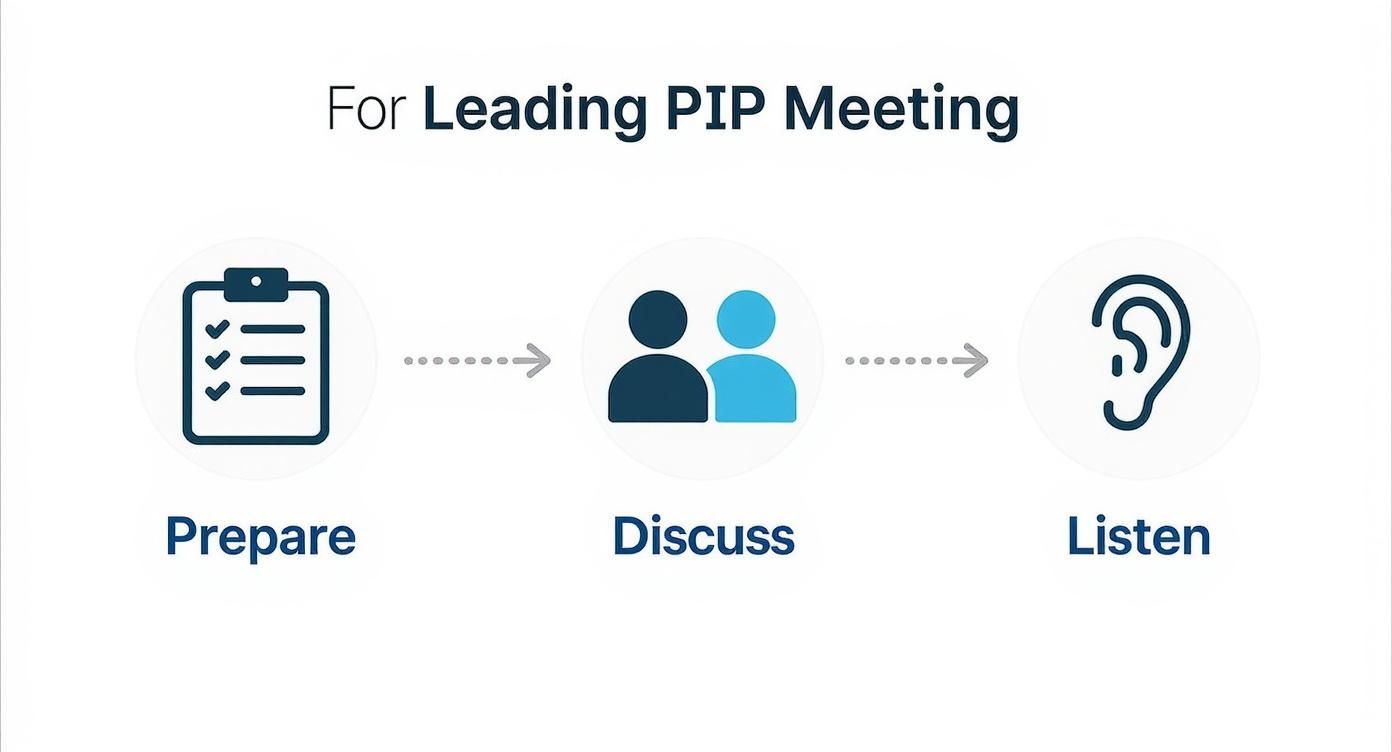
As you can see, a successful meeting is not just about talking at the employee. It requires preparation and listening just as much as discussion.
Structuring Productive Check-In Meetings
Good check-ins are brief, focused, and predictable. For a standard 90-day PIP, a weekly 30-minute meeting is a great rhythm. If the plan is shorter, you might need to connect more often. The goal is to establish a cadence the employee can count on.
Every meeting needs a clear agenda. This is not the time for casual small talk. You are there to review progress against the specific SMART goals you both agreed to.
Here is a simple checklist to guide every follow-up session:
- Review Progress on Goals: Go through each goal, one by one. Ask the employee to walk you through their progress with specific examples or data. If a goal was to reduce report errors, ask for the error rate from their latest work.
- Discuss Roadblocks and Challenges: Use open-ended questions like, "What got in your way this week?" or "Talk me through the challenges you ran into." This creates a safe space for them to voice concerns and helps you see where they need more help.
- Offer Additional Support: Based on what you hear, provide targeted guidance. You might need to clarify an expectation, point them to a helpful resource, or offer a specific tip. This proves you are invested in their success, not just checking a box.
- Document Key Takeaways: Wrap up by summarizing the conversation and clarifying next steps. This ensures you both leave the room aligned on what was accomplished and what the focus is for the next week.
The Importance of Consistent Documentation
After every check-in, you need to document what was discussed. This is non-negotiable.
Your notes create a clear, chronological story of the employee’s progress, the feedback you gave, and any adjustments made along the way. This documentation is your safety net, ensuring fairness and protecting the company.
Keep your notes objective and factual. Stick to what was said and observed.
A strong documentation trail should be clear enough for an HR partner or another manager to read and understand the entire history of the PIP without extra context. It should detail dates, topics discussed, employee progress, and your feedback.
This record becomes the single source of truth when it is time for the final review. It eliminates ambiguity and ensures the final decision is based on a well-documented pattern of performance over the entire PIP period, not a gut feeling or a recent event. Check out our guide on how to motivate underperforming employees for more strategies.
Knowing When and How to Adjust the Plan
Sometimes, things change. You might uncover new information during a check-in that makes an adjustment necessary.
For example, an employee might reveal a legitimate obstacle, like a broken software tool, that prevented them from hitting a target. In those cases, it is fair and smart to modify the plan.
Any adjustments must be made formally and in writing. If you change a goal, a deadline, or a resource, update the official PIP document. Have the employee sign the revised version and save it. This keeps the process transparent and maintains its integrity. A little flexibility shows that the PIP is a genuine tool for improvement, not a rigid trap.
Finalizing the PIP and Deciding What's Next
The clock has run out on the PIP. It is time for the final, decisive meeting. This is where you will sit down with the employee and review their performance against the specific goals you both agreed upon. How you prepare for this conversation is important; it is the moment that solidifies the outcome of the process.
Your first step is to gather all your documentation. Pull together your notes from every check-in, the data tracking their performance metrics, and any feedback you have shared. Your goal is to make an objective, evidence-based decision, not one swayed by a recent good day or your own feelings. This paper trail is your foundation for a fair and legally sound conclusion.
When a PIP ends, there are three possible outcomes. You need to be ready to discuss and execute any of them. Each path requires a different conversation and a clear set of actions.
Evaluating the Final Outcome
This final review meeting needs to be structured and direct. Lay out the data you have collected over the PIP timeline. Walk the employee through how they performed against each SMART goal. This is not a negotiation; it is a clear presentation of the results.
After you present the facts, you will deliver the final decision. If you have been conducting consistent and honest check-ins, the outcome should not be a shock. You already laid the groundwork throughout the follow-up process.
Here are the three potential paths:
- Success: The employee has consistently met or surpassed all the goals outlined in the plan.
- Partial Improvement & Extension: The employee has made real progress but has not hit all the targets.
- Failure to Meet Expectations: The employee has not shown enough improvement, and their performance is still not where it needs to be.
Each of these outcomes triggers a specific course of action.
The final decision must be rooted in the evidence you have gathered. An objective assessment, based on documented progress, protects both the employee and the company from any claims of unfairness. Always loop in HR to make sure your decision aligns with company policy.
No matter the outcome, your tone needs to remain calm and professional. Your job is to deliver the news clearly and respectfully, manage the next steps, and officially close out the performance improvement plan.
Communicating the Decision and Next Steps
How you deliver the final news matters. It reflects your leadership and the company’s values. Be ready for an emotional reaction and have a clear game plan for each scenario.
Scenario 1: The Employee Succeeded
This is the outcome everyone hopes for. Officially close the PIP and congratulate the employee on their hard work and progress. It is crucial to clarify that the expectation is for this improved performance to be the new standard.
Map out a plan for their continued success. This might involve more frequent check-ins for a short period to ensure they stay on track. Document the successful completion in their employee file and shift the conversation toward their future growth on the team.
Scenario 2: The Plan Is Extended
If you have seen significant, tangible improvement but the goals were not fully met, you might consider extending the PIP. This is a good move only if you believe more time and support will get them across the finish line.
Be specific about which goals were not met and explain why you are offering an extension. Set a new, shorter deadline, usually an additional 30 days. Formally document this extension, have the employee sign off on it, and keep the check-in process going. Make it clear that this is the final opportunity for improvement.
Scenario 3: The Outcome Is Termination
If the employee failed to meet the plan’s requirements, you must move forward with termination. This is a tough conversation that must be handled with directness and compassion. You should have an HR representative in this meeting.
State the decision clearly and tie it directly back to the PIP goals that were not met. Explain that because the required improvements were not made, the company has decided to end their employment. Do not get pulled into a debate. From there, provide the necessary information about their final paycheck, benefits, and the offboarding process. Your HR partner should lead this part of the conversation, ensuring all legal requirements and company policies are followed.
Got Questions About PIPs? Let's Unpack Them.
Even with a perfect plan on paper, rolling out a PIP can feel complicated. You will likely run into resistance, wonder how to handle things with remote employees, and want to avoid legal missteps. Let's tackle the most common questions so you can move forward with confidence.
These are the tricky, real-world scenarios that pop up. Knowing how to handle them makes the difference.
What if an Employee Refuses to Sign the PIP?
It is a moment that can make any manager nervous. You slide the document across the table, and the employee pushes it back, refusing to sign. It feels like a roadblock, but it is not.
First, take a breath. An employee’s signature is not an admission of guilt. It is an acknowledgment that they received the document and that the conversation happened. Their refusal does not invalidate the plan. The PIP is a directive from management, not a contract that requires mutual consent.
If you find yourself in this situation, here is the play-by-play:
- Clarify the Signature's Purpose. Calmly explain, "To be clear, signing this only confirms you have received it. It does not mean you agree with everything in it."
- Offer a Rebuttal. Give them an outlet. Say, "You are welcome to write a formal response outlining your perspective. We can attach it directly to this document in your employee file." This shows you are being fair.
- Document the Refusal. If they still say no, make a note on the signature line yourself. Something simple like, “Employee received a copy on [Date] but declined to sign.” Then, have your HR partner or another manager witness it and add their signature.
- Move Forward. The plan is still in effect. Make it clear that the expectations, check-ins, and potential outcomes outlined in the document are moving forward, regardless of the signature.
This approach keeps the process documented and fair while respecting the employee's choice.
Does a PIP Always Mean Someone Is Getting Fired?
Let's clear this up now. A PIP is not the first step in a long, bureaucratic process to fire someone. That is a common and damaging misconception.
When done right, a PIP is a genuine, good-faith effort to help an employee get back on track. It is a support structure, not a trapdoor. The goal is to salvage the relationship and retain a team member you have already invested in. Many employees turn things around after a PIP and go on to be strong performers.
The success of a performance improvement plan hinges on fairness, clear goals, and your commitment as a manager to coach them through it. If you see it as a box to check before termination, you have already failed.
The outcome is in the employee’s hands, based on their progress toward the goals you have set together.
How Do You Manage a PIP for a Remote Employee?
Managing a PIP for someone you do not see in person requires you to be more intentional. You cannot rely on body language or quick desk-side check-ins, so you have to build a more structured, transparent process.
Here is how to adapt your approach for a remote team member:
- Increase the Check-ins. Instead of one long weekly meeting, try shorter, more frequent video calls. A daily 15-minute sync might be more effective for keeping them on track and feeling supported.
- Lean on Measurable Metrics. Focus on output-based goals you can track digitally. Think closed support tickets, code commits, or project milestones hit in your project management tool. The data should tell the story.
- Use Your Tech Stack. Your tools are your best friends here. Shared documents for tracking progress, platforms like Asana or Jira for task management, and Slack for quick updates create a clear, real-time record of their work.
- Document Everything. Over-communication is key. After every call, send a brief follow-up email summarizing what you discussed and what the next steps are. This eliminates any chance of confusion.
The core principles of a good PIP are the same. You need to be more deliberate and create a digital paper trail to bridge the physical distance.
What Are the Legal Risks I Should Worry About?
Navigating the legal side of PIPs is non-negotiable. A well-documented, fair process is your best defense, but a sloppy one can open you up to serious risk.
Your number one shield is consistency. Are you putting this employee on a PIP for something you let slide with others? That is a red flag. The process must be applied evenly to all employees in similar roles with similar issues. This is your strongest protection against claims of discrimination or unfair treatment.
Most importantly, get HR involved from day one. Do not write a PIP in a silo. Your HR partner is there to review the plan, check your objectivity, and ensure it aligns with both company policy and employment law. They are your safety net, helping you manage performance confidently while minimizing legal exposure.
Feeling overwhelmed by difficult conversations? PeakPerf provides managers with a structured toolbox to prepare for performance improvement plans, feedback sessions, and tough one-on-ones in minutes. Our guided workflows and proven frameworks help you build clear, professional drafts, so you can lead with confidence. Start for free at PeakPerf.


