10 Effective Questions for Feedback to Improve Your Team in 2025
Effective feedback is the foundation of high-performing teams. The quality of your feedback often depends on the quality of your questions. Asking the right questions helps you move past generic advice and provide specific, actionable insights that support employee growth. When you shift from making statements to asking thoughtful questions, you invite collaboration and open a two-way dialogue. This builds trust and encourages ownership.
This guide provides a list of structured questions for feedback designed for different situations. You will find questions for performance reviews, developmental one-on-one meetings, peer feedback sessions, and daily check-ins. Each item is a tool. We will show you when and how to use each one, with practical examples and suggested phrasing to adapt to your context.
Using these targeted questions for feedback, you will learn to facilitate more productive conversations. You will clarify expectations, uncover the root causes of performance issues, and help your team members identify their own paths to improvement. This approach makes every feedback opportunity a chance for meaningful development. It turns routine discussions into catalysts for progress and stronger working relationships. This article gives you the exact language to make that happen.
1. What went well? What could be improved?
This two-part question is a foundational framework for delivering balanced, constructive feedback. It guides a conversation by first acknowledging successes before exploring areas for development. This approach creates psychological safety, reduces defensiveness, and makes the recipient more receptive to the discussion. Its simplicity makes it one of the most versatile questions for feedback for managers.
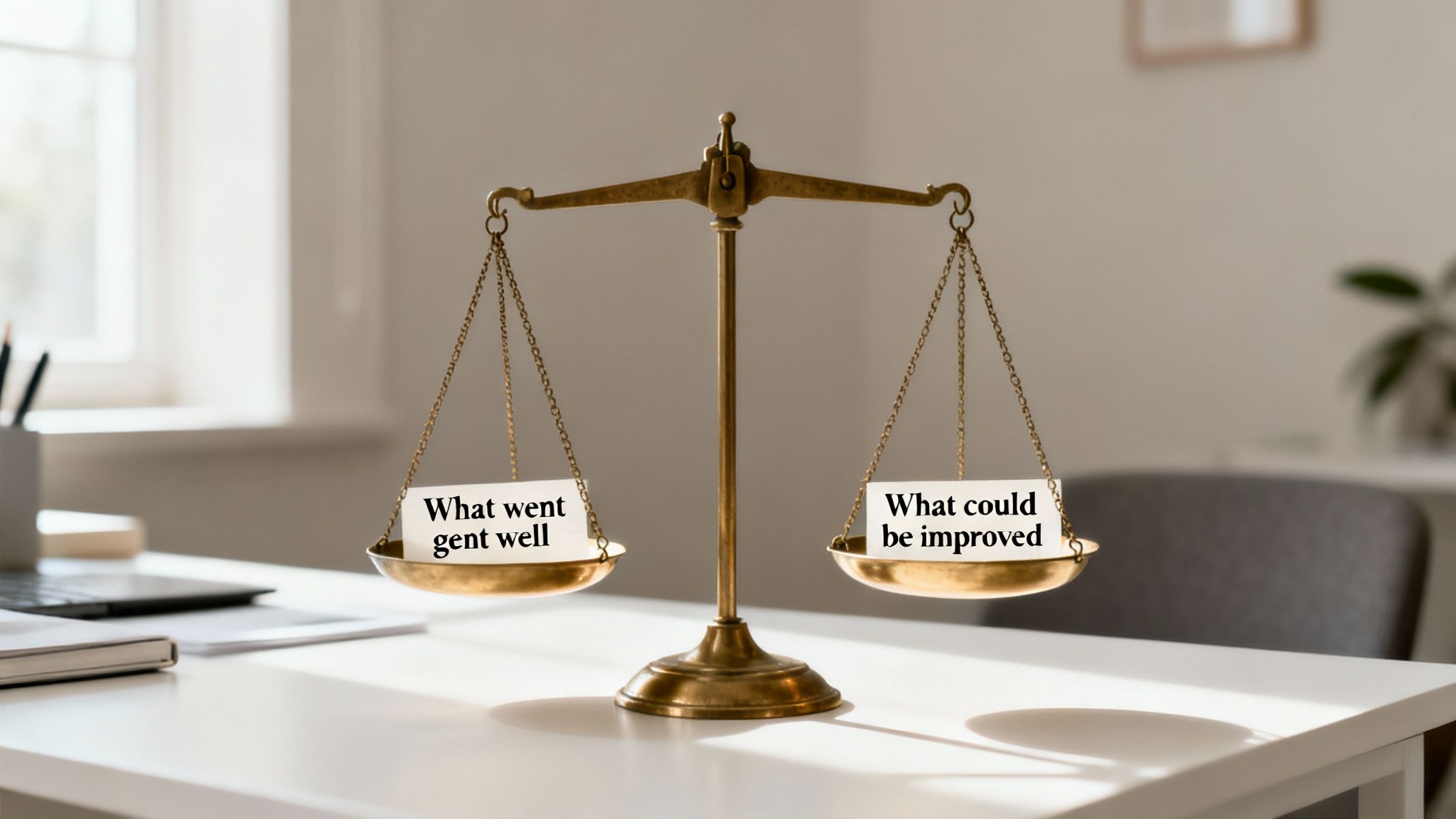
The "What went well?" portion encourages reflection on positive outcomes and the specific behaviors that led to success. The "What could be improved?" portion opens the door to discuss challenges and identify concrete opportunities for growth. This structure is effective because it frames feedback as a holistic review, not a critical one.
When to Use This Question
This framework is highly adaptable. Use it during:
- Performance Reviews: To provide a comprehensive look at an employee's contributions over a specific period.
- Project Retrospectives: To analyze team performance after a project concludes, identifying both wins and lessons learned. Agile and Scrum teams use this format often.
- Regular 1-on-1 Meetings: To create a consistent feedback loop on recent work or ongoing initiatives. These questions fit into a structured meeting format. You can build one using these tips for an effective one-on-one meeting agenda.
- Peer Feedback Sessions: To help colleagues provide balanced input to one another in a structured, non-confrontational way.
How to Implement It Effectively
To get the most value from this question set, follow these steps.
1. Prepare Specific Examples:
Instead of saying, "Your presentation went well," try, "The data visualization you used in the Q3 presentation clearly communicated our progress to the stakeholders." Specificity makes feedback credible and actionable.
2. Balance the Conversation:
Dedicate roughly equal time to both parts of the question. Rushing through the positives to get to the improvements undermines the model's purpose. Acknowledge and explore successes thoroughly before moving on.
3. Define Actionable Next Steps:
The conversation should not end with identifying areas for improvement. Collaborate to define clear, measurable next steps. For example, if a report needs better data analysis, a next step might be, "Let’s sign you up for the advanced spreadsheet training next month." This turns feedback into a concrete development plan.
2. On a scale of 1-10, how satisfied are you with [specific aspect]?
This quantitative question converts subjective feelings into measurable data. Using a numerical scale allows managers to track sentiment, identify trends, and compare feedback across topics or time periods. This approach, rooted in survey science like the Likert Scale, provides a structured starting point for deeper qualitative discussions.

The rating itself offers a quick snapshot of satisfaction or agreement. It serves as a gateway to understanding the "why" behind the number. Asking for a rating is one of the most efficient questions for feedback because it simplifies complex emotions into a single data point. This makes spotting significant changes or outliers that require attention easier.
When to Use This Question
This question is ideal for gathering quick, quantifiable feedback. Use it for:
- Employee Engagement Surveys: To measure team morale or satisfaction with company policies, management, or work environment.
- Post-Training Feedback: To gauge the effectiveness of a workshop or training session after it concludes.
- 1-on-1 Check-ins: To track progress on specific goals or get a pulse check on workload. For example, "On a scale of 1-10, how manageable is your current workload?"
- Change Management: To assess how the team is adapting to a new process, tool, or organizational structure.
How to Implement It Effectively
To maximize the value of a rating scale question, apply these steps.
1. Define Clear Scale Anchors:
Ensure everyone understands what the numbers mean. Clearly label the endpoints, for example, 1 = "Very Dissatisfied" and 10 = "Very Satisfied." This consistency is crucial for collecting accurate and reliable data.
2. Always Ask a Follow-up Question:
A number alone lacks context. The real insight comes from the follow-up. After receiving a rating, ask, "What is the primary reason for your score?" or "What would it take to move that score from a 7 to a 9?" This uncovers the specific drivers behind the rating.
3. Analyze Both Trends and Outliers:
Use the data to monitor trends over time. A declining average satisfaction score requires investigation. Also, pay attention to extreme scores. A rating of 1 or 10 often signals a strong experience that provides valuable learning opportunities.
3. What specific example demonstrates this feedback?
This question shifts feedback from abstract opinion to concrete observation. It forces the giver to ground their comments in specific, observable events. This makes the feedback more credible and less likely to be seen as a personal attack. By focusing on tangible examples, you create a foundation for a productive conversation about behavior and its impact, instead of making broad character judgments.

General feedback like "You need to be more proactive" is vague and difficult to act upon. Asking yourself for a specific example transforms it into, "During the project launch meeting on Tuesday, you waited for me to assign tasks. A more proactive approach would have been to suggest a plan for the next steps before I asked." This specificity makes it one of the most direct questions for feedback for driving real behavioral change.
When to Use This Question
This approach is crucial whenever feedback could be interpreted as subjective. Use it during:
- Performance Management: To justify ratings or address behavioral patterns with factual evidence instead of generalized feelings.
- Behavioral Coaching: To help a team member understand how their actions affect others in specific situations.
- Delivering Difficult Feedback: To provide a clear, undeniable basis for a tough conversation. This keeps the discussion focused and less emotional.
- Code and Design Reviews: To pinpoint exact lines of code or elements of a design that need improvement, explaining the specific outcome of that choice.
How to Implement It Effectively
To use this question to frame your feedback, follow these steps.
1. Prepare Your Example in Advance:
Before the meeting, identify a recent, relevant example. Structure it using the Situation-Behavior-Impact (SBI) model. Describe the situation, the specific behavior you observed, and the resulting impact.
2. Use "I" Statements:
Frame the feedback from your perspective. Start with phrases like, "I observed that..." or "I noticed when you..." This avoids accusatory "You always..." language, which can put someone on the defensive.
3. Describe Behavior, Not Personality:
Focus on what the person did, not who you think they are. Instead of saying, "You were disorganized," say, "In the client update email, the key metrics were missing, which caused confusion." This focuses the conversation on a correctable action. For more guidance on this, review these tips on how to give constructive feedback to employees.
4. Invite Their Perspective:
After presenting your example, ask for their view. Say, "How did you see that situation?" or "What was your thought process there?" This turns the feedback into a two-way dialogue, which fosters understanding and collaboration.
4. How can I help you succeed?
This forward-looking question transforms a feedback session from an evaluation into a collaborative partnership. It positions a manager as a supportive resource dedicated to an employee's growth, not a judge of past performance. This approach, rooted in coaching psychology, builds trust and psychological safety, making it one of the most effective questions for feedback a leader can ask.
By asking "How can I help you succeed?", you shift the focus toward future actions and shared responsibility. The question communicates a genuine investment in the team member's development and empowers them to articulate their needs. This framing is essential for fostering a growth mindset culture.
When to Use This Question
This supportive question is ideal for developmental conversations. Use it during:
- Manager 1-on-1s: To check in on progress, remove blockers, and reinforce your role as a supportive coach.
- Career Development Discussions: To understand an employee’s long-term goals and identify how you can help them get there.
- After Delivering Tough Feedback: To transition from a difficult conversation to a constructive, forward-looking plan.
- Mentorship Meetings: To open the door for a mentee to request specific guidance, resources, or connections.
How to Implement It Effectively
To make this question impactful, you must follow it with genuine commitment and action.
1. Practice Active Listening:
After asking the question, listen without interrupting or formulating your response. Your goal is to fully understand the employee's perspective and needs. Acknowledge what you hear to confirm your understanding before you suggest solutions.
2. Identify Concrete Resources:
Be prepared to offer tangible support. This could mean approving a budget for a training course, reallocating workloads to free up their time, or making an introduction to a subject matter expert inside the company. Your ability to provide concrete help demonstrates your commitment.
3. Create a Shared Action Plan:
Work together to define clear next steps. For example, if an employee needs more visibility on a key project, an action step might be, "I will ensure you present your findings at next month's departmental meeting." This creates mutual accountability. Improving your ability to guide these conversations is a key part of developing your coaching skills for managers.
5. What was your intention vs. the impact your actions had?
This question separates intent from impact. It creates a framework for addressing unintended negative consequences. It is a tool for navigating sensitive interpersonal issues, as it acknowledges that good intentions do not negate negative outcomes. This approach helps individuals see how others perceive their actions, which fosters empathy and self-awareness.
This is one of the most transformative questions for feedback because it shifts the focus from blame to understanding and resolution. It allows for a non-confrontational exploration of misalignments between what someone meant to do and what happened. This makes it central to restorative conversations.
When to Use This Question
This question is ideal for emotionally charged situations or when addressing behavioral patterns. Use it during:
- Conflict Resolution: To mediate disputes between team members where actions were misinterpreted.
- Diversity and Inclusion Conversations: To address microaggressions or other non-inclusive behaviors where the person may not have realized the impact of their words or actions.
- Post-Incident Debriefs: After a communication breakdown or a team dynamic issue, this question helps unpack the situation without assigning blame.
- Developmental Coaching: To help an employee build greater emotional intelligence and awareness of their professional presence.
How to Implement It Effectively
To use this question productively, you must create a space of psychological safety. Follow these steps for a constructive dialogue.
1. Lead with Curiosity, Not Judgment:
Approach the conversation with a genuine desire to understand, not to accuse. Your tone should be inquisitive. For instance, say, "Can you walk me through what you were hoping to achieve with that comment?" instead of "Why did you say that?"
2. Acknowledge Positive Intentions First:
Start by validating the person's stated intention. For example, "I understand you intended to be helpful by offering that feedback in the team meeting." This confirms you heard them and makes them more open to hearing about the impact.
3. Describe the Impact Objectively:
State the consequences of the action without interpretation or emotion. Use "I" or observational statements. For example, "When you gave the feedback publicly, I noticed a few team members became quiet and disengaged for the rest of the meeting."
4. Co-Create a Path Forward:
The goal is to align future actions with positive intentions. End the conversation by collaborating on a new approach. You could ask, "How can we ensure your intention to be helpful lands as you want it to next time?" This makes the feedback a forward-looking development opportunity.
6. What would success look like going forward?
This forward-looking question transforms feedback from a review of past events into a blueprint for future achievement. It shifts the conversation from identifying problems to co-creating solutions and defining clear, shared expectations. This approach empowers the individual by making them an active participant in their own development. This increases buy-in and accountability. It is one of the most effective questions for feedback for ensuring conversations lead to tangible results.
By asking "What would success look like?", you prompt the recipient to visualize a positive outcome. They can then articulate the specific behaviors, skills, or results needed to get there. This process bridges the gap between understanding feedback and knowing how to act on it. It converts a discussion into a concrete action plan.
When to Use This Question
This question is ideal for formalizing next steps and ensuring alignment. Use it during:
- Performance Improvement Plans (PIPs): To clearly define the exact standards and outcomes required to meet expectations.
- Goal-Setting Sessions: To establish a clear vision of success for a new quarter, project, or role.
- Post-Feedback Development Talks: After delivering constructive criticism, this question helps pivot the conversation toward positive action and growth.
- Career Development Meetings: To help employees articulate their long-term aspirations and the milestones needed to achieve them.
How to Implement It Effectively
To get the most value from this question, focus on creating clarity and mutual commitment.
1. Use a Structured Framework:
Guide the conversation using the SMART goal framework. Define success criteria that are Specific, Measurable, Achievable, Relevant, and Time-bound. For instance, success is not "better communication." It is "providing a weekly project update email every Friday by 4 PM."
2. Involve the Recipient in Defining Success:
Ask the employee to first describe what success looks like from their perspective. This fosters ownership over the outcome. You can then refine their definition together to ensure it aligns with team and organizational goals.
3. Break Down Large Goals:
If the vision of success is large or long-term, break it into smaller, manageable milestones. This makes the goal less daunting and creates opportunities to celebrate progress along the way. Establish checkpoints and review dates to track progress and offer support.
4. Identify Necessary Resources:
Part of defining success is identifying what support is needed to achieve it. Ask, "What resources, training, or support do you need from me to make this happen?" This demonstrates your commitment to their development and removes potential roadblocks.
7. How do you see your strengths, and how can we leverage them?
This strengths-based question shifts the feedback conversation from fixing weaknesses to amplifying talents. Rooted in positive psychology, this approach focuses on identifying what an individual does well and finding ways to apply those skills more intentionally. It helps employees feel valued and understood, which improves engagement and retention.

By asking employees to self-identify their strengths first, you empower them to take ownership of their professional development. The second part of the question, "how can we leverage them?", turns the conversation toward strategic action. This makes it one of the most direct questions for feedback for building a high-performing and motivated team.
When to Use This Question
This approach is especially effective in specific contexts:
- Career Development Discussions: To align an employee’s career path with their natural talents and passions.
- Role Design and Team Planning: To structure roles and projects around the team's collective strengths, maximizing effectiveness.
- Onboarding Meetings: To understand a new hire's capabilities and quickly find opportunities for them to contribute and feel successful.
- Performance Reviews: To provide a more motivating and forward-looking alternative to deficit-focused feedback.
How to Implement It Effectively
To successfully apply this strengths-based approach, consider these steps.
1. Start with Self-Assessment:
Always ask the employee to share their perspective on their strengths first. This shows respect for their self-awareness and provides a foundation for the conversation. You can then add your own observations to build a complete picture.
2. Connect Strengths to Business Goals:
The goal is not just to list strengths but to apply them. Discuss how a particular talent, like strategic thinking or relationship building, can help solve a current business challenge or contribute to an upcoming project.
3. Create Stretch Assignments:
Design tasks that specifically require the employee to use and develop their identified strengths. For example, if someone excels at communication, ask them to lead a client presentation or mentor a junior team member on their presentation skills. This turns feedback into a tangible growth opportunity.
8. What barriers or challenges are preventing progress?
This systemic question shifts the focus of feedback from individual performance to environmental obstacles. It acknowledges that systems, resources, and workplace conditions influence an employee's output, not just personal effort. This approach helps managers avoid attribution bias and fosters a culture of blameless problem-solving. This makes it one of the most effective questions for feedback for understanding the bigger picture.
This question transforms feedback into a collaborative effort to improve processes. Instead of asking what an individual did wrong, you ask what is getting in their way. This is a core principle in practices like blameless post-mortems used in the tech industry and the process improvement methodologies found in Lean manufacturing. It creates a space for honest dialogue about systemic issues without assigning blame.
When to Use This Question
This question is ideal for uncovering hidden inefficiencies. Use it during:
- Performance Reviews: When an employee is underperforming despite clear effort, to identify external factors.
- Project Kick-offs and Check-ins: To proactively identify potential roadblocks before they derail a project timeline.
- 1-on-1 Meetings: When a team member expresses frustration or seems stuck on a specific task or goal.
- Upward Feedback: To encourage employees to share challenges they see inside team or company processes that leaders can address.
How to Implement It Effectively
To use this question to drive real change, follow these steps.
1. Distinguish Between Barriers:
Help the employee differentiate between internal challenges (like a skill gap) and external ones (like outdated software or unclear goals). This clarifies whether the solution is individual development or a process change.
2. Focus on Actionable Solutions:
Once you identify a barrier, ask, "What is one thing we could do to reduce this challenge?" or "What resources would help you overcome this?" This keeps the conversation solution-oriented.
3. Assign Ownership for Removal:
If you identify a systemic barrier, take ownership as the manager to address it. For example, if the barrier is a slow approval process, your action item is to speak with the relevant department. This demonstrates commitment and builds trust.
9. How does this feedback align with your self-perception and goals?
This reflective question transforms a feedback session from a one-way delivery into a collaborative dialogue. It invites the recipient to connect external observations with their internal self-awareness, personal identity, and professional aspirations. This approach improves ownership over the feedback, making the individual an active participant in their own development.
By framing the discussion around self-perception, you encourage the employee to integrate the new information instead of simply accepting or rejecting it. This method, rooted in executive coaching and self-determination theory, is one of the most effective questions for feedback for driving genuine, long-term behavior change. It links professional growth to personal motivation.
When to Use This Question
This question is ideal for developmental conversations where the goal is deep reflection, not just a quick correction. Use it during:
- 360-Degree Feedback Debriefs: To help an individual process input from multiple sources and compare it against their own view.
- High-Potential Development Programs: To guide emerging leaders in aligning feedback with their long-term career trajectory.
- Career Planning Meetings: To ensure that developmental feedback directly supports an employee's stated professional goals.
- After a Challenging Project: To help someone understand how their actions were perceived and how that perception aligns with their intended contributions.
How to Implement It Effectively
To get the most value from this question, you need to create a safe space for honest reflection.
1. Set the Context First:
Before asking, briefly touch on the individual's personal strengths and career aspirations. For example, "I know your goal this year is to take on more leadership responsibilities. With that in mind, let's talk about the feedback from the recent project."
2. Explore Discrepancies with Curiosity:
If the feedback conflicts with their self-perception, avoid a judgmental tone. Ask follow-up questions like, "That's an interesting difference. What do you think might be causing that gap in perception?" This encourages analysis, not defensiveness.
3. Identify Patterns Together:
Work with the employee to find connections between the feedback and their past experiences or self-identified patterns. You might ask, "Have you received similar feedback before? How does it connect to the strengths you want to build?" This helps integrate the feedback into their self-concept.
4. Co-Create an Integration Plan:
The outcome should be a shared plan for how to use the feedback. If the feedback suggests a need to be more assertive in meetings, and their goal is leadership, the next step could be, "Let’s identify one specific action you can take in our next team meeting to practice this." This makes development tangible and self-directed.
10. What would you like feedback on from me/us?
This question inverts the traditional feedback dynamic by empowering the recipient to direct the conversation. Instead of pushing feedback onto someone, you invite them to pull it from you. This approach builds agency and trust. It ensures the discussion focuses on what the individual values most for their own growth. It is one of the most effective questions for feedback for fostering a reciprocal, high-trust culture.
By asking what they want to hear about, you uncover their self-perceived strengths and weaknesses, their career priorities, and their level of self-awareness. It shifts the manager’s role from a critic to a supportive coach. This makes the entire feedback process a collaborative partnership. This method is a cornerstone of modern feedback practices seen in agile tech companies and coaching professions.
When to Use This Question
This question is effective for building ownership and engagement. Use it during:
- Coaching and Mentoring Sessions: To ensure you provide guidance that aligns with the coachee's specific development goals.
- Peer Feedback Requests: To allow colleagues to seek input on skills or projects they are actively working to improve.
- Developmental 1-on-1s: To open a conversation about long-term growth instead of just recent performance.
- After a Major Project or Presentation: To let an employee guide the debrief toward the areas they felt most uncertain about.
How to Implement It Effectively
To maximize the impact of this question, apply these practical strategies.
1. Create Psychological Safety:
Individuals will only ask for honest feedback if they feel safe doing so. Consistently demonstrate that feedback is a tool for growth, not punishment. Acknowledge the courage it takes to ask for constructive input.
2. Follow Through Reliably:
When someone requests feedback, provide it thoughtfully and promptly. Failing to follow through undermines trust and discourages future requests. Your reliability shows you respect their initiative.
3. Be Prepared for the Unexpected (and the Critical):
While this question empowers the employee, you are still responsible for providing critical feedback if they do not ask for it. If you notice a significant issue they are avoiding, you can gently transition: "Thank you for that. I have some thoughts on X. I also want to share some observations about Y, as I believe it's important for your development."
10-Question Feedback Comparison
| Question | 🔄 Implementation complexity | ⚡ Resource / effort | ⭐ Expected effectiveness / outcomes | 📊 Ideal use cases | 💡 Key advantages / tips |
|---|---|---|---|---|---|
| What went well? What could be improved? | Low — simple two-part prompt | Low — quick to use and scale | ⭐⭐⭐⭐ — balances recognition and development | Agile retrospectives, performance reviews, education | Creates psychological safety; use specific examples |
| On a scale of 1–10, how satisfied are you with [specific aspect]? | Medium — requires clear anchors and design | Low — fast for respondents; analysis needs tools | ⭐⭐⭐⭐ — provides measurable trend data | CSAT/NPS, large surveys, engagement tracking | Include follow-up open question and define anchors |
| What specific example demonstrates this feedback? | Medium — needs observation and recall | Medium — time to gather and articulate examples | ⭐⭐⭐⭐⭐ — anchors feedback in observable behavior | Code reviews, coaching, teaching observations | Use "I observed..." language and recent incidents |
| How can I help you succeed? | Low–Medium — needs genuine follow-through | Medium — requires resources and ongoing support | ⭐⭐⭐⭐ — builds trust and actionable support | 1:1s, coaching, mentorship, manager check‑ins | Ask, listen actively, identify concrete resources |
| What was your intention vs. the impact your actions had? | High — sensitive facilitation required | Medium–High — emotional time and safety needed | ⭐⭐⭐⭐⭐ — reveals misalignments and fosters empathy | D&I training, restorative justice, conflict resolution | Lead with curiosity; state impact objectively |
| What would success look like going forward? | Medium — needs goal‑setting structure | Medium — time to define SMART criteria and milestones | ⭐⭐⭐⭐ — converts feedback into measurable goals | PIPs, SMART goal planning, development plans | Co‑create SMART goals and set checkpoints |
| How do you see your strengths, and how can we leverage them? | Low–Medium — requires self‑reflection | Low–Medium — may use assessments or conversation | ⭐⭐⭐⭐ — increases engagement and retention | Strengths‑based development, talent management | Ask recipient first; link strengths to stretch tasks |
| What barriers or challenges are preventing progress? | Medium–High — systemic analysis often needed | Medium — investigation and organizational buy‑in | ⭐⭐⭐⭐ — identifies root causes beyond individuals | Blameless post‑mortems, process improvement, systems thinking | Distinguish internal vs external barriers; assign ownership |
| How does this feedback align with your self‑perception and goals? | Medium — reflective and deeper conversation | Medium — time for integration and follow‑up | ⭐⭐⭐⭐ — improves feedback acceptance and ownership | Executive coaching, 360s, career counseling | Explore discrepancies with curiosity; connect to goals |
| What would you like feedback on from me/us? | Low — recipient‑driven and simple to ask | Low — efficient but requires timely response | ⭐⭐⭐⭐ — increases relevance and agency | Peer feedback, coaching, learner‑centered settings | Ask regularly; combine with 360 to surface blind spots |
Putting These Questions into Practice
You now have a library of questions for feedback. Each one is designed to open specific doors to productive conversation. Moving from reading this list to applying it effectively is your next step. The value of these questions is not in memorizing them, but in understanding which one to use at the right moment to achieve a specific outcome. A well-placed question transforms a difficult conversation into a collaborative problem-solving session. It shifts the focus from judgment to development and from conflict to alignment.
The goal is to build a feedback loop where communication is continuous, expected, and constructive. This consistent practice reduces the anxiety often associated with performance discussions. When your team members know that feedback is a regular part of their growth, not an annual event, they become more receptive and engaged in the process.
From Questions to Actionable Habits
Integrating these questions into your management routine requires intention. Asking "What went well?" without creating a safe space for an honest answer will yield little value. The effectiveness of your questions for feedback depends on the trust you have built with your team.
Follow these steps to make this transition successful:
- Start Small: Do not try to use every question this week. Select one or two questions that resonate with an upcoming conversation. For example, if you have a one-on-one focused on a recent project, prepare to ask, "What specific example demonstrates this feedback?" to ground your observations in concrete reality.
- Set the Context: Before asking a direct question, explain your intent. A simple opener like, "I want to support your development, so I would like to ask a few questions about the X project to understand your perspective," can make a significant difference.
- Listen Actively: The purpose of asking a question is to receive information. After you ask, focus completely on the response. Avoid formulating your next sentence while the other person is speaking. Paraphrase their points to confirm your understanding, using phrases like, "So, if I hear you correctly, you felt that..."
Preparing for High-Stakes Conversations
For more sensitive topics, such as performance gaps or behavioral feedback, preparation is non-negotiable. Asking, "What was your intention vs. the impact your actions had?" requires you to have clear examples of the impact. Walking into these discussions unprepared risks damaging trust and creating confusion.
Your preparation should include:
- Defining the Goal: What is the one thing you want the person to understand or do differently after this conversation?
- Gathering Specific Data: Collect concrete, observable examples. Vague feedback like "You need to be more proactive" is unhelpful. Instead, use specific instances to support your points.
- Anticipating Reactions: Consider how the individual might react. Thinking through potential responses helps you remain calm and guide the conversation back to its intended purpose.
By mastering the art of asking thoughtful questions for feedback, you build a foundation of psychological safety. Your team learns that their voice is valued and that your primary role as a manager is to help them succeed. This skill is a cornerstone of effective leadership. It turns performance management from a top-down directive into a partnership for growth. This leads to higher engagement, stronger performance, and a more resilient team culture.
Tired of struggling to find the right words for tough conversations? PeakPerf helps you prepare for any feedback scenario with guided workflows and structured templates. Build your confidence and deliver clear, professional, and actionable feedback every time.


