Your Guide to the Self Assessment Performance review Template
A good self-assessment performance review template is a tool that helps you pause and reflect on your work. It removes the guesswork from reviewing your accomplishments, challenges, and goals. This turns a stressful task into a productive moment of self-awareness.
Why Traditional Performance Reviews Fail
Traditional, top-down performance reviews often miss the mark. They feel like a one-sided conversation where managers pass judgment and employees listen. For many, the process feels disconnected from their day-to-day work.
Data supports this feeling. Globally, only 14% of employees report feeling inspired to improve after a typical performance review. Even more telling, 95% of managers are unhappy with their company's current review systems. The old way is not working.
The Value of Employee Self-Reflection
A self-assessment changes the dynamic. It puts you at the center of the conversation. A monologue from your manager becomes a dialogue. By giving you a structured way to think about your contributions, it ensures your perspective is heard.
This approach has clear benefits:
- It Is More Accurate: Nobody knows your work better than you do. Your self-assessment provides context and detail that a manager might have missed.
- It Boosts Buy-In: When you help evaluate your performance, you become more invested in the outcome and the development plan.
- It Fosters Development: The focus shifts from a simple rating to a forward-looking conversation about your growth, skills, and future.
Creating a Collaborative Dialogue
The goal is to build a collaborative and complete picture of your performance. When you complete a thoughtful self-assessment, you give your manager the information needed for a meaningful discussion. It sets the stage for a partnership focused on your professional journey. You can learn more about creating this environment by reviewing some performance review best practices.
The most effective performance conversations happen when both people are prepared. Your self-assessment is your preparation, making sure your voice and accomplishments are front and center.
To make this happen, many companies are replacing old systems with new tools. A modern employee self-service portal, for example, empowers you to take a more active role in your performance and development cycles. It is a practical step toward making reviews something you look forward to.
The Essential Self Assessment Performance Review Template
Staring at a blank page is the hardest part of writing a self-assessment. To get you past that hurdle, our downloadable self-assessment performance review template gives you a clear structure to organize your thoughts. It helps you frame your contributions in a professional way.
The template breaks everything down into four key areas. Each one builds on the last, helping you paint a complete picture of your performance.
Your Key Achievements
This is your highlight reel. It is the place to document your most significant wins and contributions. You need to think bigger than your day-to-day tasks and focus on results. What major projects did you complete? Where did you exceed your goals? Be specific and use data to support your claims.
Here are a few prompts to get you thinking:
- What were my three biggest accomplishments during this review period?
- Which projects am I most proud of, and what was my role in their success?
- How did my work directly advance team or company goals?
- Did I receive positive feedback from colleagues, my manager, or clients?
- What numbers, metrics, or data points prove the impact I made?
Challenges and Obstacles
Talking about challenges is not about listing failures. It shows self-awareness and a growth mindset. This part of the template is your space to talk about roadblocks you hit, what you did to overcome them, and what you learned.
Think about these questions:
- What were the biggest professional hurdles I had to overcome?
- Did any projects get delayed by unexpected issues?
- Were there any goals I did not meet? If so, what got in my way?
- What skills or resources would have made these challenges easier to handle?
When reviews lack a clear structure, they can feel pointless and frustrating for everyone. This creates a cycle of irrelevance and dissatisfaction.
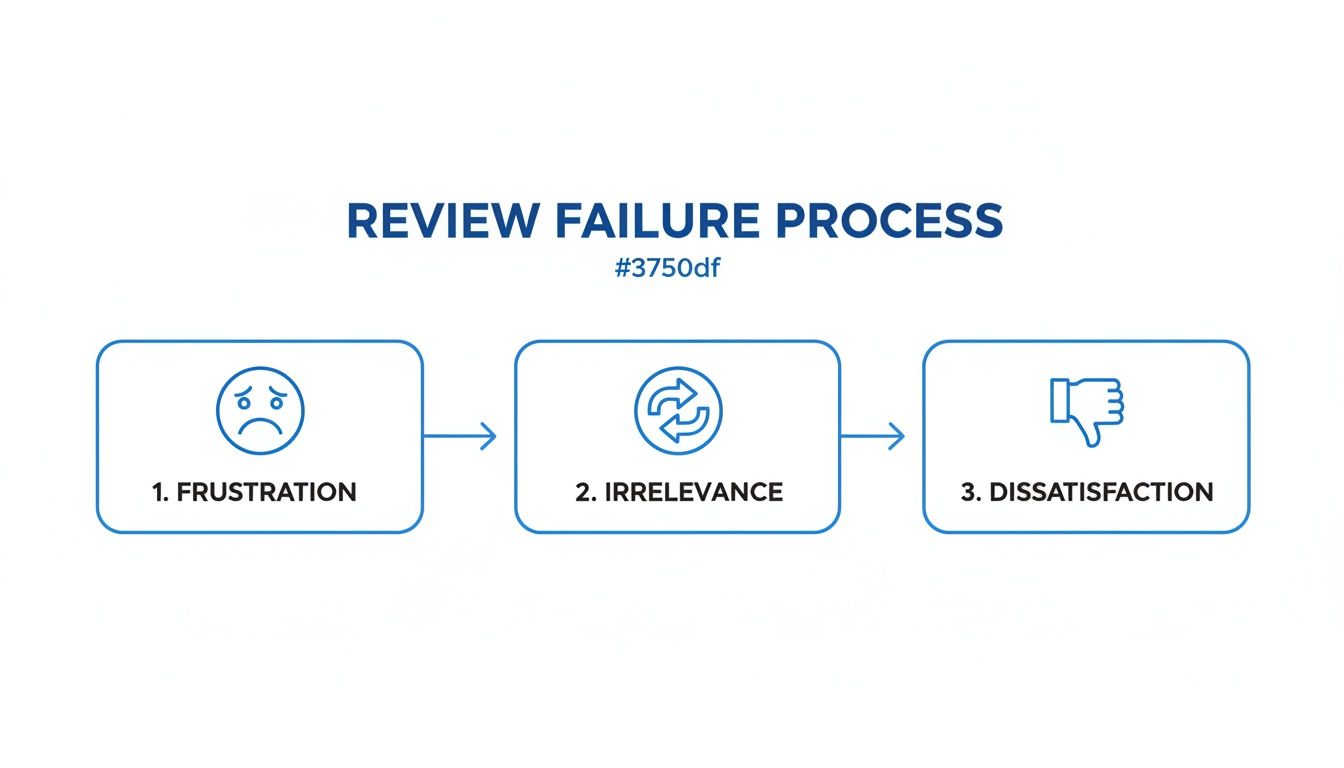
A poorly designed process almost guarantees employees will feel the system is a waste of time.
Key Learnings and Development
Growth never stops. This section is where you reflect on how you have developed professionally. Talk about the new skills you acquired, the insights you gained, and how you have evolved in your role.
Your ability to learn and adapt is as important as the results you produce. Show your manager you are invested in your own development.
Prompts to guide your reflection:
- What new skills or knowledge did I gain over the last few months?
- How did I act on the feedback from my last review?
- What is a key lesson I learned from a mistake or a big win?
- Did I take on any new responsibilities or step outside my comfort zone?
Future Goals and Aspirations
Now it is time to look forward. This final section connects your past performance to your future ambitions. Lay out clear, actionable goals for the next review period. This shows your manager that you are thinking strategically about your direction and how you can continue to contribute. For more information, check our guide on setting goals for employees with a template that aligns with company objectives.
Use these questions to map out your next steps:
- What are my top three professional goals for the next quarter or year?
- What support will I need from my manager to achieve these goals?
- Are there any training programs that could accelerate my development?
- How do my personal goals align with the team’s upcoming projects?
How to Write Your Self Assessment with Impactful Examples

You have reflected on your year. Now you need to translate those thoughts into a compelling self-assessment. The key is to move beyond vague statements and provide clear, professional examples of your work.
This is your chance to guide your manager's perspective and show the value you delivered. To do that, you need to ground your contributions in reality. Vague claims like "I worked hard" get overlooked. Concrete examples backed by data are difficult to ignore.
Frame Your Accomplishments with the SBI Model
If you are not sure how to structure your thoughts, the Situation-Behavior-Impact (SBI) model is a helpful tool. It is a simple way to talk about your achievements and challenges without emotion. It forces you to stick to the facts, which is what your manager wants to see.
Here is the breakdown:
- Situation: First, set the scene. Briefly explain the context of what was happening. When and where did this take place?
- Behavior: Next, detail what you specifically did. Focus on your actions or words.
- Impact: Finally, connect your actions to a result. What happened because of what you did? How did it affect the team, the project, or the company?
Using SBI transforms a weak line like "I helped with the marketing campaign" into a strong story of your contribution.
Applying the SBI Model to Your Self Assessment
Let's look at how the SBI framework turns a generic statement into a high-impact summary. This structure helps you tell a clear story of your value.
| Component | Weak Example | Strong SBI Example |
|---|---|---|
| Situation | We needed to improve our social media. | During the Q3 product launch, our initial social media engagement was 15% below target. |
| Behavior | I made some changes to our ads. | I analyzed our audience data and identified that our content was not resonating. I then proposed and executed a new A/B testing strategy for ad creatives. |
| Impact | The campaign did better. | My new strategy increased engagement by 30% within two weeks, surpassing our original goal and contributing to a 10% lift in launch day sales. |
The strong example provides a clear narrative that showcases initiative, problem-solving skills, and a direct link to business results.
Role-Specific Examples Using SBI
"Impact" looks different depending on your role. Applying the SBI model helps you tailor your self-assessment to your specific job functions.
Here are a few examples from different fields:
Marketing Specialist Example:
- Situation: During the Q3 product launch, our initial social media engagement was 15% below target.
- Behavior: I analyzed our audience data and identified that our content was not connecting with our target demographic. I proposed and executed a new A/B testing strategy for our ad creatives.
- Impact: The new strategy increased engagement by 30% within two weeks, surpassing our original goal and contributing to a 10% lift in launch day sales.
Software Developer Example:
- Situation: The customer support team flagged a recurring bug that was crashing the application for about 5% of our users.
- Behavior: I spent two days reviewing the code and traced the problem to a memory leak in a third-party library. I implemented a patch and added new automated tests to prevent it from happening again.
- Impact: The patch eliminated the crash, which improved application stability and cut the related support tickets by 100%.
Customer Support Agent Example:
- Situation: A high-value client was frustrated with our onboarding process and threatened to cancel their $50,000 annual contract.
- Behavior: I scheduled a call to listen to their specific pain points. Based on their feedback, I created a custom onboarding checklist for their team and personally walked them through it in a one-hour training session.
- Impact: The client completed their onboarding successfully and sent a positive note to my manager. They have renewed their contract and expanded their usage.
These examples do more than list tasks. They connect your day-to-day work to measurable business outcomes.
Using a simple framework like SBI ensures your self-assessment is grounded in facts, not opinions. It helps you present a professional and objective account of your performance.
When you structure your points this way, you make it easy for your manager to see the value you bring. This clarity builds a strong foundation for a more productive performance review conversation. It also sets you up to define your future goals with the same level of detail.
Common Mistakes to Avoid in Your Self Assessment
Writing a self-assessment requires balance. You have to advocate for your work without sounding arrogant. You need to own your mistakes without looking incompetent. Getting it right means avoiding a few common mistakes that can undermine your review.
Many people downplay their accomplishments by being overly humble or too hard on themselves. If you only talk about what went wrong or minimize your wins, you give your manager an incomplete and inaccurate picture. They need the whole story, including how you turned challenges into learning moments.
Vague Language and Generalizations
This is the most common mistake. People fill their reviews with fuzzy statements like “I was a good team player” or “I worked hard on several projects.” These phrases sound nice, but they are empty. They do not give your manager anything concrete.
The fix is to use numbers. Always. Instead of saying you improved a process, be specific: “I implemented a new workflow that cut project delivery time by 15%.” This trades a vague claim for proof of your value.
A self-assessment performance review template is only as good as the information you put into it. Specificity is your greatest tool for demonstrating value and building a strong case for your performance.
Focusing Only on Challenges
Another mistake is to list all your problems without explaining what you did about them. A self-assessment is not a confession. If a project missed its mark, the story is not that it failed. The real story is why it failed, what you learned, and how you are using that lesson to succeed next time.
Every obstacle is a chance to show your persistence. Frame challenges as learning experiences. It shows you are resilient, committed to growing, and have the self-awareness to improve. Every manager looks for that combination.
- Do not just say: "I missed the Q3 deadline."
- Instead, explain: "We missed the Q3 deadline due to an unforeseen technical dependency. I have since implemented a pre-mortem process for all major projects to better anticipate these risks and prevent future delays."
Being Too Modest or Overly Critical
Finding the right tone is important. Some people are hesitant to promote themselves, fearing they will sound arrogant. But your self-assessment is the place to document your wins. It is your chance to make sure your manager sees all the great work you did, especially the work that might have gone unnoticed.
On the other hand, do not be too critical. It is good to acknowledge where you can improve because it shows self-awareness. But focusing only on your faults can make you seem insecure. The goal is to paint a balanced, honest picture of your performance. This includes your strengths, your wins, and the areas you are actively working to develop.
A Manager’s Guide to Reviewing Employee Self Assessments
As a manager, your employee's self-assessment is a valuable document. It is a direct window into how they see their own work, their wins, their roadblocks, and their future goals. Your job is not to grade it like a test. You should use it as the starting point for a collaborative conversation.
Think of it as the opening line in a dialogue. Before you meet, read through their assessment to identify key themes. You are looking for two things: areas where your perceptions align, and areas where there is a noticeable gap. These points of alignment and divergence are where the most productive conversations happen.
Prepare for a Productive Dialogue
Your preparation elevates a routine review into a coaching session. Resist forming immediate conclusions. Instead, prepare open-ended questions that encourage your employee to elaborate.
Coming in with thoughtful questions shows you engaged with what they wrote. It also steers the conversation toward a shared understanding and a concrete plan for the future.
Try questions like these:
- "You listed Project X as a huge win. What part of that are you personally most proud of?"
- "You noted a challenge with resource allocation. If you could go back, what support would have made the biggest difference?"
- "You set a goal to build your data analysis skills. What is one step we could take next quarter to get you started?"
This shift turns a backward-looking critique into a forward-looking development plan. Organizations that use continuous feedback see 40% higher employee engagement and a 26% improvement in performance. Teams that get feedback focused on their strengths are 12.5% more productive.
Use the self-assessment to understand the ‘why’ behind an employee's performance. It provides context you might have missed, giving you the full picture of their contributions and struggles.
Co-Create the Path Forward
The goal is to build a development plan together. The self-assessment is their starting point. Your feedback provides the organizational context and direction. When you combine the two, you can build a roadmap that is both realistic and motivating.
This collaborative approach builds trust and shows your employee that you are invested in their career. Learning https://blog.peakperf.co/how-to-give-feedback/ effectively is the key to making this partnership succeed.
Beyond one-on-one reviews, it helps to understand team health. Reading an ultimate guide to team performance assessment can give you a broader framework. This ensures each person's growth aligns with the team's collective goals. That is how you build a cohesive and high-performing unit.
Your Questions, Answered
Let's address some common questions that appear when you face a blank self-assessment form. These are the difficult parts, but some expert guidance can make the process feel much clearer.
How Honest Should I Be?
The goal is honest self-awareness, not just a highlight reel. You should own your achievements and back them up with specific data and examples. Did you increase leads by 15%? Mention it. Did you launch a new feature? Describe the process.
But do not stop there. True self-awareness also means being open about the challenges you faced. The key is to frame them as learning opportunities. Talk about what you learned from a project that did not go as planned or what support you need to improve in a specific area. This shows your manager you are proactive and committed to growth. This builds more trust than pretending everything was perfect.
What if My Manager and I Disagree?
First, disagreement happens. Your self-assessment is not about "winning" the review. It is about presenting your perspective with clear, fact-based evidence. If your manager sees things differently, your job is to listen and understand their point of view.
Instead of getting defensive, ask for specific examples to clarify their position. Use the conversation to find common ground. A well-written self-assessment is your best tool here. It gives you a documented, evidence-based starting point for a productive discussion, rather than a debate.
Your self-assessment is your chance to document your perspective with facts. This preparation allows for a more objective conversation about performance and growth.
How Far Back Should My Self-Assessment Go?
Stick to the official review period. If your company does annual reviews, your assessment should cover accomplishments and challenges from the last 12 months. For quarterly or semi-annual reviews, keep your focus on that shorter timeframe.
Here is a tip that will save you a lot of stress: keep a running list of your achievements, challenges, and key learnings throughout the year. It can be a simple document or a note on your phone. This habit prevents you from forgetting important details and makes writing your self-assessment much easier when the time comes.
Ready to stop dreading performance reviews? PeakPerf is a lightweight management toolbox that helps you prepare for your toughest conversations in minutes, not hours. Go from a blank page to a structured, professional draft using proven leadership frameworks. Try PeakPerf for free and turn your next review into your best one yet.


