
A Practical Guide to SMART Goals for Performance Management
You have been there. You tell a team member to "increase productivity" or "improve customer satisfaction" and you both nod in agreement. What does that mean?
Does it mean faster response times? Higher survey scores? Fewer complaints? Without specifics, you leave your team to guess. This leads to inconsistent effort and wasted time.
This ambiguity is a classic failure point in traditional goal setting. It creates a gap between what managers expect and what their teams deliver. When people cannot see a clear connection between their daily work and the company's objectives, they become disengaged.
Why Vague Goals Do Not Work

This is not just about confusion. It actively hurts performance and builds a culture where "good enough" is the standard.
Consider this. Research shows only about 20% of companies hit around 80% of their strategic goals. That is a huge disconnect.
Much of that failure comes from poor goal setting from the start. It leads to situations where 66% of managers admit to setting easy targets to avoid failure. This practice kills any chance of real growth or innovation. The financial impact is real. Disengagement driven by unclear goals costs a company around $16,000 per employee every year. You can look at more goal setting statistics to see the full picture.
A goal without a plan is just a wish. When targets are vague, you do not set your team up for success. You set them up for frustration because they have no idea what the finish line looks like.
Setting the Stage for a Better Way
What is the fix? You need a system that brings clarity, focus, and accountability. You need a way to turn fuzzy ideas into concrete, actionable plans.
This is where the SMART framework comes in. It is a simple checklist that forces you to think through the critical details of any objective you set.
Here is a quick look at the SMART framework. It is a tool for making sure every goal is well-defined and has a real impact.
SMART Framework Quick Reference
| Letter | Stands For | Key Question to Ask |
|---|---|---|
| S | Specific | What exactly do we want to accomplish? |
| M | Measurable | How will we know when we have achieved it? |
| A | Achievable | Is this goal realistic with our resources and constraints? |
| R | Relevant | Why does this matter to the team and the business? |
| T | Time-bound | What is the deadline for this goal? |
By adopting this simple structure, you eliminate the guesswork. You give your team a clear roadmap. This empowers them to focus their energy where it matters. It is how you turn performance management from a source of anxiety into a tool for growth.
Breaking Down Each Letter of Your SMART Goal
The SMART framework is your best tool for turning a vague idea into a concrete plan. Think of each letter as a filter. It helps you sharpen your focus until you are left with a goal that is clear, motivating, and moves the needle.
Let's walk through how to build each piece so it has a real impact on performance.
S for Specific: Get Crystal Clear on the “What” and “Why”
A specific goal cuts through the noise. It answers the basic "W" questions: Who is involved? What do I want to accomplish? Why is this important? Vague goals like “improve customer support” are where good intentions go to die. They sound nice, but nobody knows what to do.
To make a goal specific, you nail down the exact outcome. Instead of “get better at project management,” try this: “Implement the new project management software for the marketing team to track campaign progress.” See the difference? It clearly states the action (implement software), the group (marketing team), and the purpose (track campaign progress). There is no ambiguity.
A specific goal is about precision. If you cannot describe what success looks like in a single, straightforward sentence, you need to go back to the drawing board.
M for Measurable: If You Cannot Measure It, You Cannot Manage It
This one is simple: how will you know when you have won? The "Measurable" part is about attaching hard numbers to your goal. It is the difference between wishing for something and planning for it. This is how you track progress and know when you have crossed the finish line.
"Increase website traffic" is not measurable. But "Increase organic website traffic by 20% over the next quarter" is. Now you have a clear target and an objective way to see if you hit it.
Think about the metrics that matter for the role.
- Quantity: Increase sales leads by 15%.
- Quality: Achieve a customer satisfaction score of 95% or higher.
- Cost: Reduce operational expenses by 10%.
- Time: Decrease average customer response time to under 24 hours.
When you add metrics, you give the goal teeth. This is critical for having meaningful conversations during performance check-ins.
A for Achievable: Ambitious, Not Impossible
Goals need to stretch your team, not break them. An achievable goal is one your people can realistically hit with their current skills, resources, and time. Setting the bar impossibly high leads to burnout and kills motivation. A goal that is too easy breeds complacency.
Before you set a goal, do a quick reality check. Look at the team's current workload, the budget you have, and the skills they bring to the table. Do they have the tools and support they need? For example, asking a junior developer to build a complex app from scratch in one month sets them up to fail. A better goal would be to have them complete a specific, challenging module of that app with mentorship from a senior dev.
This is not about lowering your standards. It is about setting smart, ambitious targets that build momentum and confidence.
R for Relevant: Connecting the Dots to the Bigger Picture
Nobody wants to feel like their work does not matter. A goal is relevant when it clearly connects to the wider team, department, and company objectives. Motivation increases when people see how their individual effort contributes to the organization's mission. It makes the work meaningful.
Before finalizing any goal, ask: why are we doing this? How does this objective help the company win? For instance, a marketing specialist's goal to "Increase social media engagement by 25%" is highly relevant if a key company objective is to "Expand brand awareness in new markets." The individual's work is now directly tied to the company's strategic plan.
This connection provides purpose. Most companies wait more than three months into a performance cycle to set goals. A recent report found that only 10% even bother to quality-check them. Using the SMART framework ensures that the three to four goals you set per employee are high-quality and relevant from day one. It is a foundational practice for hitting peak performance.
You can find more data-backed insights like this in the Global Performance Management Report.
T for Time-Bound: A Deadline Creates Urgency
A goal without a deadline is a dream. The "Time-bound" element adds a finish line. This forces prioritization and keeps important work from getting pushed to the back burner forever. A target date creates a healthy sense of urgency and gives everyone a schedule to work against.
"Launch a new employee onboarding program" will likely stay on a to-do list for months. But "Launch the new employee onboarding program by the end of Q2" is a commitment.
For bigger initiatives, break the timeline down into smaller milestones. It makes the whole thing feel less daunting.
- Milestone 1: Complete program content draft by April 30th.
- Milestone 2: Finalize training materials by May 31st.
- Milestone 3: Conduct pilot session by June 15th.
- Final Deadline: Full program launch by June 30th.
This approach makes a huge project manageable. It also creates natural checkpoints to review progress and make adjustments along the way. It keeps everyone accountable.
Connecting Employee Goals to Company Objectives
A well-written SMART goal is only half the battle. Its real value comes when an employee sees how their daily work contributes to the bigger picture. When your team understands that connection, the "why" behind their tasks, their focus sharpens. So does their motivation.
This link prevents the feeling of working in a vacuum. Instead of checking boxes, employees become active partners in the company's mission. You build a team of engaged contributors who get the impact of their work.
Cascading Goals From Top to Bottom
The most practical way to create this alignment is by cascading goals. This is not corporate jargon. It is a simple process. It starts with the highest-level company objectives. It breaks them down into smaller, relevant goals for each department, team, and individual. It is a clear method for mapping someone's day-to-day responsibilities directly to what the company is trying to achieve.
Let's walk through an example. A company might have a high-level objective to "Increase market share by 10% in the next fiscal year." That is too big for any single person to own. But you can break it down.
- Department Goal (Marketing): Generate 2,000 new marketing qualified leads (MQLs) in Q3 to support sales growth.
- Team Goal (Content Team): Publish 12 SEO-optimized blog posts and two downloadable guides to attract new leads.
- Individual Goal (Content Writer): Write and publish four high-quality blog posts per month, each targeting a specific keyword with a goal of ranking on the first page of Google within 90 days.
See how each goal directly supports the one above it? The content writer’s success contributes to the team’s goal. This helps the marketing department hit its target. This drives the company's main objective. This creates a clear line of sight from individual effort to organizational success.
When your team sees how their daily work moves the company forward, their engagement improves. It gives their work a purpose beyond a job description.
The data backs this up. Strong alignment is a driver of performance. Some research shows proper goal alignment can improve team performance by up to 60%. What is more, employees who understand how their work connects to company objectives are 3.5 times more engaged. This is a huge advantage when global employee engagement is hovering at 21%.
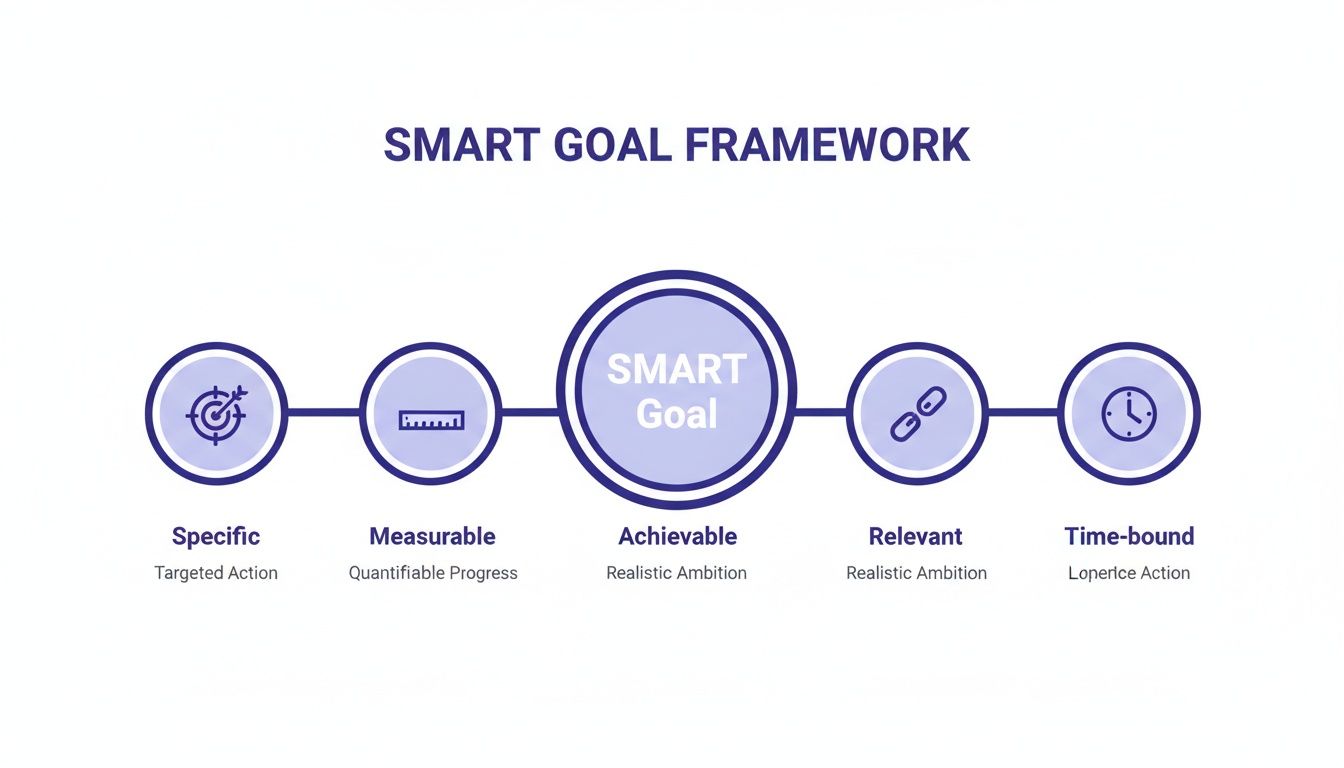
This kind of visualization makes it clear: an effective goal must check all five boxes to provide the clarity everyone needs.
Facilitating Goal Alignment Conversations
Creating this connection requires deliberate conversations between you and your team members. It is not enough to assign goals from on high. You need to explain the "why" behind them.
Start by openly sharing the company and department objectives for the upcoming quarter or year. Then, sit down with each employee to draft their individual SMART goals. Constantly ask, "How does this goal support our team's mission?"
Here are a few questions I use to guide these alignment discussions:
- What are our team's most important priorities right now?
- Which of your core responsibilities has the biggest impact on those priorities?
- How can we shape your goal to directly contribute to a specific team or company objective?
- What does success in your role look like, and how does that help our company succeed?
Frameworks like Objectives and Key Results (OKRs) are built on this principle. They connect ambitious company objectives to measurable employee key results. These frameworks are not mutually exclusive. They work well together. OKRs set the direction. SMART criteria make sure each key result is well-defined and actionable.
These conversations are central to good management. They show your team you value their contribution and trust them to help achieve significant outcomes. For more guidance on this, check out our guide on the best practices for performance management. By investing time in these discussions, you build a foundation of clarity and shared purpose that pays off in higher engagement and better results.
Templates and Examples for Different Roles
Knowing the theory behind SMART goals is one thing. Seeing them in action makes the concept click. This is where you turn an abstract idea into a practical tool that drives performance. It is how you get from a vague instruction like "sell more" to a concrete plan for success.
Let's break down how this transformation works across a few different departments. These are real-world examples you can grab and adapt for your own team.
From Vague Ideas to Actionable Plans
The whole point is to move beyond fuzzy requests and bring absolute clarity to the table. A well-defined goal gives someone a precise target to aim for. This is infinitely more motivating than a directionless objective.
To show you what this looks like in practice, here is a quick before-and-after that turns common, vague goals into SMART goals.
Role-Specific SMART Goal Transformation
| Role | Vague Goal | SMART Goal Example |
|---|---|---|
| Sales Rep | Sell more | Increase new client sales revenue by 15% in Q3 by closing at least 10 new deals. |
| Marketing | Improve social media | Grow our LinkedIn follower count by 20% and achieve a 5% average engagement rate on posts by the end of Q4. |
| Developer | Write better code | Reduce the number of bugs reported in your code by 30% over the next quarter by implementing unit tests for all new features. |
This table makes the shift from ambiguity to precision clear. Each SMART goal example gives you a specific metric, a deadline, and a tangible outcome. This leaves zero room for misinterpretation.
Breaking Down a SMART Goal for a Sales Role
Let's dig into that sales example to see how each piece of the SMART framework comes together. The original goal, "sell more," is something we have all heard. It is common, but it is also completely ineffective because nobody knows what "more" means.
The SMART version is: "Increase new client sales revenue by 15% in Q3 by closing at least 10 new deals."
- Specific: It is not just about revenue. It is about new client sales revenue and a specific number of new deals. That is a focused target.
- Measurable: Success is defined by a 15% increase and 10 closed deals. These are hard numbers you can track week over week.
- Achievable: A 15% jump in a quarter should feel like a stretch, but not impossible. It must be grounded in reality, based on past performance and market conditions.
- Relevant: This goal ties directly into the company's bigger picture. It drives business growth and helps hit revenue targets.
- Time-bound: There is a clear deadline: the end of Q3. This creates urgency and a natural point for evaluation.
By transforming a simple request into a structured objective, you are not giving an order. You are handing your sales rep a roadmap. They know what winning looks like and what they need to deliver in the next three months.
Examples for Other Key Business Functions
This same process works for any role in your company. When you bring this kind of structure to goal setting, every person on your team understands their priorities. They also understand how their work helps move the whole company forward.
Customer Support Specialist
- Objective: Enhance customer satisfaction and efficiency.
- SMART Goal: Reduce the average first-response time to customer support tickets from 4 hours to under 2 hours by the end of Q2, while maintaining a customer satisfaction (CSAT) score of 90% or higher.
Human Resources Coordinator
- Objective: Improve the new hire onboarding process.
- SMART Goal: Redesign the employee onboarding program and achieve an average new hire satisfaction rating of 95% on post-onboarding surveys by December 1st.
These examples should give you a solid foundation. If you need a more extensive list for even more roles, check out these additional SMART goals examples for employees for more inspiration.
Software Developer
- Objective: Improve platform stability and performance.
- SMART Goal: Decrease the average page load time for the user dashboard from 2.5 seconds to 1.5 seconds by the end of the quarter by refactoring three key legacy components.
Use these templates as a starting point. The real value happens when you sit down and collaborate with your team to build goals that are smart and meaningful. This is how you get everyone aligned, motivated, and ready to do their best work.
How to Track and Review Goals Effectively

Let’s be honest: a well-written SMART goal is a starting point. The value is not in the document itself. It is in the consistent follow-up that brings it to life. Without a solid process for tracking and reviewing, even the most brilliant goals end up collecting digital dust.
An effective review process turns a static objective into a living tool for growth. It is about creating a rhythm of conversation that keeps goals relevant, spots roadblocks early, and makes sure your people feel supported. Waiting for the annual review to talk about progress is a recipe for disaster. By then, it is far too late to course-correct.
Establish a Regular Check-in Cadence
Forget the once-a-year performance discussion. Continuous feedback is where real growth happens. Regular check-ins, like weekly or bi-weekly one-on-ones, create the dedicated space you need to talk about what is happening with their goals.
These meetings are not just for status updates. They are your prime opportunity for coaching, collaborative problem-solving, and celebrating the small wins along the way. This steady cadence keeps goals top of mind for both you and your direct report. A Gallup study found that employees whose managers hold regular meetings with them are almost three times more likely to be engaged.
Your goal-setting process is only as strong as your review cadence. A goal written down and ignored for three months is not a management tool. It is a document collecting digital dust.
The conversation should be forward-looking. Focus on progress and learning with questions like:
- What ground have you covered since we last talked?
- What is getting in your way, and how can I help clear the path?
- Based on what we know now, do we need to tweak the goal or the timeline?
- What do you need from me to make this happen?
Structure Productive Goal Conversations
How you structure these check-ins matters. A good conversation leaves an employee feeling motivated and clear on their next steps. It does not make them feel like they are under a microscope.
A simple agenda keeps everyone on track. Kick things off by looking at the key performance indicators (KPIs) tied to the goal. What does the data show? This objective starting point grounds the discussion in facts, not feelings. For more on this, our guide on how to conduct a performance review offers practical advice for making these talks productive and fair.
From there, pivot to the "how." What specific actions did they take that moved the needle? Where did they get stuck? This is where you uncover the context behind the numbers and find those perfect coaching moments.
Use Simple Tools for Visibility
You do not need a clunky, over-engineered system to track goals well. The best tools are often the simplest ones, as long as they provide clear visibility and are easy for everyone to use.
Here are a few options, from the straightforward to the more sophisticated:
- Shared Spreadsheets: A simple Google Sheet or Excel file can work. Create columns for the goal, metrics, target date, status, and a spot for notes from your check-ins.
- Project Management Tools: Platforms like Asana, Trello, or Monday.com can be easily adapted. Treat goals like projects and milestones like subtasks.
- Dedicated Software: Purpose-built tools like PeakPerf are designed for this. They offer workflows specifically for creating, tracking, and discussing performance goals, keeping everything in one streamlined place.
The right tool is the one your team will use. It should give you an at-a-glance view of progress. This makes your check-ins more focused and keeps momentum high.
Common SMART Goal Pitfalls and How to Avoid Them
Even with a solid framework like SMART, it is surprisingly easy to miss the mark. I have seen it happen time and again. A well-intentioned manager sets a goal that ends up being just as confusing as a vague one. This leads to nothing but frustration and wasted effort.
Refining your approach means spotting these potential traps before you fall into them. The truth is, a few small adjustments can make a world of difference in how your team receives, acts on, and ultimately crushes their objectives. The whole point is to create clarity and motivation, not accidental roadblocks.
Setting Too Many Goals at Once
This is probably the most common mistake I see managers make. They overwhelm an employee with a laundry list of objectives, thinking it shows ambition. When everything is a priority, nothing is. This dilutes focus and sends team members straight toward burnout as they scramble to make progress on too many fronts at once.
The fix? Stick to the essentials.
- Prioritize Ruthlessly: Sit down with your employee and hammer out the 3-4 most critical goals for the next quarter. No more.
- Focus on Impact: Constantly ask, "Which of these will have the biggest positive impact on our team and the company?"
- Align with Key Responsibilities: Make sure every single goal connects directly back to the core functions of their role.
This kind of focus helps your team channel their energy where it matters. This leads to far better outcomes and a real sense of accomplishment.
A long list of goals is not a sign of ambition. It is a sign of unclear priorities. Real effectiveness comes from identifying the few objectives that will make the biggest difference and then executing them flawlessly.
Creating Unrealistic or Unachievable Goals
Big, hairy, audacious goals are great. Impossible ones are demoralizing. The "A" in SMART stands for Achievable, yet it is often the first letter to be ignored. Managers will set targets without a realistic thought for the resources, time, or skills available. This sets their employee up for failure before they even start.
To avoid this, you must ground your goals in reality. Before you finalize anything, have an honest conversation about what it is going to take to succeed. Ask questions like, "What resources do you need from me?" and "What potential obstacles do you see getting in your way?"
This simple, collaborative check turns a goal from a source of stress into a healthy stretch. It also builds a ton of trust because it shows you are invested in their success, not just in hitting a number.
Failing to Measure the Right Things
So, your goal is measurable. Great. But are you measuring what matters? It is a classic pitfall: focusing on vanity metrics or simple outputs instead of tangible outcomes. For example, tracking the number of sales calls someone makes is easy. It misses the entire point if you are not tracking the revenue generated from those calls.
Make sure your metrics directly reflect the desired business outcome. Stop tracking activity and start tracking impact. A software developer's goal should not be "write code." It should be something like "reduce critical bug reports by 30%." This small shift ensures the work being done is genuinely valuable and tied to what the business needs to achieve.
Got Questions? We Have Answers.
How Often Should We Be Looking at These SMART Goals?
This is a great question. The answer is probably more often than you think. The old way of setting goals and only looking at them during a quarterly or annual review is a recipe for failure. By that point, it is far too late to offer real support or make a course correction.
Instead, you should be checking in on progress during your regular one-on-one meetings. Whether you hold those weekly or every other week, that frequent touchpoint is key. It keeps the goals from being forgotten. It allows you to help clear roadblocks in real time. It ensures the objectives stay relevant to what is happening in the business.
Can This SMART Framework Work for My Whole Team, Not Just Individuals?
Yes. The SMART framework is fantastic for setting team-wide objectives. The trick is to make sure every person on the team knows how their work plugs into that bigger, collective goal.
When you are writing a team goal, you must be crystal clear about the shared outcome you are all aiming for. Define what success looks like as a group, how you will measure it, and when it needs to be done. This transforms a vague mission into a concrete plan everyone can rally behind.
Ready to build better goals in minutes, not hours? PeakPerf provides managers with guided workflows and proven frameworks to draft clear, fair, and effective performance goals. Reduce prep time and lead your team with confidence. Start for free at PeakPerf.co.


