
What Is Transformational Leadership Style Explained
Do you feel like you manage tasks instead of leading people? Many managers get caught in the daily grind of deadlines and deliverables. What if you could do more? What if you could inspire your team to meet expectations and also exceed them?
This is the core idea behind transformational leadership. This style is not about getting the job done. It is a leadership style where you inspire and motivate your team to achieve incredible results. In the process, they grow into leaders themselves. It creates real, positive change for your people and the company.
Understanding the Core of Transformational Leadership
Transformational leadership is built on a simple idea: leaders and their teams lift each other to a higher level of morale and motivation. It is a shift away from the typical transactional approach of "you do this, you get that."
Instead of managing tasks, you rally people around a shared vision they believe in. You become a role model. You not only set a high bar but also help the team challenge their own assumptions, learn new skills, and innovate.
This leadership depends on trust, respect, and admiration. You do not get that by assigning work. You earn it by showing unwavering integrity and a real commitment to your team's goals and their individual well-being. The focus moves from hitting short-term metrics to building long-term capabilities. Your success is not your own. It is measured by your team's ability to solve tough problems and eventually lead themselves.
Key Traits of a Transformational Leader
What does this look like in practice? It comes down to a few consistent behaviors that set these leaders apart.
- Inspiring Motivation: You do not present a roadmap. You paint a vivid picture of the future that gets people excited. This gives their daily work a deeper sense of purpose.
- Intellectual Stimulation: You create an environment where it’s safe to question the status quo. You challenge your team to think differently, explore new ideas, and find creative solutions on their own.
- Individualized Consideration: You function as a coach and mentor. You take the time to listen to each person's unique needs, ambitions, and challenges, providing tailored support to help them grow.
The Impact on Your Team's Performance
This is not a feel-good theory. It delivers tangible results. Research shows that teams guided by transformational leaders are more engaged, satisfied, and committed.
For instance, studies found this approach leads to a 40% increase in employee satisfaction and a 30% increase in productivity. It also fosters a connection to the company's mission, resulting in a 45% increase in organizational commitment. You can learn more about transformational leadership statistics and their impact.
A transformational leader is someone who raises the aspirations of their followers and helps them achieve those aspirations. This means you connect with people on a personal level, tapping into their values and emotions to bring about change.
The goal is to build a culture where people feel empowered and valued. When you get this right, you create a high-performing team that is productive, resilient, engaged, and ready for what comes next.
To make these concepts clearer, let's break down the four main pillars of this leadership style.
The Four I’s of Transformational Leadership
These four components, often called "The Four I's," are the building blocks of this leadership style. They provide a practical framework for putting these ideas into action.
- Idealized Influence (II): This is about walking the talk. You act as a role model with high ethical standards, earning trust and respect from your team. They do not follow your instructions. They admire your example.
- Inspirational Motivation (IM): This is where you articulate a clear and compelling vision. You inspire your team by giving their work meaning and showing them how their contributions fit into the bigger picture.
- Intellectual Stimulation (IS): You challenge old assumptions and encourage creativity. You create a safe space for your team to experiment, take calculated risks, and solve problems in new ways.
- Individualized Consideration (IC): You act as a coach or mentor, providing personalized support and encouragement. You recognize that each team member is unique and invest in their individual development.
This table gives a quick summary of how these principles translate into daily leadership.
Core Principles of Transformational Leadership at a Glance
| Principle | What It Means for Your Team |
|---|---|
| Idealized Influence | Your team trusts your judgment and sees you as a role model for integrity. |
| Inspirational Motivation | Your team is energized by a shared vision and feels a strong sense of purpose. |
| Intellectual Stimulation | Your team feels empowered to innovate, challenge the status quo, and think for themselves. |
| Individualized Consideration | Each team member feels seen, heard, and supported in their personal and professional growth. |
By consistently applying these four principles, you create an environment where people do not work for you. They work with you to achieve something extraordinary.
The Four Pillars of Transformational Leadership
What does it mean to be a transformational leader? It is not an abstract theory. It is a style built on four distinct, interconnected behaviors. Think of them as the ingredients that, when combined, create a recipe for inspiring exceptional performance.
They are often called "The Four I's." They provide a clear roadmap for moving beyond managing tasks to developing people.
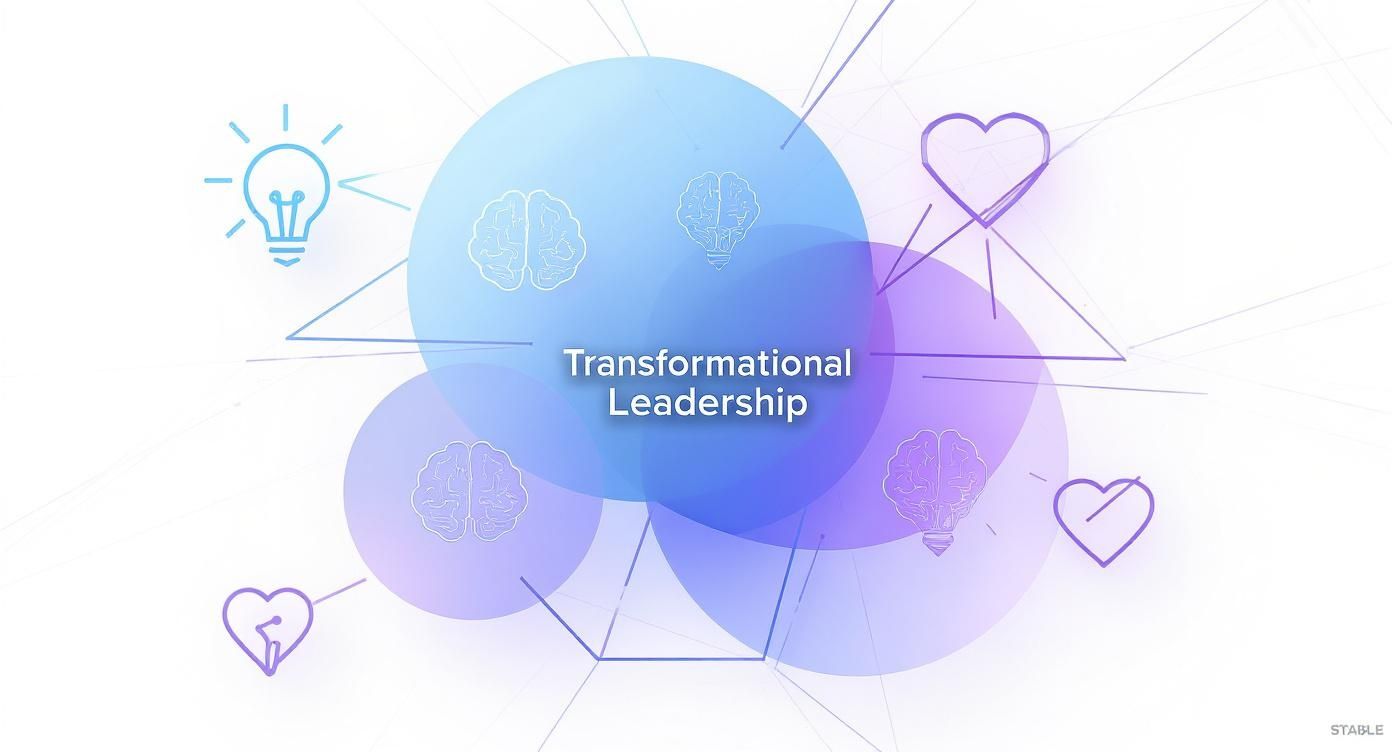
This style is a balance. You are sparking new ideas (the lightbulb), challenging how your team thinks (the brain), and supporting the people you lead (the heart). Each pillar is essential. Get them working together, and you will build a team that not only performs but thrives.
Idealized Influence
The first pillar is Idealized Influence. This means you lead by example. You are the kind of role model your team respects and wants to emulate, not because you are the boss, but because of who you are.
This comes down to integrity. Your team watches you, especially when things get tough. When they see you consistently doing the right thing over the easy thing, it builds deep trust. It makes your influence authentic.
Imagine a project goes wrong. A manager who steps up and takes public responsibility for the team's stumble, rather than pointing fingers, is showing idealized influence. They are shielding their people and owning the outcome. That single act earns a level of loyalty and respect that no memo ever could.
Inspirational Motivation
Next is Inspirational Motivation. This is your ability to paint a compelling picture of the future and make it feel within reach. You do not assign work. You give it meaning.
How? By connecting the dots between the daily grind and the bigger, shared purpose. When people see how their individual contributions move the needle on goals that matter, their whole perspective changes. A mundane task becomes a piece of a meaningful mission.
A great example is a team lead kicking off a difficult project. Instead of diving into the to-do list, they start by explaining why it is so important to your customers or the company. That context turns a checklist into a cause.
A key part of the transformational leadership style is making people feel that their work is important. When employees see the bigger picture, their motivation shifts from external rewards to an internal drive to contribute.
This shift is everything. It is what helps people push through the roadblocks because they believe in where they are going.
Intellectual Stimulation
The third pillar, Intellectual Stimulation, is about challenging your team to think bigger and question the old way of doing things. You build an environment where it is safe to be curious, creative, and a little disruptive.
You do this by asking great questions instead of handing out all the answers. You encourage your team to challenge assumptions, including your own, and experiment with new solutions. This is not about undermining authority. It is about empowering your team to become better problem-solvers themselves.
Here are a few ways to bring this to life:
- Encourage Debate: Foster healthy discussions where different viewpoints are explored without judgment. The best idea should always win.
- Reframe Problems: When the team is stuck, help them look at the challenge from a new angle. Ask the "what if" questions.
- Support Calculated Risks: Create a culture where failure is a learning opportunity, not a career-ending mistake.
For instance, in a brainstorming session, a manager might ask, "What if we had zero budget?" or "How would our biggest competitor tackle this?" These kinds of questions force the team out of their comfort zone and often lead to the most innovative solutions.
Individualized Consideration
Finally, we have Individualized Consideration. This pillar is about seeing and supporting each person on your team as a unique individual. You become a coach and mentor, actively investing in their personal and professional growth.
This requires you to pay attention. You need to listen, observe, and take the time to understand each person's career goals, strengths, and development areas. With that knowledge, you can provide tailored guidance, feedback, and opportunities that resonate.
A manager who notices an employee has a knack for data analysis and assigns them to a project that sharpens that skill is practicing individualized consideration. Even better, they follow up with resources for more training. This personalized support shows people they are valued for who they are, not what they produce. It builds incredible loyalty and helps people reach their full potential.
Comparing Leadership Styles
To get a feel for transformational leadership, it helps to put it side-by-side with other common approaches. There are many leadership models, but looking at how this style stacks up against transactional and servant leadership makes its unique strengths clear. It clarifies why one style might be the right tool for one job, but not another.
Think of it this way: your leadership approach is the operating system for your team. It determines their motivation, their focus, and their performance. This is not about finding the "one true style," but about matching your methods to what your team and your company need to win.
Transformational vs. Transactional Leadership
The classic comparison is with transactional leadership. These two styles are built on fundamentally different philosophies. Transactional leadership is a straightforward exchange, a deal. Leaders set clear goals, and they use rewards (a bonus) or consequences (a bad review) to get people to meet them.
This "if you do X, you get Y" system is effective for keeping things stable and hitting short-term targets. It works best in environments built on structure, process, and tight monitoring. The goal is to execute tasks correctly and efficiently within the existing system.
Transformational leadership is about changing the system itself. Instead of using rewards, these leaders light a fire by rallying the team around a compelling vision. Motivation does not come from a paycheck. It comes from a deep, collective belief in the mission. A transactional leader manages performance. A transformational leader builds potential.
Transformational vs. Servant Leadership
Another style mentioned in the same breath is servant leadership. At first glance, they look similar. Both are people-centric, prioritizing the growth and well-being of their team members. Both styles are built on a foundation of trust and strong relationships.
The real difference is the starting point. A servant leader's primary objective is to serve their team. They put their employees' needs first, working from the belief that if you take care of your people, the organization will thrive. The company's success is a byproduct of a well-supported team.
A transformational leader also cares deeply about their team, but their focus is always fixed on the organization's vision. They develop their people so the team has the skills and drive to innovate and push the company forward. Individual growth is the engine for achieving the larger, collective mission.
While a servant leader asks, "How can I help you be your best?" a transformational leader asks, "How can I help you be your best to help us achieve our vision?" The distinction is subtle but important.
So, how do you choose? It all comes down to what you are trying to accomplish. To make it even clearer, here is a simple breakdown of how these three influential styles compare.
Comparison of Leadership Styles
This table contrasts Transformational, Transactional, and Servant leadership styles across key attributes.
| Attribute | Transformational Leadership | Transactional Leadership | Servant Leadership |
|---|---|---|---|
| Primary Goal | To innovate and inspire long-term, positive change. | To maintain stability and meet short-term objectives. | To serve and empower the team, putting their needs first. |
| Motivation Source | Internal drive, based on a shared vision and purpose. | External rewards and the avoidance of negative consequences. | A desire to help others grow and succeed. |
| Team Focus | Developing followers into future leaders and innovators. | Ensuring followers comply with procedures and meet targets. | Nurturing individual well-being and professional development. |
| Best Environment | Dynamic, changing settings that require innovation. | Stable environments where processes are well-defined. | Organizations with a strong focus on ethics and community. |
Knowing these differences helps you become a more intentional leader. While transformational leadership is a great tool for driving growth and engagement, a great leader knows when to borrow from other playbooks. They can be transactional when a deadline is absolute or act as a servant leader when an employee is facing a personal challenge. The real skill is knowing how to adapt your approach to fit the moment, the mission, and the people you lead.
Applying Transformational Leadership in Your Daily Work
Knowing the theory behind transformational leadership is one thing. Putting it into practice during a tough conversation or a one-on-one meeting is another. The real test of your leadership happens in these small, daily interactions. This is where you turn a grand vision into concrete action and build a culture of growth, one conversation at a time.
This section is about getting practical. We will give you actionable steps to weave these principles into your management routine, showing you how to structure those key moments to inspire your team and spark new ways of thinking. Let's move from theory to reality.
Structure Your One-on-One Meetings for Growth
Your one-on-one meetings are the single tool you have for showing individualized consideration. But too often, they become status updates. A transformational leader sees this time for what it is: a chance to coach, mentor, and connect with each team member on a deeper level.
Instead of asking, "What are you working on?", try shifting the focus to development and growth. Your goal is to create a safe space where your direct reports feel comfortable talking about their challenges, ambitions, and big ideas. This simple shift builds immense trust and proves you are invested in their careers, not their daily output.
Here is a simple framework to get more out of your one-on-ones:
- Start with the Person, Not the Project. Kick things off by asking how they are doing. Check in on their week, their energy levels, or any roadblocks they are hitting. It shows you care about their well-being first.
- Discuss Long-Term Goals. Always carve out time to talk about their career aspirations. Ask questions like, "What skills are you hoping to build this quarter?" or "What kind of projects get you the most excited?".
- Connect Daily Work to the Big Picture. Help them draw a straight line from their day-to-day tasks to the team's broader mission. This reinforces that inspirational motivation and gives their work a sense of purpose.
Give Feedback That Stimulates Growth
Feedback is the engine of intellectual stimulation. How you deliver it determines whether it shuts someone down or sparks a desire to improve. Ditch generic comments like "good job" or "this needs work." Instead, offer specific, actionable insights that challenge your team to think differently.
A great way to do this is to frame feedback around learning and exploration. For instance, instead of saying, "Your presentation was confusing," you might ask, "What was the main point you wanted the audience to walk away with? Let's brainstorm some ways to make that crystal clear next time." This transforms a critique into a collaborative problem-solving session. Honing your coaching skills for managers makes this approach possible.
Transformational feedback is not about judging past performance. It is about building future capability. The goal is to help your team members see new possibilities for themselves and their work.
Create Collaborative Development Plans
A personal development plan should never be a top-down directive. That is a recipe for a document that gathers dust. A transformational leader co-creates these plans with their team members, making sure the goals are meaningful to the individual while still aligning with the organization's needs. This turns a bureaucratic chore into a motivational tool.
Here are a few steps to build a plan that works:
- Identify Strengths and Passions. Start by talking about what the employee enjoys and where they already excel. Development is not about fixing weaknesses. It is also about amplifying strengths.
- Define Aspirational Goals. Ask them where they see themselves in the next one or two years. What skills or experiences will they need to get there?
- Set Clear, Achievable Milestones. Break that big, ambitious goal into smaller, manageable steps. This creates a clear roadmap and gives you regular opportunities to check in and offer encouragement.
- Align with Team Objectives. Connect their personal goals to upcoming team projects or company needs. This shows them how their growth directly fuels the team's success.
Lead Meetings That Encourage Innovation
Meetings are often seen as a productivity killer. But you can flip that script and use them as a forum for intellectual stimulation. A transformational leader facilitates meetings that demand participation, challenge assumptions, and generate fresh ideas. The key is to shift the focus from delivering information to solving problems together.
Try these techniques in your next team meeting:
- Frame the Agenda with Questions. Instead of listing topics, pose them as questions to be solved. For example, "How can we cut our customer onboarding time in half?" invites more engagement than a stale "Onboarding update."
- Assign a Devil's Advocate. Appoint someone to respectfully challenge the popular opinion. This simple practice helps prevent groupthink and forces the team to consider an issue from all angles.
- Use Silent Brainstorming. Before any discussion, give everyone five minutes to quietly write down their ideas. This technique ensures introverted team members' ideas are heard and prevents one or two loud voices from dominating the conversation.
The Upside and Downside of This Leadership Style
Every leadership style has its trade-offs, and transformational leadership is no different. It can do wonders for your team and the organization, but it is not a magic wand. You need to be aware of the potential challenges to make it work.

This image captures the core dilemma. On one hand, you get a rush of innovation (the lightbulb) and a team that feels cared for (the heart). On the other, the constant "on" energy it demands can lead straight to burnout (the warning sign). The real skill is finding a sustainable balance.
Key Benefits for Your Team
The upsides here are huge. They directly tackle some of the most common problems managers face, like disengagement and stale thinking. This style creates an atmosphere where people feel like their work matters and are fired up to bring their A-game.
When you get this right, you will start seeing a few things happen:
- Deeper Employee Engagement: You are not assigning tasks. You are connecting them to a bigger mission. That sense of purpose is a massive motivator and locks in a level of commitment you cannot buy.
- More Innovation: By encouraging your team to question everything and try new things, you build a culture where smart problem-solving becomes the norm. People are not afraid to fail, so they are more willing to take the creative risks that lead to breakthroughs.
- Real Employee Development: Your focus is on coaching and mentoring each person individually. This is not about getting the work done. It is about investing in their careers. That builds incredible skill and loyalty.
The data backs this up. Research links transformational leadership with higher employee trust, job satisfaction, and a real commitment to the organization. It also correlates with stronger job performance, both for individuals and the team as a whole. You can find more details in the full research about leadership impact.
A key advantage of what is transformational leadership style is its ability to build a resilient, high-performing team. By empowering your people and uniting them around a shared vision, you are getting your organization ready to navigate whatever changes come its way.
Potential Drawbacks to Keep an Eye On
No leadership style is a silver bullet. The sheer intensity and emotional energy this approach requires can create some real challenges for you and your team if you are not careful.
One of the biggest risks is leader and team burnout. The constant push for innovation and the high bar you are setting can be exhausting. As a leader, you have to bring a ton of energy and enthusiasm every day, and that is not sustainable long-term without a plan.
It is also not the right fit for every situation. If you are in a stable, process-heavy environment where consistency is king, all this energy for change can feel more disruptive than helpful. It demands a leader who can read the room and know when to push and when to hold back.
Here are a few potential downsides to watch for:
- Dependency on the Leader: The team's motivation can become so attached to one inspirational person that if that leader leaves, the whole team's momentum can evaporate.
- Risk of Misalignment: A charismatic leader can accidentally rally a team around a vision that, while inspiring, does not line up with the company's larger strategic goals.
- Slow to Start: Building the deep trust and psychological safety this style relies on takes time. It will not give you the quick, compliance-based wins you might get from a more transactional approach right away.
Communicate a Clear and Inspiring Vision
Inspirational motivation is about connecting the daily grind to a bigger, more compelling mission. But how do you make that connection real for your team?
PeakPerf’s goal-setting features are built for this. When you set performance or development goals, the platform guides you to frame them within the team’s larger objectives. This simple step helps your team members see exactly how their individual work pushes the collective mission forward. A to-do list becomes a vital part of a shared purpose.
This screenshot shows how PeakPerf’s goal dashboard helps you track progress against key objectives.
With a clear visual layout, you can easily monitor progress, celebrate small wins, and keep everyone pulling in the same direction.
Support Your Team with Individualized Consideration
Acting as a coach and mentor is individualized consideration in a nutshell. It means giving personalized feedback and genuine support to each person on your team.
PeakPerf's feedback and recognition tools are made for these conversations. The platform offers frameworks to help you structure feedback that is specific, objective, and focused on growth. Instead of staring at a blank page for an hour, you can create a thoughtful draft in minutes.
This frees you up to focus on the human side of the conversation, listening to their perspective and offering guidance that is tailored to them. It is a great way to show you are invested in their success.
Foster Intellectual Stimulation and Growth
Transformational leaders do not assign tasks. They challenge their teams to think bigger and find new ways to solve problems. This is intellectual stimulation, and it requires creating the right growth opportunities.
PeakPerf’s performance analytics help you uncover trends and identify skill gaps across your team. You can use these insights to build targeted development plans that stretch your people’s abilities and encourage them to innovate. By understanding where your team shines and where they need to grow, you can assign projects that spark creativity.
For more on this, check out our guide on creating a leadership development plan template to help you structure these efforts.
With the right support system in place, adopting a transformational leadership style becomes a much more manageable process. You can build the habits that inspire your team, drive incredible results, and make you the leader you want to be.
Common Questions About Transformational Leadership
When you first start exploring a new leadership style, it is natural to have a few questions. Let's tackle some of the most common ones I hear from managers trying to figure out what transformational leadership looks like day-to-day.
Can Anyone Learn To Be a Transformational Leader?
Yes. While some people might seem like "natural" visionaries, this leadership style is not a personality trait you are born with. It is a set of skills you can build.
At its core, it is about learning how to listen with intent, paint a picture of the future that gets people excited, and coach your team members toward their own growth. These are all teachable skills. The real keys are consistent practice and a willingness to look at your own habits.
How Does This Style Work With a Remote Team?
It is not only possible, it is effective for remote teams, but you have to be more intentional about it. When you cannot rely on physical presence, your job is to build psychological safety and trust through a screen.
This means prioritizing video calls for the important stuff where tone and body language matter. It means using tools like Slack or Teams to celebrate wins and keep everyone looped in on progress. Your one-on-one meetings become even more critical for that individualized consideration piece.
The core principles do not change because you are remote. You are still inspiring your team, challenging them to think bigger, and supporting their growth. You have to adapt how you deliver on those principles in a virtual world.
What Is the First Step To Becoming a More Transformational Leader?
The simplest, most impactful first step is to get serious about the quality of your feedback. That starts with getting feedback on yourself.
A great way to do this is to learn more about the 360-degree review feedback process. It gives you a full picture of your impact from every angle: your boss, your peers, and your direct reports. Use that insight to make small, consistent tweaks in how you show up for your team.
Becoming the leader your team needs is a journey. With PeakPerf, you can confidently handle your toughest leadership moments. Prepare for clear, impactful conversations in minutes, not hours. Get started for free on PeakPerf.


