A Manager's Guide to Writing an Employee Review
Writing an effective employee review follows a simple, repeatable process. You define your goal, gather real evidence, structure the feedback with care, and build a plan for what comes next.
This is not about checking a box. You can turn a mandatory HR task into a genuine conversation about an employee's growth and performance. Getting these steps right makes your feedback fair, balanced, and impactful.
Laying the Groundwork for a Productive Review

Before you open a blank document, you must do the prep work. This is the most critical part of the entire process.
Jumping straight into writing a review without facts and a clear purpose leads to vague feedback and awkward conversations. The goal is to move past feelings and anchor the evaluation in objective, observable data you gathered over the review period.
This prep work makes the writing part smoother for you. It also builds trust with your employee because they see the feedback is based on facts, not your opinion.
Define Clear Goals for the Review
First, what are you trying to achieve with this review?
Is the main goal to correct a performance issue? Is it to recognize a star player and map out their future? Or is it to chart a path for a solid performer who has high potential? Your answer shapes the tone, content, and direction of the entire document.
Without a clear goal, a review can feel like a random list of comments that lead nowhere. A focused objective ensures every piece of feedback you give serves a purpose. For instance, a solid goal might be, "Reinforce John's excellent project leadership skills while creating a concrete plan to improve his cross-team communication."
A well-prepared review is not about judging the past. It is about coaching for future success. You can use it to align an individual's growth with the team's goals, turning feedback from a verdict into a development tool.
Gather Comprehensive Evidence
Your feedback is only as good as the evidence you have to back it up.
Relying on memory is one of the most common traps for managers. It leads to recency bias, where you only focus on what happened in the last few weeks instead of the entire year. To avoid this, you need a system for gathering information throughout the performance cycle.
This is more important than ever. Traditional performance reviews have received criticism for years. In 2019, about 95% of HR managers were unhappy with their company's performance systems. This pushed many to shift toward more continuous, data-driven feedback. You can learn more about trends in employee performance feedback.
To build a complete and balanced picture, you will want to pull from several sources:
- Project Outcomes: Did projects hit their deadlines? Did the quality of work meet expectations? Document the results and note the employee's specific contributions.
- Peer Feedback: Talk to the people who work with your employee every day. Ask their colleagues for specific, concrete examples of collaboration, communication, and teamwork.
- Self-Assessment Notes: Always have the employee complete a self-review. This gives you insight into their perspective on their wins, challenges, and accomplishments.
- Behavioral Observations: Keep a running log, a simple document will do, of specific, observable behaviors. Note when an employee demonstrated company values, took extra initiative, or handled a tough situation well.
Structuring Your Review for Maximum Impact
How you lay out the review document matters. A clear, logical flow makes it easier for you to write. It also makes the feedback much easier for your employee to hear and process. Think of it this way: a solid structure turns a list of comments into a constructive conversation.
The right framework walks the employee through their performance journey. It starts with wins, moves to growth areas, and wraps up with a clear plan. This balanced approach is your best defense against defensiveness. It keeps the focus on development, not judgment.
Create a Positive and Purposeful Opening
Start on the right foot. The opening paragraph sets the tone for the conversation, so you want to nail it. Ditch generic introductions. Instead, get straight to the point. State the purpose of the review and reinforce their value to the team.
Your goal here is to create a forward-looking, supportive atmosphere from the start. This helps the employee feel like you are in their corner, not putting them under a microscope.
For instance, you could open with something like: "The purpose of this review is to discuss your significant contributions over the past year and map out your goals together for the coming months. Your work on the Q3 launch was instrumental, and I want to talk about how we can build on that success."
Document Strengths with Specific Examples
After you set the stage, address their strengths. This section needs to be packed with specific, data-backed examples of what they accomplished. Vague praise like "good job" has almost zero impact. You need to connect their specific actions to tangible outcomes for the team or the company.
Give context to every strength you highlight. Explain how their actions made a difference. This is not just about validation. It shows you pay close attention to their work and understand their contribution.
As you write this part, ask yourself:
- Did it connect to a goal? How did their work push a team or company objective forward?
- Can I prove the impact? Use metrics or project outcomes to make it real. For example, "Your new onboarding checklist cut new hire ramp-up time by 15%."
- Was it a behavior worth repeating? Acknowledge things like initiative, great collaboration, or mentorship. For example, "You consistently stepped up to mentor the junior developers, which improved the team's overall code quality."
Address Areas for Growth Objectively
This is where things can get tricky. Addressing areas for growth demands care and complete objectivity. The key is to frame this section around development opportunities, not a list of failures. Focus on specific, observable behaviors that need adjustment. Steer clear of any commentary on personality or attitude. The goal is to be helpful, not critical.
Stick to neutral language and provide clear examples of the behavior you are discussing. Then, explain the impact of that behavior on their work, the team, or a project. Instead of saying, "You're disorganized," try something more concrete: "On three occasions this quarter, project deadlines were missed due to incomplete task tracking. This caused delays for the marketing team." Using a solid performance review template for managers can give you the right language for these tougher conversations.
The secret to constructive feedback is focusing on the 'what' and 'how,' not the 'who.' Describe the action and its outcome without laying blame. This keeps the conversation centered on performance and opens the door for productive problem-solving.
Create a Forward-Looking Development Plan
Always end by looking ahead. The development plan turns feedback into action. It shows you are committed to their growth. This should not be a top-down directive. It has to be built together, with clear, actionable steps the employee can take.
Each development goal should spell out what they will do, what resources you will provide, and how you both will measure progress. A strong plan transforms the review from a backward-glancing report card into a forward-looking roadmap for their success. It’s the clearest way to show you are invested in their future here.
Using Frameworks to Deliver Clear Feedback
Writing a review can feel subjective. Frameworks help. They are not about being robotic. They are about being clear. Using a proven model helps you anchor your feedback in specific, observable actions, which is key to a fair and productive review.
Instead of vague judgments, you get a structure that turns a potentially awkward conversation into a concrete discussion about performance and growth. It shifts the entire dynamic.
This simple four-step flow is a great mental map for structuring your review from start to finish.
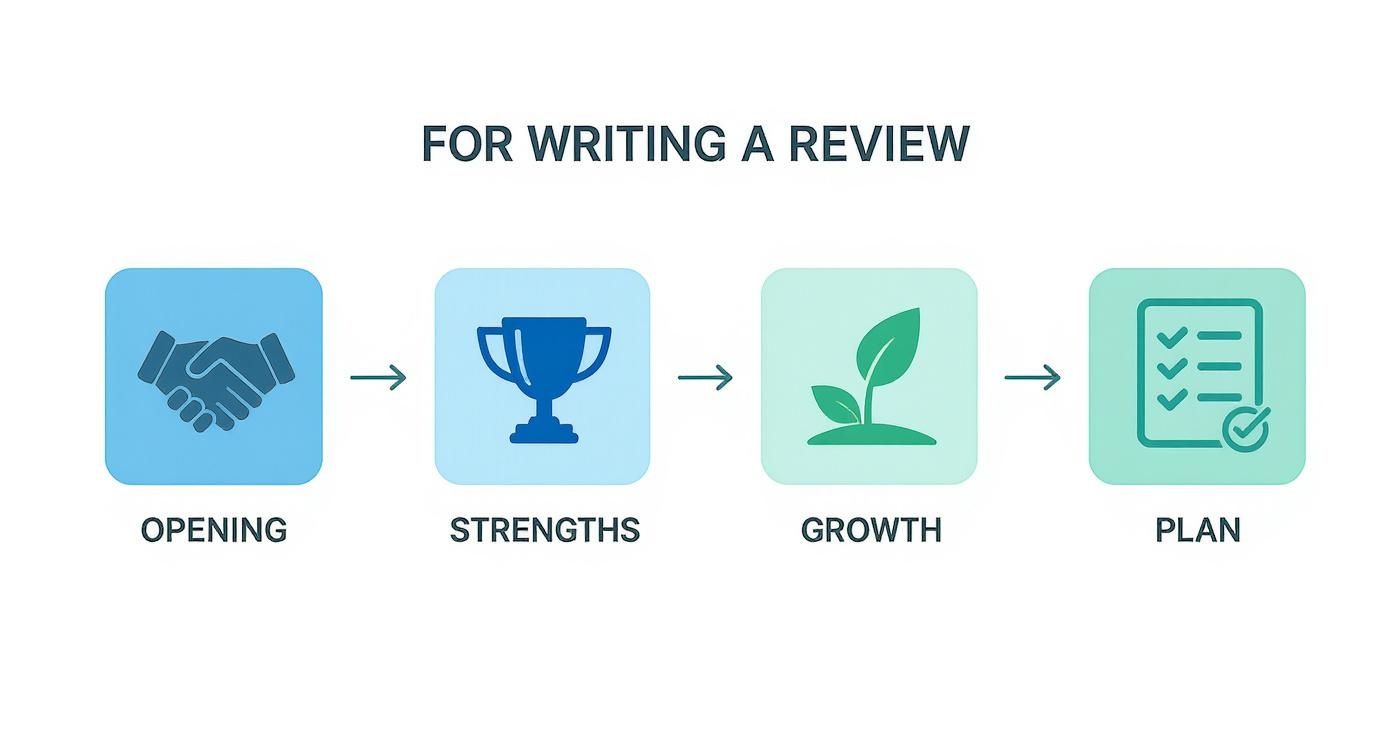
As you can see, a well-balanced review moves logically from a positive opening to celebrating strengths. Then it tackles growth areas before landing on a solid, forward-looking plan.
Use SBI for Specific Feedback
One of the best tools for this is the Situation-Behavior-Impact (SBI) framework. It’s a simple way to deliver feedback that’s easy to understand and hard to argue with because it’s based on facts, not feelings. It works for praise as well as for constructive criticism.
Here’s the breakdown:
- Situation: Pinpoint the specific "when and where."
- Behavior: Describe the exact, observable action the person took. No interpretations, just facts.
- Impact: Explain the result of that behavior on the project, the team, or the business.
Instead of a generic, "You were great in the client meeting," SBI helps you deliver something more meaningful: "In yesterday's client kickoff meeting (Situation), you walked them through the project timeline and backed up every answer with data (Behavior). That immediately built trust and set a fantastic tone for the whole project (Impact)."
This is exactly how you can give constructive feedback to employees without triggering defensiveness.
A framework like SBI does not remove the human element. It makes the conversation more productive. By focusing on actions and outcomes instead of personality traits, you create the foundation for a fair and effective review.
The SBI framework helps you structure your thoughts clearly, separating observation from judgment. Here’s a quick look at how it works for both positive and constructive feedback.
Applying the SBI Framework for Employee Feedback
| Framework Component | Positive Feedback Example | Constructive Feedback Example |
|---|---|---|
| Situation | "During the Q3 project planning session last Tuesday..." | "In the team stand-up this morning..." |
| Behavior | "...you created a detailed risk assessment chart that nobody had thought of." | "...when Alex was sharing his update, you interrupted him twice to ask questions." |
| Impact | "...the impact was that we identified two major roadblocks ahead of time, which saved the team from potential delays down the line." | "...the impact was that he lost his train of thought, and the rest of the team did not get to hear his full update. It also disrupted the flow of the meeting." |
As you can see, the formula keeps the feedback specific and tied to a real-world outcome. This makes it easier for the employee to either repeat the positive behavior or correct the negative one.
Set SMART Goals for Development
You have delivered the feedback. What's next? You need a development plan. Vague goals like "work on your communication skills" are useless because no one knows what "done" looks like.
This is where SMART goals are a manager’s best friend. They provide the structure needed to create goals that are actionable.
A goal must check all five of these boxes:
- Specific: What, exactly, needs to be done?
- Measurable: How will we track progress and know when it's achieved?
- Achievable: Is this goal realistic right now?
- Relevant: Does it align with their role and our team's objectives?
- Time-bound: What’s the deadline?
Let's transform a fuzzy goal. "Get better at project management" becomes: "By the end of Q3, complete the online Project Management Professional certification (Specific, Achievable, Relevant, Time-bound). You will then lead the next internal website update project, and we will measure success by a 100% on-time completion rate and positive feedback from at least 3 stakeholders (Measurable)."
See the difference? There is no room for confusion. Your employee has a clear target, and you have a concrete way to measure their progress. Frameworks like these ensure every part of your review is purposeful and drives real results.
Choosing the Right Tone and Language
The words you choose in a performance review are as important as the data you gathered. Your tone can be the difference between a motivated employee and a demoralized one.
A professional, supportive tone is non-negotiable. It helps build the trust needed to turn a review from a critique into a collaborative conversation about what’s next for their career. The goal is always to be direct and clear without being harsh.
This matters more than ever right now. Global employee engagement is at a low 21% as of 2025. With nearly half of U.S. workers considering a job change, effective performance management is a critical retention tool. This is especially true when you consider that 42% of voluntary departures are seen as preventable.
Use an Active Voice and Focus on Actions
Always write in an active voice. It’s a simple shift that makes feedback clearer and more direct by showing who did what.
- Passive voice: "The project was completed ahead of schedule." (Okay, but by who?)
- Active voice: "You completed the project ahead of schedule." (Better. It gives credit where it's due.)
This small change assigns clear ownership. It also helps you keep the focus on observable actions and behaviors, not on personality traits, which are impossible to measure and easy to dispute.
Sample Phrases for Different Scenarios
Having a few go-to phrases in your back pocket can make the writing process smoother. The key is to always be specific and tie your comments to concrete examples. For a much bigger list, check out our extensive guide to performance review phrases for managers.
For a High Performer
When you write about a top employee, do not say they are great. Show them how their exceptional work moves the needle. This validates their effort and shows them what to keep doing.
- "You consistently exceed expectations, like when you increased Q3 sales by 15%."
- "Your initiative on the new workflow project directly streamlined team operations, saving us five hours a week."
- "Your mentorship of the junior team members has been instrumental in building their skills and confidence."
Language that is specific, objective, and forward-looking shows you are invested in an employee's success. It shifts the focus from judging past performance to building future potential. This makes the feedback more constructive and motivational.
For a Solid Performer with Growth Potential
Many of your people will fall into this category. They get the job done but have room to stretch. Your language here should be encouraging. Frame feedback as an opportunity for development.
- "You are fantastic at meeting all your project deadlines. To build on that, let's focus on you taking more of a lead role in the initial project planning stages."
- "Your technical skills are a huge asset to the team. A great next step would be to enhance your client presentation abilities so you can better showcase that great work."
For an Underperformer
This is the tough one. Delivering difficult feedback requires a balance of compassion and clarity. Be direct, but focus on the behavior and its impact, never on the person.
Here's a simple, three-step model:
- Start with the observation: "I noticed that on three separate occasions last month, your reports were submitted after the deadline."
- Explain the impact: "This created a domino effect, causing delays for the finance team and requiring them to work late to hit their own targets."
- Define the needed change: "Moving forward, the hard deadline for these reports needs to be the end of business on the final Friday of each month. Let's talk about what we can do to make sure that happens."
This approach keeps the conversation objective and zeroed in on a solution. It gives the employee a clear path to get back on track and resets expectations without ambiguity.
How to Avoid Common Review Pitfalls
Even well-intentioned managers can fall into common traps when writing performance reviews. The good news is that knowing what they are is half the battle. Once you can spot them, you can build a fairer, more accurate, and more helpful evaluation.
These mistakes do not come from malice. They usually come from natural human biases that can warp your perception of an employee's performance over a full year. Actively working against these tendencies is what separates a good manager from a great one.

Guarding Against Common Biases
Recency bias is the most common pitfall. It’s the tendency to let the last few weeks or months overshadow everything that happened earlier in the year. A big win from Q1 is forgotten after a minor stumble last week. The best defense here is simple: keep a running log of notes throughout the entire review period. It does not have to be fancy, but it ensures you evaluate the whole picture, not the final chapter.
Then there is the halo/horns effect. This is when one standout trait, good or bad, casts a glow or a shadow over everything else. For instance, if an employee is a fantastic presenter (the halo), you might gloss over their consistent trouble with hitting deadlines. On the flip side, if they are always a few minutes late to meetings (the horns), you might unfairly discount their incredible technical expertise.
To deliver a fair review, you have to assess each competency on its own merit. Ground every point of feedback in specific, documented examples. This simple practice stops one part of their performance from coloring your view of all the others.
Do not underestimate the impact of getting this right. The quality of your reviews directly affects retention. Recent data shows that 18% of new hires leave during their probationary period, often because of poor feedback and evaluation. When you consider that only 46% of new hires in Europe are deemed successful and 36% of employees are unhappy with their jobs, the need for a better approach is clear. You can find more of these insights in recent 2025 workforce research.
Delivering Feedback Constructively
Delivering tough feedback is part of the job, and it is rarely easy. The key is to handle it with care. Your goal is not to tear someone down. It is to address a performance gap without crushing their motivation.
Here are a few tips for navigating those tricky conversations:
- Be direct and specific. Vague feedback like "you need to be more proactive" is useless. Give them a concrete example of what you mean.
- Focus on behavior, not personality. Always talk about the action and its impact. It is about what they did, not who they are.
- Make it a collaboration. Frame the conversation around solving a problem together. Ask for their perspective first, then work on an improvement plan as a team.
This approach transforms a potentially demoralizing confrontation into a productive, forward-looking conversation. It shows your employee you are in their corner, and it turns a difficult moment into an opportunity for real growth.
Frequently Asked Questions About Employee Reviews
When you stare at a blank page, a few questions always seem to pop up. Let's tackle them head-on so you can move forward with confidence.
How Long Should a Performance Review Be?
This is a common question. There’s no magic word count, but the goal is to be comprehensive without being overwhelming.
You need enough detail to include specific examples for both strengths and areas for growth. But you do not want to hand your employee a novel that they will never read. Generally, a few well-written pages get the job done. It is about quality and clarity, not length.
How Much Employee Input Should I Include?
A lot. Your employee’s input is essential. Before you start writing, you should always ask for a self-assessment.
Doing this accomplishes two critical things:
- First, it gives you a window into how they see their own performance, which can be revealing.
- Second, it immediately flags any major gaps between your assessment and theirs. Those gaps are exactly what you need to discuss.
When you weave their perspective into the review, it signals that this is a conversation, not a lecture. It makes the process feel more collaborative and less like a top-down directive.
The best employee reviews are dialogues, not monologues. When an employee feels heard and sees their input reflected in the document, they are far more likely to engage with the feedback and buy into the development plan you build together.
What if My Employee Disagrees With the Review?
It will happen. Disagreement is normal. Sometimes, it’s a productive part of the process. The key is how you handle it.
If an employee pushes back on your feedback, your first job is to listen. Do not get defensive. Ask them to walk you through their perspective and provide specific examples that support their view. The goal is not to "win" the argument but to find a shared understanding.
This is where your year-long prep work pays off. If you have been gathering objective evidence and keeping notes, you can calmly refer back to that data.
Focus the conversation on finding common ground and reaffirming that you are committed to their growth. Even if you do not see eye-to-eye on every point from the past, the meeting should end with a clear path forward. An evidence-based review prevents most of these disagreements from happening.
Ready to make your next performance review more effective and less stressful? PeakPerf provides managers with guided workflows and proven frameworks to create clear, fair, and impactful feedback in minutes. Go from a blank page to a professional draft with tools that help you prepare for every leadership moment. Start for free at PeakPerf and see how easy it is to lead confident conversations.


