How to Give Feedback: A Growth-Driven Manager's Guide
Giving feedback that helps someone grow requires clarity, specific examples, and psychological safety. A good way to structure your thoughts is around the situation, the person's behavior, and the impact. This method removes judgment and starts a real conversation.
Why Most Feedback Fails to Make an Impact

You have likely spent time planning what you thought was helpful feedback, only to have it fall flat. Worse, your employee became defensive.
This happens because a gap often exists between your intent as a manager and how your employee hears the message.
Well-meaning advice misses the mark when it feels like a personal attack instead of a supportive observation. Without a clear, fact-based structure, feedback sounds vague, overly critical, or unfair. This triggers a defensive response. Once that happens, the employee’s ability to listen and learn shuts down.
The Perception Gap in Communication
Your goal is to help someone improve. If the delivery is off, all they hear is criticism. They might walk away feeling micromanaged or that their contributions are not valued. This leads to disengagement. It is often not what you say, but how you say it and the context you build around it.
Data supports this. Only 16% of employees describe their most recent manager conversation as meaningful. When people receive meaningful feedback, their engagement increases four times more than what hybrid work alone provides. The problem is that only 50% of employees act on the feedback they receive. This tells us the feedback is not specific or actionable enough.
The number one reason feedback fails is ambiguity. If your employee has to guess what you mean or what they need to do differently, you have lost the opportunity for growth.
To give you a clearer picture of what to avoid, here is a quick look at some common feedback mistakes and how to correct them.
Common Feedback Failures and Effective Solutions
This table breaks down frequent mistakes managers make and offers a better way forward.
| Common Failure | Why It Fails | Effective Solution |
|---|---|---|
| Vague Praise: "Good job on the project." | It is generic and does not tell the employee what specific behavior to repeat. They do not know what was good. | Be Specific: "The way you organized the project timeline with clear milestones was excellent. It kept everyone on track." |
| The "Feedback Sandwich" | People often ignore the criticism placed between two compliments, or they feel the praise is insincere. | Be Direct and Kind: State your positive intent clearly. "I want to see you succeed, so let's talk about..." |
| Personal Judgments: "You seemed disengaged." | This is an assumption about their internal state. It is an interpretation, not an observation, and invites defensiveness. | Focus on Observable Behavior: "I noticed you were quiet during the team meeting and did not contribute to the brainstorm." |
| Saving It All for the Annual Review | By waiting, you let small issues fester and miss opportunities for immediate course correction. It feels like an ambush. | Make It Timely: Provide feedback as close to the event as possible. This makes it more relevant and easier to recall. |
Avoiding these common traps is half the battle. When you shift your approach to be more specific, timely, and behavior-focused, you set the stage for a productive dialogue instead of a confrontation.
Common Barriers to Effective Feedback
A few psychological hurdles can stop well-delivered feedback from getting through. Knowing what they are is the first step to getting over them.
- Confirmation Bias: We are wired to accept feedback that aligns with how we already see ourselves and push back against anything that does not fit that picture.
- Fear of Negative Consequences: Employees often worry that negative feedback is a negative mark that affects their job security, reputation, or relationship with you.
- Lack of Trust: If there is not a solid foundation of trust, even constructive feedback will be met with suspicion. It is seen as an attack, not an attempt to help.
These barriers are why having a framework is so important. By preparing your thoughts, you deliver feedback that feels supportive, objective, and focused on future improvement, not past mistakes. The same principles apply whether you are talking to your team or learning about strategies for collecting customer feedback. It is all about creating a chance for genuine development.
Preparing for a Constructive Feedback Session

The best feedback conversations are decided before you sit down to talk. The quality of your prep work directly dictates the outcome. Improvising often leads to vague statements, emotional reactions, and a breakdown in communication.
Your job is to turn a potentially tense moment into a constructive dialogue. You shift away from subjective opinions and ground the conversation in objective facts. When you walk in with specific examples, you take personal judgment out of the equation and focus everyone on observable behaviors and their results.
This prep work has another benefit: it calms your own nerves. When you know you have clear, factual examples and a defined purpose, you can lead the conversation with confidence, not anxiety.
Gather Specific and Objective Examples
Evidence is everything. Without it, your feedback is an opinion, and opinions are easy to dismiss. Before you schedule the meeting, your first job is to collect concrete instances of the behavior you need to discuss.
Adopt a journalistic approach. You are here to report the facts, not your interpretation of them. Instead of thinking, "John was disengaged," document what you saw.
- Weak Example: "You seemed checked out during the client presentation."
- Strong Example: "During yesterday's client presentation, I noticed you were looking at your phone and did not ask any questions when the client shared their concerns."
The second example is factual and undeniable. It points to a specific action at a specific time, creating a solid, non-emotional starting point for a real conversation. You can pull data from your project management tools, reference specific emails, or look at performance dashboards to ground your feedback.
Define a Clear Purpose for the Conversation
Every feedback session needs a single, clear goal. Are you trying to correct a recurring issue, praise exceptional work, or coach someone toward a new skill? If you try to cover too much at once, you will overwhelm the employee and dilute your most important message.
Before the meeting, write down one sentence that summarizes what you want to achieve.
The purpose of this conversation is to help you see how missing project deadlines impacts the team's workload, so we can figure out a solution together.
This statement becomes your guide. If the conversation gets emotional or goes off track, use it to gently guide it back. Having a clear purpose is also a key part of building a great one on one meeting agenda, making sure every minute you spend together is productive.
Anticipate Reactions and Plan Your Responses
People react to feedback in different ways. Some get defensive, some shut down, and others are receptive. Spending a few minutes thinking through potential reactions helps you prepare responses that de-escalate tension and keep the tone constructive.
Think through a few common scenarios:
- Defensiveness: If they say, "That's not fair, everyone else does it," you can respond calmly with, "I appreciate you sharing that. For now, I'd like to focus on this specific example and how we can work on it together."
- Silence: If they go quiet, give them a moment. Do not rush to fill the space. You can gently prompt them with, "I know this is a lot to take in. What are your initial thoughts?"
- Agreement: If they immediately agree, you can pivot to problem-solving. "I'm glad we are on the same page. Let's talk about what support you need to make a change."
By anticipating these paths, you will not be caught unprepared. You can respond with empathy and keep the conversation moving toward a positive outcome.
Use a Pre-Conversation Checklist
To make sure you have covered all your bases, a simple checklist is useful. It helps organize your thoughts and ensures you walk into that room feeling prepared and confident, not stressed.
- What is the single most important message I need to deliver?
- What are two or three specific, factual examples I will use?
- What is the impact of this behavior on the team, project, or company?
- What is my desired outcome for this conversation?
- What open-ended questions can I ask to encourage dialogue?
This is not about creating a rigid script. It is about building a repeatable process that turns your preparation from a source of anxiety into a tool for success. It ensures every feedback conversation you lead is fair, focused, and about growth.
Mastering Feedback Delivery with the SBI Model
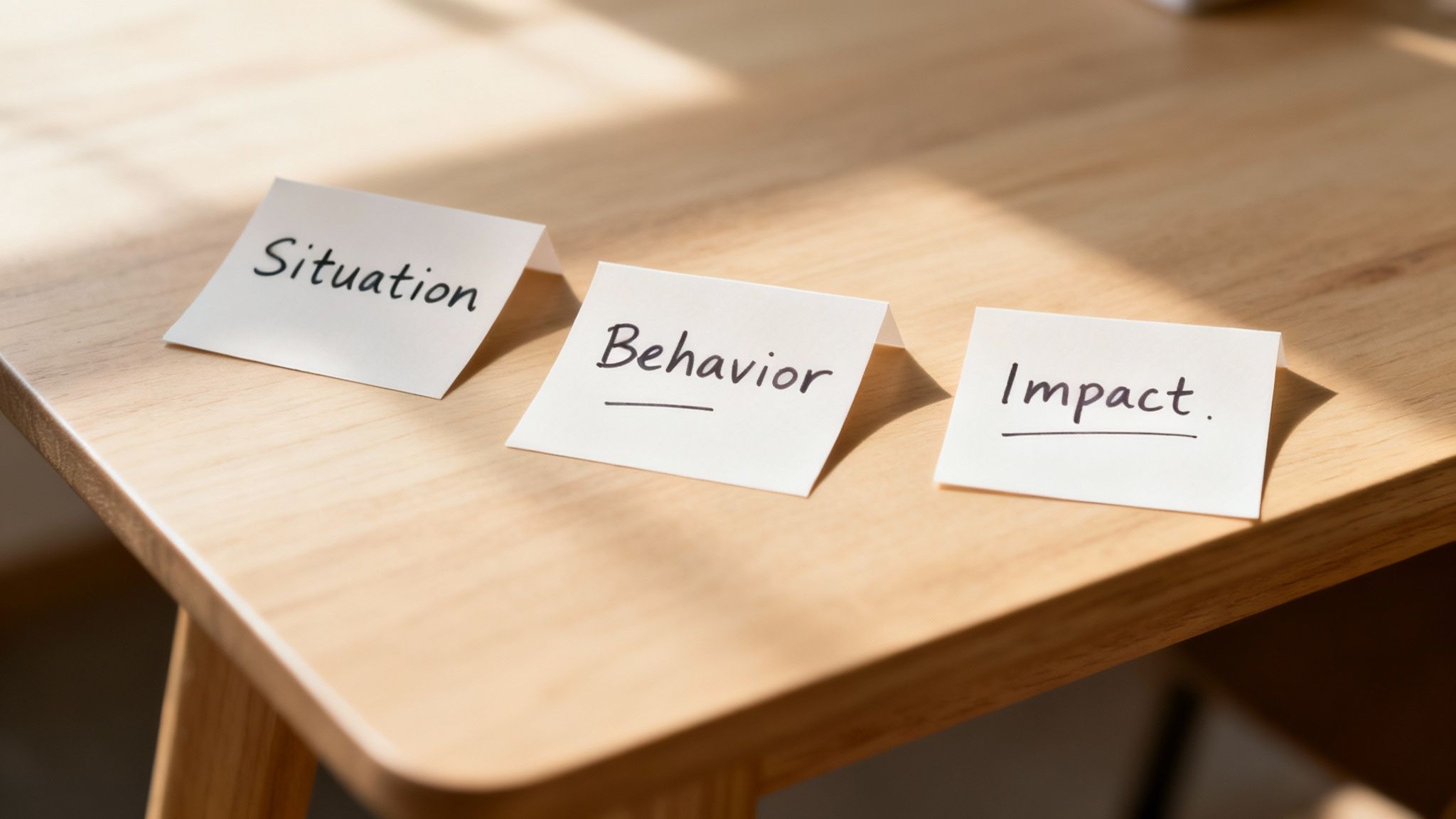
After you have done your prep work, it is time to structure the conversation. The best feedback is clear, objective, and feels more like coaching than a confrontation.
This is where a solid framework is helpful. One of the best is the Situation-Behavior-Impact (SBI) model. It helps managers learn how to give feedback effectively.
SBI gives you a simple, repeatable script that removes the emotion and personal judgment that often derail these talks. It forces you to stick to the facts, which makes it easier for your employee to hear what you are saying. By breaking it down into three parts, you create a logical flow from context to action to outcome.
Understanding Situation
First is Situation. This is your chance to set the scene. You need to get specific about the "where and when" of the event you are discussing. Pinpointing the exact context helps your employee immediately recall the moment you are talking about.
Vague statements like "last quarter" or "in general" do not work. They leave the person guessing and can feel like a broad attack. You have to be precise.
Think of it like this:
- "During the team planning meeting on Tuesday morning..."
- "In the client call with ACME Corp yesterday afternoon..."
- "When you submitted the Q3 performance report last Friday..."
Starting with a clear Situation grounds the conversation in a shared reality. It instantly shows you are talking about a specific instance, not making a sweeping judgment about their character.
Describing the Behavior
Next comes Behavior. This is the most important part of the SBI model. Your job here is to describe what the person did or said in purely factual terms. Think like a camera. Report what you saw and heard, leaving out any assumptions or interpretations.
You are describing an action, not labeling a person. Getting this right is everything.
Look at the difference:
- Judgment (Do not do this): "You were unprofessional in the client meeting."
- Behavior (Do this): "You interrupted the client multiple times while they were explaining their concerns."
The first one is a label that immediately puts someone on the defensive. The second is an objective description of an action. It is hard to argue with a fact. Stick to what they said or did, and you will keep the conversation on track.
Explaining the Impact
The final piece is Impact. This is where you connect the dots for your employee. You explain the consequences of their behavior, how it affected you, the team, the project, or the company. This step makes the feedback stick because it helps them understand why it matters.
The Impact statement has to be tangible. It shows the real-world effects of their actions, giving them a compelling reason to listen and adapt. For a closer look at how this plays out, you can find many helpful manager feedback examples that bring the model to life.
The Impact statement is what makes your feedback motivating. It answers the "So what?" question and helps the employee see the connection between their individual actions and the bigger picture.
When you explain the impact, you can touch on its effect on emotions, productivity, or business goals. A simple frame like, "When you did X, the impact on me was Y" makes it feel less like an accusation and more like you are sharing your perspective.
Applying SBI in Real-World Scenarios
To see how this all works together, let's walk through how to use the SBI model for both good and bad situations. The structure stays the same. Only the focus changes.
Example of Corrective Feedback
Let's say an employee, Alex, has been showing up late to team meetings.
- Situation: "In our team sync this morning..."
- Behavior: "...you joined the call ten minutes after we started."
- Impact: "...which meant we had to repeat the initial discussion for you, and it pushed our entire agenda back. This affects the team's ability to get through our key decisions for the day."
The feedback is direct, factual, and links the behavior to a clear team-level problem. Alex knows exactly what the issue is and why it needs to change, all without feeling personally attacked.
Example of Positive Feedback
Now, let’s flip it. Imagine a team member, Maria, excelled in a presentation.
- Situation: "During the project kickoff with the leadership team yesterday..."
- Behavior: "...the way you clearly explained the project risks and had thoughtful answers prepared for their questions was impressive."
- Impact: "...it built a lot of confidence in our plan and helped us secure their full support right from the start. Your preparation made the entire team look great."
This is much more effective than a simple "good job." Maria now knows exactly which behaviors to repeat and why they were effective.
The table below offers a few more scripts to show how versatile the SBI model is across different common workplace moments.
SBI Feedback Model Examples
This table provides practical scripts using the SBI model for various workplace scenarios, illustrating how to structure both positive and corrective feedback.
| Scenario | Situation | Behavior | Impact |
| :--- | :--- | :--- |
| Missed Deadline | "On Friday's project update..." | "...the final report was not submitted by the end of day as planned." | "This delayed the client's review, and now we risk missing our launch date." |
| Exceptional Teamwork | "During the final push for the Q1 launch..." | "...you proactively stayed late to help the engineering team resolve a critical bug." | "Your help allowed us to deploy on schedule and prevented a major setback." |
| Poor Communication | "In the email you sent to the sales team yesterday..." | "...you announced the new feature without including the training guide we discussed." | "This created confusion, and the support team received over 20 tickets from sales reps who were unprepared for client questions." |
| Proactive Problem-Solving | "When the client reported an issue with their data migration last week..." | "...you immediately scheduled a call with them, identified the root cause, and presented a clear solution." | "This turned a potentially negative situation into a positive one and strengthened our relationship with the client." |
When you use the SBI model consistently, you start building a culture where feedback is seen as a normal, helpful part of growing, not something to dread.
How to Adjust Your Tone for Different Scenarios
The words you choose are only half the story. In any feedback conversation, your tone often speaks louder than the words themselves. It is the invisible force that determines whether your message lands as supportive help or a critical attack.
Consciously shifting your tone to fit the person and the situation is a necessary leadership skill. It is a signal of empathy, creating the psychological safety someone needs to hear what you are saying.
The right tone builds trust. The wrong one can destroy it in an instant.
We will break down the three essential tones every manager needs to master: supportive, direct, and developmental. Knowing when and how to use each one allows you to tailor your delivery for maximum impact while keeping your working relationships strong.
When to Use a Supportive Tone
Think of the supportive tone as your tool for reinforcement. It is warm, appreciative, and designed to build confidence and encourage positive behaviors. You use this when you see someone doing great work and you want them to know it and keep doing it.
A supportive tone is perfect for situations like these:
- Acknowledging Extra Effort: When an employee puts in extra hours or goes above and beyond, a supportive tone validates that hard work. It makes them feel seen and valued.
- Building Confidence: For a team member learning a new skill or feeling unsure, supportive feedback is the fuel they need to keep going.
- Reinforcing Company Values: Catching someone living out a core company value is a golden opportunity. Reinforcing it with a positive, supportive tone encourages everyone else to do the same.
Example Phrasing: "I was impressed with how you handled that difficult client call earlier. Your patience and clear communication were spot-on."
Adopting a Direct Tone
Sometimes, ambiguity is your enemy. A direct tone is for moments when you need absolute clarity. You use it for addressing critical performance issues, correcting a repeated mistake, or discussing behavior that is harming the team.
Direct is not aggressive. It is firm, focused, and leaves zero room for misinterpretation.
Being direct means getting straight to the point while staying professional and respectful. The goal is clarity, not confrontation. Your body language should be neutral, your voice calm and steady.
A direct tone works because it cuts through emotional fluff and focuses on the issue and its impact. Your goal is to make sure the message is received exactly as you intend, especially when the stakes are high.
For instance, if a team member repeatedly misses deadlines, a gentle, hinting approach will not work. You need to be direct, state the facts using a model like SBI, and clearly explain the consequences.
Example Phrasing: "We need to talk about the project deadline. This is the third time it has been missed, and it is now impacting our client relationship."
Fostering Growth with a Developmental Tone
The developmental tone is about coaching and looking ahead. You shift into this mode when you are helping an employee grow their skills, prepare for a new role, or work through a challenge. It is collaborative, forward-looking, and driven by questions.
This tone feels much more like a partnership. You are not just telling them what to do. You are asking open-ended questions to guide their thinking and empower them to find their own solutions.
This approach is ideal for:
- Career Pathing Discussions: When you are talking about an employee's long-term goals and what it will take to get there.
- Skill Gap Coaching: You have identified an area for improvement that could make them more effective, and you are helping them build a plan.
- Delegating New Responsibilities: When you hand off a challenging new task and want to coach them through it, not just assign it.
Your language here should be encouraging and focused on potential. Using phrases like, "What are your thoughts on how we can..." or "Let's brainstorm some ways you could..." invites them into the process. This approach empowers your team to take real ownership of their professional growth.
Creating Actionable Next Steps and Following Up

A feedback conversation without a clear plan is a talk. If you want your feedback to stick and drive real change, you must build a bridge from this conversation to future action. Nobody should leave the room until you have a documented agreement on what happens next.
This part of the process separates good managers from great ones. The follow-up is your proof that you are invested in their development, not just checking a box or pointing out flaws. It turns a one-time event into an ongoing rhythm of growth and support.
Skip this, and even the most perfectly delivered feedback will fade. You will be having the same conversation again in a few months.
From Feedback to a Forward-Looking Plan
After you have shared the feedback and given them a chance to respond, you should pivot the conversation toward solutions. Your job is not to dictate the plan, but to guide them toward defining their own next steps. This creates a stronger sense of ownership.
Start the process with collaborative, forward-looking questions.
- "Based on what we just talked about, what is one thing you think you could try differently next time?"
- "What kind of support or resources would be helpful for you as you work on this?"
- "How can we best track your progress on this together?"
Questions like these shift the energy from reflecting on the past to building the future. The goal is a shared plan, not a top-down directive. That collaborative spirit gets you buy-in and true engagement.
Set SMART Goals Together
The best action plans are built on SMART goals. This framework provides the clarity and structure needed to turn good intentions into actual achievements. Work together to establish goals that are:
- Specific: Clearly define what needs to be done. No ambiguity.
- Measurable: How will you both know what success looks like?
- Achievable: Make sure the goal is realistic and within their ability to complete.
- Relevant: Connect the goal directly back to the feedback and their role.
- Time-bound: Set a clear deadline for when the goal should be met.
Our guide on how to write a development plan can help you structure these goals effectively. A well-defined plan prevents misunderstandings and sets a clear bar for success.
A conversation might change someone's mind, but a plan changes their behavior. The action plan is the most critical output of any feedback session.
This structure also makes your follow-up conversations easier because you are both reviewing progress against a standard you agreed upon. To make sure nothing gets lost, learning how to write powerful follow-up email examples can solidify the next steps and their commitment.
The Critical Importance of Following Up
Your commitment to following up proves the feedback mattered. It shows you care about their success beyond that single conversation. Before you end the meeting, pull up your calendars and schedule a specific check-in. This could be a quick 15-minute chat in a week or a dedicated topic in your next one-on-one.
Putting it on the calendar right then creates instant accountability for both of you. It also carves out a dedicated space to offer more coaching, remove roadblocks, and celebrate small wins along the way. Without that follow-up loop, employees often feel abandoned, which leads to disengagement.
The link between quality feedback and engagement is undeniable. Data shows that 23% of the global workforce is highly engaged. This widespread disengagement is almost always tied to poor management habits. A lack of feedback is at the top of the list. Consistent follow-up can make a direct impact.
Common Questions About Giving Feedback
Even with the best frameworks and intentions, you will encounter tricky spots. Giving great feedback is a skill you sharpen over time. Every manager, new or seasoned, runs into questions.
Let's walk through some of the most common challenges you will face. Think of these as your standard plays for navigating tough moments, building your confidence, and keeping your conversations on track.
What Should I Do If an Employee Reacts Emotionally?
When someone has a strong emotional reaction like tears, defensiveness, or frustration, your first move is to stop and listen. Do not jump in to defend your point or re-explain the facts. Your only job in that moment is to lower the emotional temperature.
Acknowledge what you are seeing with simple, empathetic language. Something like, "I can see this is difficult to hear, and I appreciate you listening," works well. It validates their feelings without you having to back down on the feedback itself.
If the emotion is running high, it is often smart to suggest a quick break. Offering a moment to process shows respect and keeps the situation from getting worse. You could say, "Why don't we take ten minutes? Then we can circle back and talk about a path forward." The goal is to protect the relationship and make sure you are both calm before discussing solutions.
How Do I Give Feedback to a High-Performing Employee?
Feedback for your top people should feel less like a correction and more like developmental coaching. These conversations are about helping them go from great to exceptional. The key is to tie the feedback directly to their own goals and ambitions.
Stick with a framework like SBI, but focus on the "Impact" part. Frame it around how a small tweak could produce a bigger win for them. This shows you are invested in their growth, not nitpicking.
For example: "In yesterday's leadership meeting (Situation), when you presented the project update (Behavior), you nailed all the data points perfectly. I think focusing more on the long-term strategic implications would have a greater impact on getting executive buy-in for our future projects (Impact)."
This approach respects their expertise while giving them a concrete way to improve. You are shifting the conversation from "fixing a problem" to "unlocking the next stage of your career," which is what high achievers want to hear.
How Can I Effectively Give Feedback to Remote Employees?
Giving feedback remotely demands more intention. You cannot read body language or sense the energy in a room, so clarity becomes everything. For any real feedback, always use a video call.
Start the meeting with a few minutes of human connection before beginning. Ask about their weekend or their new puppy. It helps build psychological safety. When it is time to give the feedback, lean heavily on a structured model like SBI to keep your message clear. Ambiguity is your enemy on a video call.
Here is a necessary step: always send a follow-up recap. It can be a quick email or a message in a shared document.
- Briefly summarize the main points you discussed.
- Clearly list out the action items you both agreed on.
- Confirm the date for your next check-in.
This simple step prevents misunderstandings and creates a shared source of truth. The more you normalize these conversations in your remote workflow, the less stressful they become. It becomes another part of how you work together, no matter the distance between you.
Stop dreading difficult conversations and start leading them with confidence. PeakPerf is a lightweight toolbox that helps you prepare for your toughest management moments in minutes, not hours. Go from a blank page to a structured, professional draft for feedback, performance reviews, and 1-on-1s. Get started for free at https://peakperf.co.