
How to Write Up an Employee: A Clear Guide for Managers
Knowing how to write an employee write up involves more than filling out a form. You document a specific performance or behavioral issue, lay out clear expectations for improvement, and explain the consequences if things do not change. Think of it as a formal communication tool, not a punishment.
The Real Purpose of an Employee Write Up
Many managers see a write up as the last step before termination. That is a narrow view. It is a formal tool for documenting problems, but its main purpose is constructive. It creates an official record of an issue. It gives the employee a structured chance to get back on track.
The document should act as a bridge. It ensures the employee understands the gap between their actions and company expectations. That clarity is essential if you want to create a realistic path toward success.
A Tool for Correction and Clarity
When you do it right, a write up turns a difficult conversation into a productive one. It removes ambiguity and emotion by sticking to objective facts. So instead of saying, "You are always late," it specifies the exact dates and times. It connects that behavior directly to its impact on the team or a project.
This process has three key functions.
Core Functions of an Employee Write Up
This table breaks down why a write up is more than a disciplinary note. It is a tool that supports correction, documentation, and organizational fairness.
| Function | Description | Primary Goal |
|---|---|---|
| Documentation | Creates a formal, legal record of performance management actions and conversations. | To build a clear, factual history of the issue and the steps taken to address it. |
| Improvement | Provides a clear, actionable plan for the employee to succeed, with defined goals and a timeline. | To give the employee a concrete roadmap for getting back to meeting expectations. |
| Protection | Demonstrates a fair, consistent process, which protects the organization from legal risks. | To show the company acted reasonably and gave the employee a chance to improve. |
Each function works together to create a process that is fair, clear, and aimed at resolution.
Why Formal Documentation Matters
Formal documentation supports both the employee and the employer. For the employee, it removes any doubt about the seriousness of an issue. It spells out exactly what they need to do to turn things around. For the employer, it is a critical piece of fair management and legal diligence.
This type of structured feedback is one part of a larger performance management strategy. You can read more about this in our guide on the best practices for performance management. Good documentation helps you stay consistent across the team. It ensures you hold everyone to the same standards.
The numbers support this. Global employee engagement is at 21%. This problem costs the world economy $438 billion each year in lost productivity. Companies that use structured performance management tools, including formal write ups, see 14.9% lower turnover rates. This shows a direct link between clear communication, documented feedback, and better retention.
A write up should never be a surprise. It must follow informal chats and verbal warnings about the specific issue. If an employee is shocked to receive one, it is a sign that ongoing communication and feedback have failed.
Knowing how to write up an employee is a fundamental management skill. You are not punishing someone. You are setting clear boundaries, offering a path to correction, and upholding a consistent standard of performance for everyone in the organization.
Gathering Objective Information Before You Write
Before you open a document, your first job is to collect facts. A write up built on subjective feelings or vague complaints like "a bad attitude" is a liability. It lacks credibility, opens the company to legal risks, and gives the employee no clear path to fix the problem.
Your goal is to build a case based on solid evidence. This means gathering specific, observable, and measurable data that points directly to the performance or behavioral issue. Forget generalizations. Focus on what you can prove.
This process has three core goals: to document the issue, create a path for improvement, and protect the organization if things do not work out.
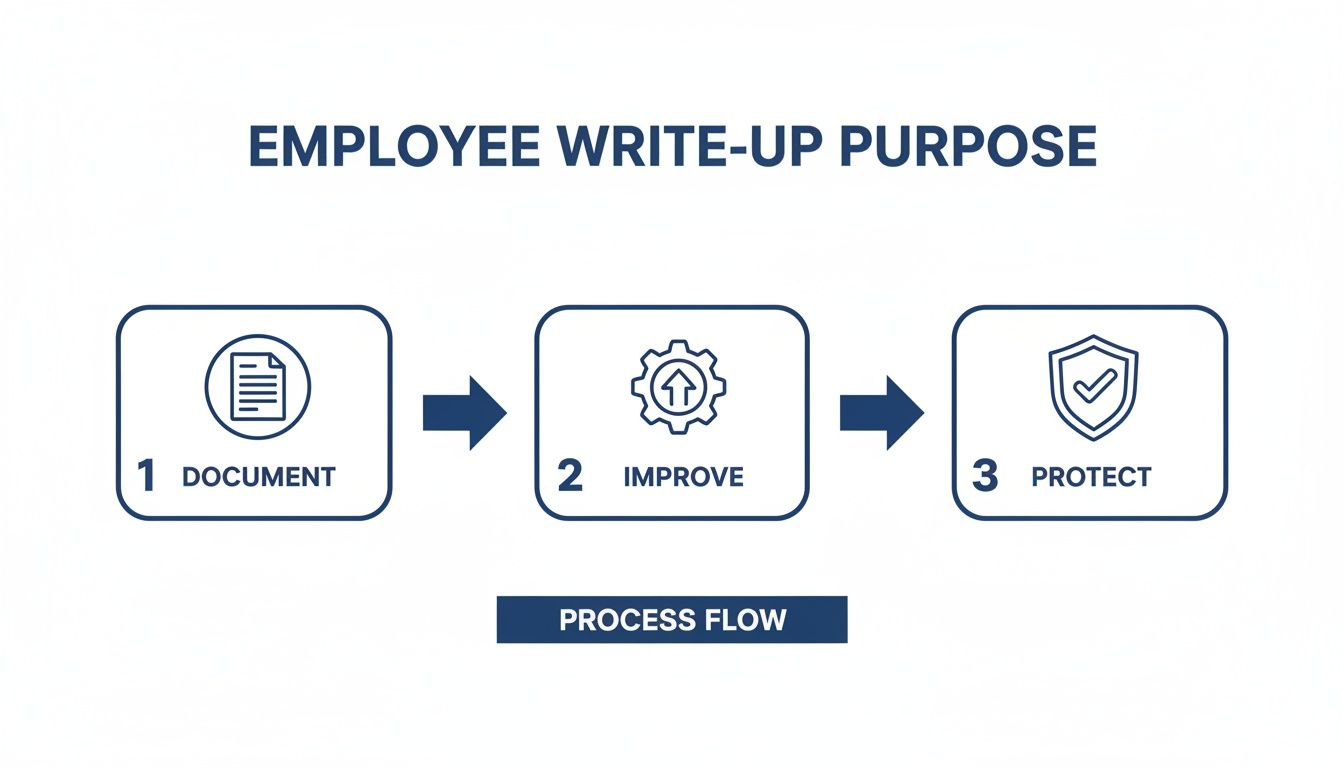
Without objective information, you cannot achieve any of these goals. The entire write up will fall apart.
Locating Factual Evidence
The right information creates a clear timeline and gives context. It removes your personal opinion from the equation. This is critical when you need to show an employee exactly how their actions affect the team or the business.
Start by looking into the concrete data points you have in your company systems.
- Attendance Logs: Pull the official timekeeping records. Are there patterns of lateness, absenteeism, or long breaks? Note the exact dates and times.
- Project Management Records: Look into your project tools, whether it is Asana, Jira, or whatever you use. Look for missed deadlines, incomplete tasks, or work that was sent back for rework.
- Email and Chat Communications: You are looking for specific examples of unprofessional communication, a failure to respond to critical messages, or clear misunderstandings caused by how they communicated.
- Direct Behavioral Observations: Write down what you personally saw or heard. Be meticulous: date, time, location, and exactly what happened, without emotional language.
For instance, instead of writing "John is always late," your evidence should read: "John arrived at 9:17 AM on Monday, 9:22 AM on Tuesday, and 9:31 AM on Thursday." That is indisputable.
Reviewing Past Performance History
A single mistake rarely warrants a formal write up, which is why context is so important. Looking into an employee’s history helps you determine if this is a one-time issue or a recurring theme.
Pull their personnel file and review past performance appraisals. Did previous managers note similar challenges? You should also check your own records for any informal feedback or verbal warnings you have given about this problem.
A write up should demonstrate a clear pattern of behavior or a single event so significant that it demands immediate action. Your documentation must show this is not an isolated mistake but part of a larger concern that needs formal correction.
If you have documented previous conversations in your one on one notes, get those, too. This trail of evidence shows you have tried to address the issue informally, which strengthens the case for escalating to a formal write up.
Speaking with Relevant Parties
Sometimes, you are not the only one who has seen the issue. You might need to talk with others to get the full picture. This could be another manager who oversees a cross functional project or a direct witness to a specific behavioral incident.
When you talk to others, keep the conversation focused on objective facts. Ask them to describe what they saw or heard, not what they felt about it.
Make sure to document these conversations immediately. Your notes should include:
- The name of the person you spoke with.
- The date and time of your conversation.
- A summary of the specific, factual information they provided.
This preparation is not about filling out a form. It is about ensuring the process is fair, consistent, and legally sound. When you build your case on objective data, you turn a tense confrontation into a constructive, fact based discussion about performance.
Laying Out the Employee Write Up: Your Blueprint for a Clear Conversation
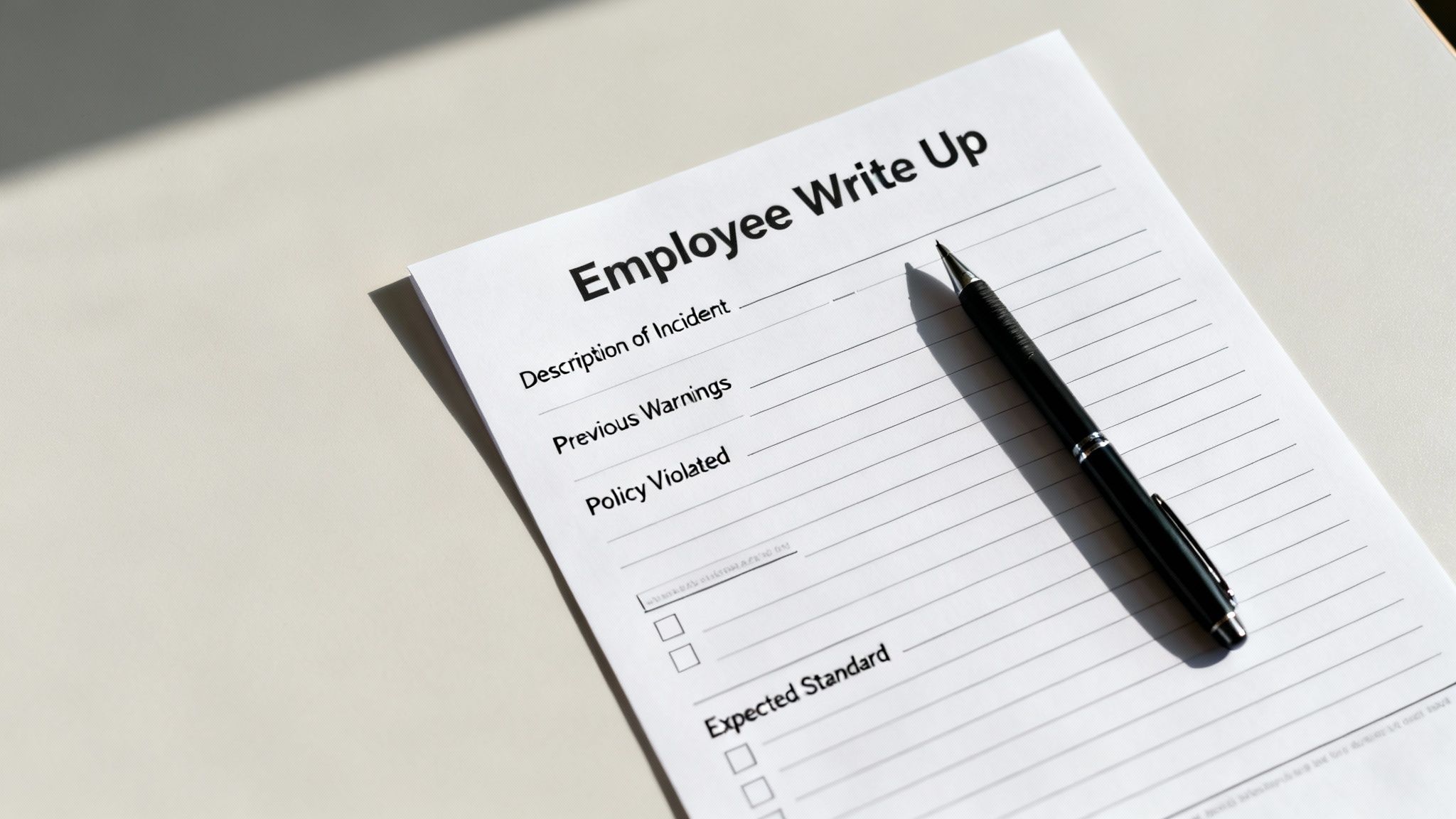
Think of the structure of a write up as a blueprint. It turns a messy, emotional conversation into a clear, professional tool for correction. Each part has a job to do. It guides the discussion and makes sure every critical piece of information gets recorded properly.
This structure does more than organize information. It keeps you, the manager, grounded and objective. When you follow a consistent format, you must stick to the facts instead of getting pulled into emotional territory. It is a crucial discipline to master when you handle these situations effectively.
Core Identifying Information
First, get the basics down. This might seem like administrative work, but it is essential for making the document an official, identifiable record. It leaves no room for confusion about who the document is for or when the issue was addressed.
Make sure the top of the form clearly includes:
- Employee's Full Name: Their legal name, no nicknames.
- Employee ID Number: If your company uses them.
- Date of Write Up: The day you are filling out the form.
- Manager's Name: Your full name and official title.
- Department: The employee’s current team or department.
This simple section immediately sets a formal tone. It establishes the document as part of the official company record. Keep it clean, accurate, and straightforward.
Describing the Incident Objectively
This is the heart of the write up, and where most managers stumble. Your mission here is to describe the performance issue or behavior using specific, factual, and non emotional language. Vague complaints like "bad attitude" or "poor work ethic" are useless because they are subjective and impossible to prove.
Instead, you need to stick to what you can see and hear. Detail what happened, when it happened, and where it happened. Consider this: the Mental Health at Work Report found that 90% of US workers face mental health challenges, and 50% report feeling burnt out. To build trust and keep things fair, stick to a model like SBI (Situation Behavior Impact). For example, "In the Q4 team meeting on Tuesday (Situation), you interrupted colleagues three times while they were speaking (Behavior), which caused the meeting to run 15 minutes over schedule (Impact)." You can find more helpful workplace statistics and learn about the importance of clear communication from Cake.com.
Use direct, factual statements. Instead of "You were disrespectful," write "During the 10 AM team meeting on October 15, you interrupted a coworker three times while they were presenting." This provides a concrete example that the employee can understand and address.
Always connect the behavior back to its effect on the business. Explain how the employee's actions affected team productivity, project timelines, client relationships, or workplace safety. This helps the employee understand why this is a serious issue that needs correction.
Referencing Company Policies and Past Warnings
To show this is not personal, you need to anchor the write up to your established company standards. Directly reference the specific policy the employee violated. Name it exactly as it appears in the employee handbook, like the "Attendance Policy" or "Code of Conduct." Quoting the relevant sentence or two can add more weight.
This step proves the issue is not just your personal preference. It shows the employee failed to meet a standard that applies to everyone. It reinforces that your management process is fair and consistent.
Next, you have to document any previous attempts to fix the problem. This is where you list any past conversations, verbal warnings, or informal coaching sessions about this issue.
For each past instance, include:
- Date of the warning: When did the conversation happen?
- Type of warning: Was it a quick verbal chat, an email summary, or a formal coaching meeting?
- Summary of the conversation: Briefly write down what was discussed and what expectations were set at the time.
Creating this timeline shows a pattern of behavior. It proves you have given the employee chances to improve before escalating things. It is a vital part of showing a fair, progressive disciplinary process. Without it, a formal write up can feel like it came out of nowhere.
Defining Expected Standards and Consequences
After you lay out the problem, you must clearly define the solution. This section is about the path forward. Be explicit about what success looks like.
For instance, if the issue is tardiness, the expectation should be clear: "You are expected to be logged in and ready to work at your scheduled start time of 9:00 AM every day." If it is about missed deadlines, be direct: "All project tasks must be completed by the deadlines assigned in our project management system."
Finally, you must state the consequences if these expectations are not met. This ensures the employee understands the seriousness of the situation and what is on the line. The language needs to be unambiguous.
Common consequences often include:
- Further disciplinary action
- Suspension without pay
- Termination of employment
The document wraps up with signature lines for the employee, you (the manager), and an HR representative or witness if needed. It is important to clarify that the employee's signature does not mean they agree with the write up. It just confirms they received it and had a conversation with you about it.
Creating an Actionable Improvement Plan
A write up that points out problems is a dead end. It is a record of failure, not a path forward. To make this document a tool for growth, you need to build a concrete, actionable improvement plan into it.
This turns the write up from a complaint into a roadmap. It gives the employee a tangible way to get back on track. It shifts the entire focus from past mistakes to future performance. A well designed plan shows you are invested in their success, which can change the tone of the conversation.

Adopt the SMART Framework
The best way to structure any improvement plan is with the SMART framework. It is a classic for a reason. It forces you to move away from vague instructions and lay out concrete, measurable actions. Every goal you set must be Specific, Measurable, Achievable, Relevant, and Time bound.
This simple structure removes all ambiguity for both you and the employee. Everyone knows exactly what needs to be done, by when, and what a successful outcome looks like. It gives you a shared language to talk about progress.
Let's break it down:
- Specific: The goal must be clear. Do not say, "Improve your communication." Instead, try: "Provide a daily written update on project status via email before 5 PM."
- Measurable: How will you track progress? A goal like, "Complete the advanced Excel training module," is easy to measure. It is either done or it is not.
- Achievable: The goal has to be realistic. An overwhelming task sets the employee up to fail again, which helps no one.
- Relevant: The goal must directly address the performance issue. The action you ask for has to be the thing that will fix the problem.
- Time bound: Every goal needs a deadline. "Submit all expense reports within 48 hours of returning from a trip, starting immediately" sets a clear timeline.
Using this framework is non negotiable if you want a plan that works.
Define Clear Actions and Desired Outcomes
With the framework in place, it is time to outline the exact steps the employee needs to take. Vague directives like "be more proactive" are impossible to follow because they mean different things to different people. The employee needs to know precisely what behaviors to start doing, stop doing, or continue doing.
Let’s say an employee is missing deadlines. The plan needs to spell out the fix.
Weak Example:
- Manage your time better.
- Get projects done on time.
Strong Example:
- Break down all new project assignments into smaller tasks with individual due dates in our project management software within 24 hours of assignment.
- Provide a status update in the weekly team meeting for each assigned project, highlighting any potential roadblocks.
- Complete the 'Time Management Fundamentals' online course by November 15th.
This level of detail gives the employee a checklist, not a lecture. They know exactly what you expect. For more strategies, our guide to performance improvement plans for employees offers more templates you can adapt.
A strong improvement plan focuses on observable behaviors, not personality traits. You can measure whether an employee submitted a report on time. You cannot measure whether they have a "better attitude."
Outline the Support You Will Provide
Correction is a two way street. The improvement plan is not just a list of demands. It must also detail the support and resources you will provide to help them succeed. This small step shows you are a partner in their improvement, not just a judge.
Your support can take many forms, but you need to be just as specific here as you were with the employee's actions.
This part of the document should clearly state things like:
- Regular Check Ins: "We will meet every Friday at 10 AM for 15 minutes to review progress on these goals for the next 60 days."
- Training Resources: "I have enrolled you in the 'Conflict Resolution in the Workplace' workshop scheduled for next month."
- Mentorship or Coaching: "I am going to ask Sarah from the senior team to be available if you have questions or need guidance on client communication."
- Access to Tools: "You will be given a premium license for the grammar software to help improve written communications."
When you document your own commitment, you create accountability for yourself. It proves the goal is genuine improvement. It also shows you are willing to invest your time and company resources to make it happen. Without this section, the plan feels punitive and one sided.
You have done the hard work. The document is drafted, the improvement plan is laid out, and you are ready to go. But now comes the part most managers dread: the conversation itself.
How you deliver this write up is just as crucial as what is written in it.
This meeting is your opportunity to show that this is about correction, not punishment. Your tone, your body language, and your approach will dictate whether the employee leaves feeling attacked or feeling like they have a path forward.
Setting the Stage for a Productive Discussion
The environment you choose for this conversation sends a message. You need a space that is professional and private. This signals the seriousness of the discussion while respecting the employee’s dignity.
Pick a neutral spot, like a conference room. Never have this conversation at the employee’s desk or in an open office. Try to schedule it for a time with minimal disruptions, like the end of the day. This gives the employee a chance to process things without having to face their colleagues.
Here is a non negotiable rule: always have a witness present. This is almost always someone from HR. Their job is to observe, take notes, and help ensure the conversation stays professional and on track. It protects both the employee and the company.
Guiding the Conversation with Professionalism
Your main job in this meeting is to be an anchor: calm, focused, and objective. The employee might react with a range of emotions, from defensiveness and anger to sadness or denial. Your composure is what will keep the conversation from spiraling.
Get straight to the point. Skip the small talk; it creates anxiety. A clear, direct opening is best.
For instance, you could start with, "Thanks for meeting with me. I have asked you here today to discuss some ongoing concerns with your performance around project deadlines."
From there, you will walk them through the document section by section. Do not just slide it across the table and expect them to read it. You need to narrate it.
- Describe the issue: Briefly recap the documented incidents. Stick to the facts.
- Reference the policy: Explain which company standard or expectation was not met.
- Review past actions: Gently remind them of any previous verbal warnings or feedback sessions.
- Present the improvement plan: This is the most important part. It is where you pivot the conversation from the past to the future.
Think of the write up as a tool for support, not a weapon. Your goal is to frame the conversation around a shared desire for their success. This shift in framing can turn a potential confrontation into a collaborative problem solving session.
Listening and Managing Reactions
Once you have presented the information, your next job is to stop talking and listen. Give the employee an opportunity to share their side of the story without interruption. They might disagree with what you have laid out. It is vital that you hear them out.
Listening does not mean you have to agree or tear up the write up. It is about showing respect, which can de escalate a tense room. Acknowledge what they are feeling with simple phrases like, "I understand this is difficult to hear."
If the employee gets emotional, stay calm and give them a moment. If they become hostile, hold your professional boundary firm. You can say, "I understand you are frustrated, but we need to keep this conversation respectful if we are going to move forward." Learning to handle these reactions is what separates good managers from great ones. If you want more strategies, check out our guide on how to have tough conversations with employees.
Ending with Clear Next Steps
No one should leave that room feeling confused. The meeting must end with absolute clarity on what is expected next.
Summarize the key actions from the improvement plan. Confirm the date of your first check in meeting. Ask them to sign the document. Be sure to explain that their signature simply acknowledges they have received it, not that they agree with everything in it.
Finally, end on a forward looking note. Reiterate your support and express your confidence in their ability to meet the new expectations. This reinforces that the goal here is improvement, not an exit. The meeting might be over, but the work of follow up has just begun.
Common Questions About Employee Write Ups
Even with a solid process, managers get tripped up by the details. These situations are often nuanced and uncomfortable. Knowing how to handle the common issues will give you the confidence to manage them fairly and effectively.
Here are the straight answers to the questions that come up most often.
When Is a Formal Write Up Necessary?
This is a big one. The line between a quick verbal warning and a formal write up comes down to two things: severity and repetition.
A single, minor slip up, like an employee showing up five minutes late once, is almost always best handled with a quick, informal chat. Save the formal write up for when the stakes are higher.
It is time for a formal write up when:
- You are dealing with a repeat offense. You have already given verbal feedback or coached them on the same issue, and the behavior has not changed. The pattern is the problem.
- The incident is serious. A major violation of company policy, like a significant safety breach or unprofessional conduct with a client, needs immediate documentation. You cannot "coach" your way out of that.
- The behavior is hurting the business. If one person's actions are consistently causing project delays, creating team wide conflict, or costing the company money, you have to formalize the feedback.
Think of it this way: a verbal warning is for a quick course correction. A write up creates a formal record when informal chats have not worked or when the issue is too big to ignore.
What If an Employee Refuses to Sign?
This is the scenario that keeps managers up at night, but it is less of a big deal than you might think. An employee's signature on a write up is not an admission of guilt. It is an acknowledgment that they received the document and that the conversation happened.
If they refuse to sign, the first step is to stay calm. Explain again, clearly and neutrally, "Your signature just confirms you have received this, not that you agree with it."
If they still refuse, no problem. Just make a note directly on the signature line.
Write something simple like, "Employee received a copy of this document but declined to sign on [Date]." Then, have your HR partner or another manager who witnessed the meeting sign and date right next to your note.
This simple act documents that the conversation took place and the write up was delivered, which is all you need to do. Their refusal does not invalidate the document or the process. As long as you have a witness, you have done your job correctly.
How Much Detail Should I Include?
Getting the level of detail right is crucial. Too little, and the write up is vague and useless. Too much, and it reads like a personal attack filled with subjective opinions. You are aiming for specific enough to be clear, but concise enough to be professional.
Here is a simple guide for what to put in and what to leave out:
- Stick to the Facts: Only include observable behaviors and measurable data. Use specific dates, times, project names, and direct quotes if they are relevant and 100% accurate.
- State the Impact: Draw a clear, direct line from the employee's action to its consequence. For example, "Your failure to complete the Q3 report by the October 15 deadline delayed the client presentation by two full days."
- Reference the Policy: Name the specific company policy that was violated. For example, "This action is a violation of our company's Attendance Policy, Section 2.1."
Avoid personal feelings, guesses about their intentions ("He did not seem to care"), or secondhand information from other team members. This document needs to be a sterile, factual record of what happened.
What Happens After the Meeting?
The write up is not the finish line. It is the starting gun. The follow up is what determines if the employee improves. Once the meeting is over, your job shifts from documenting the problem to actively managing the solution.
Your next steps should be immediate:
- File the Document: Get the signed (or noted) document to HR immediately so it can be placed in the employee’s official personnel file.
- Schedule the Check Ins: Before you leave the room, put the follow up meetings from the improvement plan on the calendar. This shows you are serious about seeing progress.
- Provide the Promised Support: If you said you would get them into a training class or connect them with a mentor, do it. Make good on your commitments.
Consistent, visible follow through shows the employee you are invested in their success. It also creates a stronger paper trail if further disciplinary action becomes necessary down the road.
Preparing for tough conversations is one of the hardest parts of being a manager. PeakPerf gives you the structure and confidence you need for every leadership moment, from performance reviews to employee write ups. Stop starting from scratch and create fair, effective, and professional documents in minutes. Start for free at https://peakperf.co.


