A Practical Manager Development Plan Template Guide
A manager development plan is a roadmap. It takes a leader's career goals and turns them into a concrete plan for improvement. This document outlines their goals, identifies skill gaps, and lays out the exact steps for growth.
When you use a template, you bring consistency to the development process for every manager in the company. It ensures everyone gets the same clear, structured support.
Why You Need a Manager Development Plan Template
Without a formal plan, manager development is often inconsistent. Some leaders proactively seek growth opportunities. Others get stuck, which creates a performance gap across your teams. A development plan template changes that.
It is a strategic tool that brings structure and accountability to leadership growth. It ensures every manager, from a new team lead to a seasoned director, has a clear path forward.
This structured approach also encourages important conversations. It gets managers and their leaders talking about specific skill gaps before they become larger problems. Is a manager struggling with delegation? Do they need to improve at giving feedback? The plan helps you pinpoint these areas and assign the right training, coaching, or project to fix them. When everything is written down, tracking progress over time becomes simpler.
Closing the "Accidental Manager" Training Gap
Many managers get their roles because they were excellent individual contributors, not because they had proven leadership skills. This is a problem. The skills that make someone a great engineer or salesperson are different from the ones needed to lead a team.
The truth is that most leaders are put into their roles without preparation. A surprising 82% of UK managers step into their roles without any formal management training. This is a direct cause of negative work environments and high employee turnover.
This is not only a UK issue. Globally, less than half of all managers report receiving any training for their role. This creates a leadership crisis that affects company culture and performance. (Kinkajou Consulting has revealing leadership development statistics).
A manager development plan provides the framework you need to start closing this gap. It formalizes the upskilling process and gives your leaders the tools they need to succeed.
Key Benefits of Using a Template
When you roll out a standardized template, the benefits become apparent for your managers and the organization.
- Consistency Across Teams: It ensures every manager is developed against the same clear criteria. This creates a shared language for what good leadership looks like at your company.
- Clear Expectations: A template clearly defines what is expected of a leader, which removes ambiguity and helps them focus their efforts.
- Improved Accountability: When goals, actions, and timelines are written down, both the manager and the company are responsible for following through on the development plan.
- Data-Driven Decisions: As you collect completed plans, you start to see patterns. You get a valuable dataset that highlights common skill gaps across the organization. This helps you make smarter investments in future training programs.
Anatomy Of An Effective Development Template
Good intentions do not automatically create progress. A manager development plan template bridges the gap between ideas and action. It sets a consistent rhythm, but adapts to each leader’s unique path.
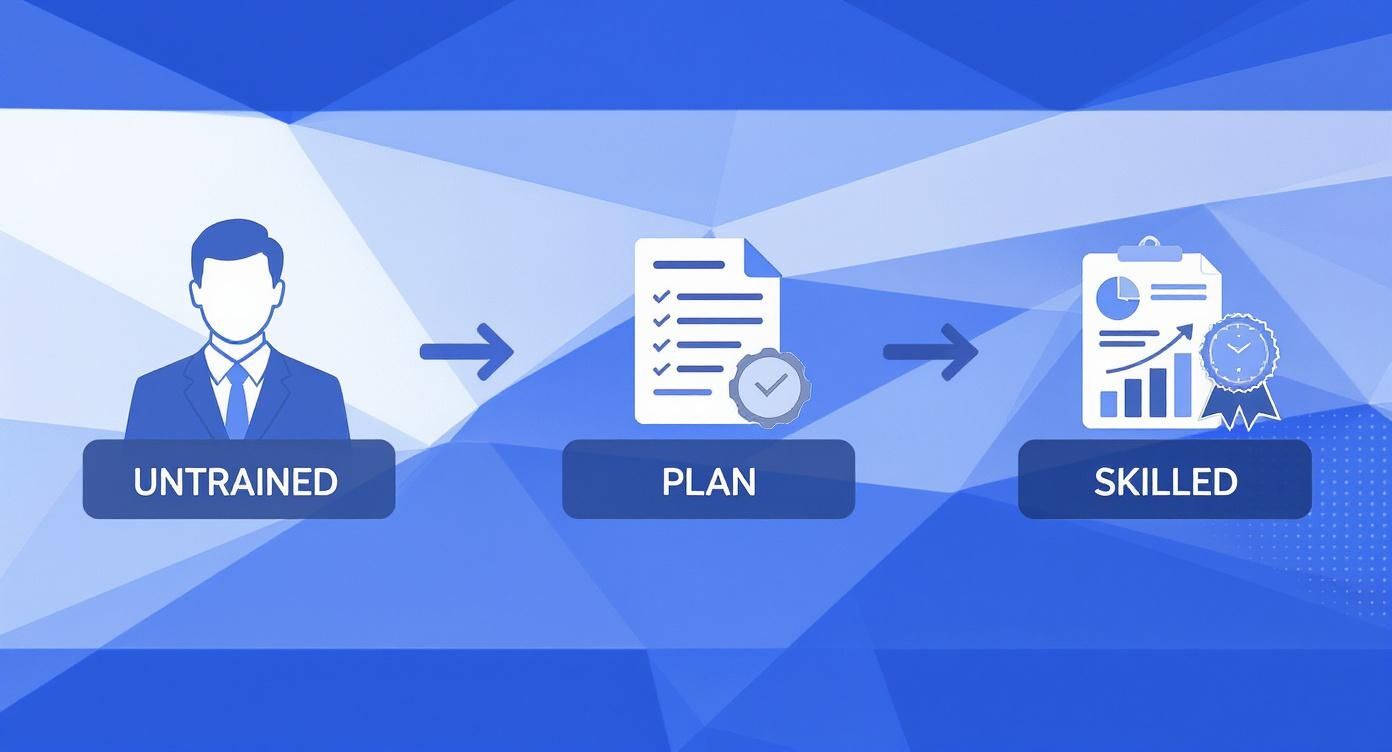
That graphic shows how you move from identifying a skill gap to developing a capable, confident manager.
Core Components Of A Strong Template
A blank sheet will not get you far. Your template should guide a productive conversation and create shared clarity on success. At a minimum, it needs:
- Manager & Reviewer Information
Capture names, roles, and the review window so nobody loses track. - Current Strengths
Highlight what the manager already does well. This builds confidence and reinforces best practices. - Development Opportunities
Pinpoint specific skills or behaviors to improve, using feedback and performance data. - SMART Goals
Turn each opportunity into a clear, measurable objective. - Action Steps & Timeline
Break goals into small tasks with deadlines for steady momentum. - Success Metrics
Define the exact data points that will prove each goal is met. - Required Resources
List training, coaching, or tools needed to complete the plan. - Signatures & Dates
Confirm commitment from both manager and reviewer with formal sign-offs.
A well-structured template turns development from a vague goal into a clear project. It gives managers a precise roadmap that shows them where they are going and how to get there.
Below is a quick look at each component’s purpose:
Template Component Breakdown
| Component | Description |
|---|---|
| Manager & Reviewer Information | Document names, roles, and the review period for clarity. |
| Current Strengths | Recognize existing strengths to reinforce positive habits. |
| Development Opportunities | Identify targeted areas for growth based on concrete feedback. |
| SMART Goals | Outline specific, measurable, achievable, relevant, and time-bound aims. |
| Action Steps & Timeline | Break down goals into tasks with clear deadlines. |
| Success Metrics | Set the data points that will show goal achievement. |
| Required Resources | Specify any training, tools, or support needed. |
| Signatures & Dates | Formalize the agreement and commitment from all parties. |
With this breakdown, you see how each piece connects into a cohesive plan.
Balancing Consistency And Personalization
A uniform template creates a common language for leadership skills. Development is not one-size-fits-all. A first-time manager’s priorities differ from a senior director’s.
Use the template as your conversation guide. Fill each section with examples, context, and goals that speak directly to the individual’s role, career hopes, and performance data. That way you get:
- The fairness and clarity HR needs
- The tailored guidance each leader wants
Performance management trends support this approach. Research shows 53% of organizations now prioritize manager training as part of their performance strategies. They also emphasize continuous feedback (60%) and regular check-ins (46%). All these elements are supported by a customized development plan. For more on how these figures are shaping modern leadership, explore Performance Management Statistics.
Turning Vague Ideas Into Actionable SMART Goals
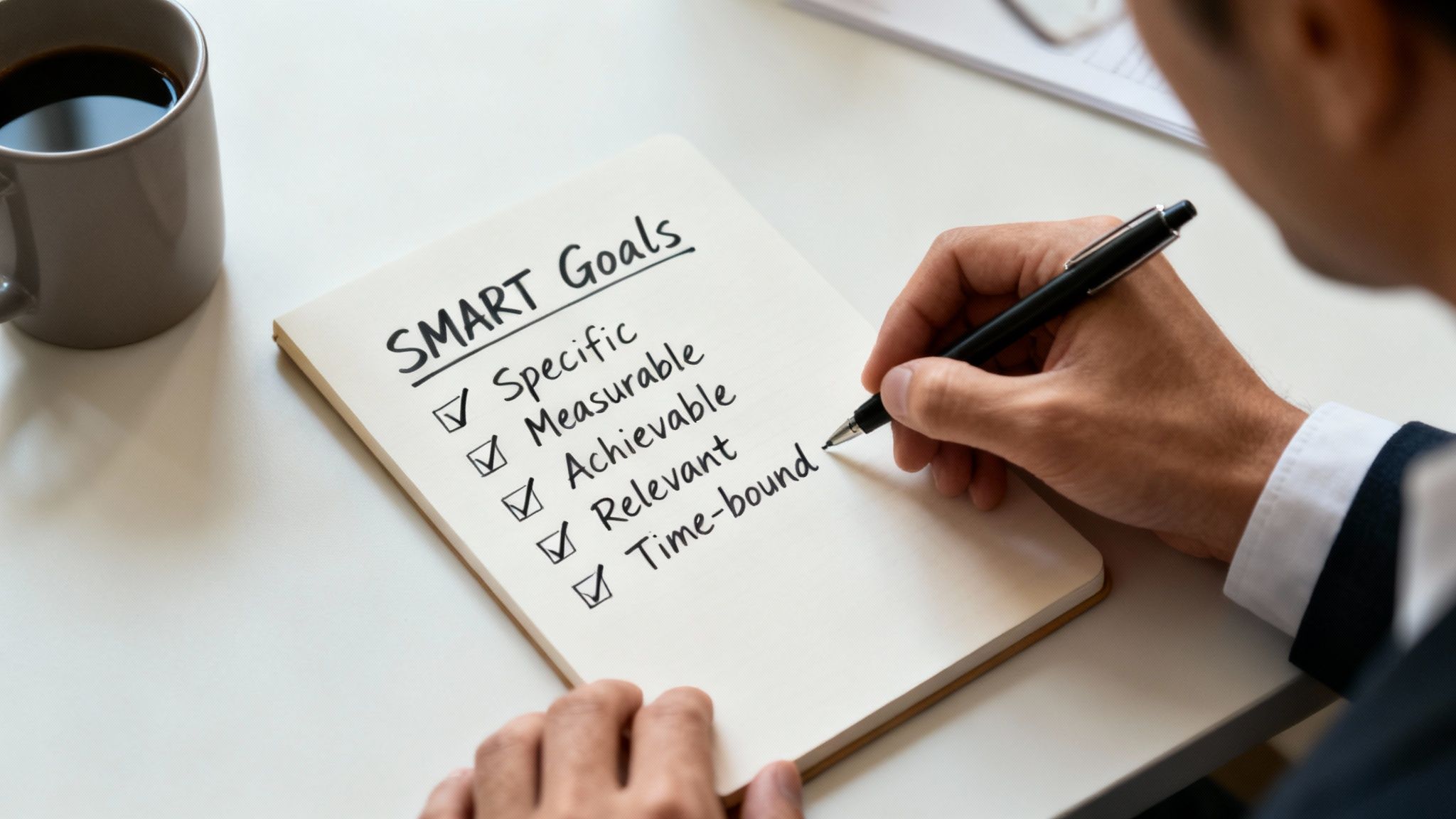
A goal like "get better at communication" is a wish. It is not a plan. For a manager's development to be effective, every opportunity needs to be shaped into a specific, measurable goal. The SMART framework gives you the structure to turn fuzzy intentions into concrete targets inside your manager development plan template.
The framework forces clarity by ensuring every objective is:
- Specific: What exactly needs to be accomplished?
- Measurable: How will you track progress and know when it is done?
- Achievable: Is this a realistic target the manager can hit with focused effort?
- Relevant: Does this align with the manager’s role and business needs?
- Time-bound: What is the deadline? This creates urgency and focus.
Using this structure removes ambiguity. A manager's development plan becomes a project plan. Each goal is a clear destination with a map showing how to get there.
How To Write SMART Goals for Managers
Writing a strong SMART goal connects a desired behavior to a business outcome. There should be no room for misinterpretation when you are done.
Start with the development area you have identified. Then, ask questions for each part of the framework. If a manager is struggling with project delivery, you might ask, "What does a successfully delivered project look like in this team?" and "How will we measure that improvement without relying on gut feeling?"
This process guarantees the goals you set are meaningful milestones, not items on a to-do list. They become tangible steps that contribute to the manager's growth and the team's success. For more information, check out these SMART goals examples for employees that you can adapt for your managers.
Goal Examples for Different Seniority Levels
A manager's goals evolve as they advance in their career. A new manager likely focuses on foundational skills, while a senior leader needs to think about strategic impact. Your template must be flexible enough for both.
Example for a New Manager (Focus on Team Communication)
- Goal: To make our team meetings more efficient, I will introduce a structured agenda and strict timekeeping for all weekly syncs over the next quarter.
- Metric: Cut the average meeting time by 15% and increase the team's meeting satisfaction score from 6/10 to 8/10 in the next quarterly pulse survey.
Example for a Mid-Level Manager (Focus on Project Delivery)
- Goal: I will improve the on-time delivery rate for my team's key projects by implementing a new project tracking system and holding weekly progress reviews by the end of Q2.
- Metric: Increase the project on-time completion rate from 75% to 90% within the next six months.
Example for a Senior Manager (Focus on Strategic Planning)
- Goal: By the end of this fiscal year, I will develop and present a three-year strategic plan for my department that aligns with the new company-wide objectives.
- Metric: Achieve full approval of the strategic plan from the executive team and secure the budget allocation for its first-year initiatives.
Each of these goals is specific, measurable, and has a timeline. They give a clear definition of success, which is the only way to keep development moving forward.
Capturing Progress Within The Template
Goals are useless if you set them and forget them. Your template must have a section for logging regular progress updates. This turns it into a living document, not a file that collects digital dust.
Schedule short, informal check-ins to talk about progress. These are not performance reviews. They are quick conversations to see what is working, identify roadblocks, and make adjustments to the plan.
Encourage your managers to write down small wins and notes directly in the template. This simple practice builds momentum and creates a clear, documented story of their growth journey for formal reviews.
Identifying Strengths And Growth Opportunities

Listing your team’s strengths alongside growth areas gives you a clear path for development. It starts with honest self-reflection and then inviting others to fill in the blind spots.
Gathering self and peer insights creates a 360-degree view of where a manager excels and where there is room to grow.
Conduct Honest Self Assessment
Reflect on recent wins and note the behaviors that made them possible.
Pinpoint recurring challenges and connect them to specific skill gaps.
Assign each strength a score from 1 to 10 to make progress obvious.
Gather Peer Feedback
- Ask colleagues to share moments when you led effectively and situations that were difficult.
- Use a short survey or simple feedback form so responses stay focused.
- Add their insights into your template under “Development Opportunities.”
Key Insight Linking growth areas to real projects ensures learning by doing and reinforces new habits.
| Role | Strength | Development Area |
|---|---|---|
| Manager | Active listening in 1-on-1s | Lead project debriefs with clear feedback cycles |
| Senior Leader | Strategic vision planning | Conduct stakeholder mapping for cross-department alignment |
Our guide on coaching skills for managers might be helpful for refining how you collect and act on feedback.
Sample Entries For Mid Level Managers
Imagine a mid-level manager working on conflict resolution:
- Lead a cross-team workshop next month.
- Measure success by a 20% drop in reported team issues over eight weeks.
- Connect it to the upcoming product launch so they practice facilitation under real pressure.
These examples connect daily skills with strategic impact.
Tips To Avoid Common Pitfalls
- Overrating strengths leaves no room to grow.
- Vague goals reduce motivation. Be specific.
- Skipping peer input narrows your perspective.
- Revisit and adjust entries every 30 days to reflect new insights.
Use PeakPerf Tools For Clarity
- SBI Prompts guide feedback around Situation, Behavior, and Impact for concrete examples.
- SMART Goal Fields turn aspirations into measurable objectives.
- Auto-Save Function helps you compare past self-assessments and see your progress.
PeakPerf’s frameworks reduce prep time and keep your plan consistent.
Link Growth To Real Work
Attach each development area to an upcoming assignment. This way, managers learn by doing rather than in theory. For instance, a market analysis project can serve as a lab for testing new strategic-planning skills.
Teams that follow this approach increase engagement by 18%. One new manager saw their team’s score jump from 6.5 to 8.2 in three months.
Track Progress Over Time
- Log peer and self-feedback quarterly.
- Compare each year’s strength scores side by side.
- Update your entries when new challenges appear.
- Share trends with leadership to secure support.
- Highlight rising team feedback scores at performance reviews.
- Schedule regular check-ins to reinforce accountability.
Revisiting your plan at every milestone helps it evolve with your managers’ growth.
Next, we move to creating actionable steps and success metrics for these areas.
Creating Actionable Steps and Success Metrics
Goals are wishes until you build a bridge to reach them. The next part of your manager development plan is about that bridge. It translates broad objectives into small, concrete actions. This part outlines what the manager will do, when they will do it, and what success looks like.
This process is important because it breaks down a large goal, like "become a better coach," into manageable pieces. It prevents feelings of being overwhelmed and creates a clear sense of progress, which makes the entire development journey feel achievable.
From Goals to Actionable Steps
Every SMART goal you have defined needs its own set of action steps. These are specific tasks, training sessions, or projects the manager will complete. Think of them as the rungs on a ladder leading to the larger objective.
Let's say a manager’s goal is to run more efficient team meetings. The action steps might look like this:
- Complete the LinkedIn Learning course on effective meeting facilitation.
- Create and share a standardized meeting agenda template with the team.
- Gather anonymous feedback from the team on meeting quality after one month of using the new template.
These steps are specific and task-oriented. They provide a clear, easy-to-follow plan that removes guesswork. Each completed step builds momentum and keeps the manager invested in their own growth.
A goal without a plan is a wish. Actionable steps turn a manager's development aspirations into a project plan with deadlines and deliverables.
Accountability is a large part of this. The manager owns their development. Their leader is responsible for providing resources and removing roadblocks. Documenting this shared responsibility keeps everyone aligned and moving in the same direction.
Defining and Measuring Success
How will you know if the plan is working? Success metrics provide the answer. These are clear, measurable indicators that prove a goal has been met. When possible, these should be quantitative, linking development efforts directly to business outcomes.
Vague measures like "improved communication" are not useful. They are impossible to track. You need to define success with specific data points. This shifts the evaluation from a subjective opinion ("I think things are better") to an objective assessment of progress.
Here are a few examples of strong success metrics:
- For a project delivery goal: Increase the on-time project completion rate from 70% to 90% by the end of Q2.
- For a team engagement goal: Achieve a 15-point increase in the team's eNPS score in the next quarterly survey.
- For a communication goal: See a 20% reduction in project misunderstandings as reported in weekly standups.
These metrics are specific, measurable, and directly tied to the manager's development area. They offer clear proof that the plan is delivering results.
Sample Action Steps and Success Metrics
The best way to bring this all together is with a simple table in your template. This visually connects each action step to its timeline and success metric. It makes the plan easy to scan and track. It is the manager's roadmap.
This structure shows them what to do and by when. It also defines what "done" looks like for each step, which makes progress reviews straightforward and data-driven.
| Action Step | Timeline | Success Metric |
|---|---|---|
| Complete the "Delegation for Managers" online course. | By March 31 | Certificate of completion; share three key takeaways with mentor. |
| Implement a new project delegation tracker in Asana. | By April 15 | 100% of new projects are assigned using the tracker. |
| Reduce personal involvement in team tasks by 25%. | By June 30 | Manager's weekly time logs show a 25% decrease in task-level work. |
This kind of detailed tracking is what separates plans that are filed away from plans that create lasting change. It builds accountability and ensures that your investment in manager development pays off.
Keeping the Plan Alive: How to Structure Your Review Cadence
A manager development plan is not a "set it and forget it" document. It is a living roadmap. Its power comes from consistent, dedicated follow-up. Without a structured review schedule, plans lose all momentum and fail to create lasting change.
Think of it this way: a regular cadence for check-ins turns the plan from a static paper into a dynamic tool for growth. It builds in accountability for both the manager and their leader. It also ensures development goals do not get lost in daily work. This rhythm of review and conversation drives progress.
Structuring Your Review Schedule
A predictable schedule is your best friend. It takes the guesswork out of the process and makes development conversations a normal part of the job. A mix of frequent, informal check-ins and more structured quarterly reviews strikes the perfect balance. It keeps progress top-of-mind without feeling like micromanagement.
Here is a structure that works well:
- Monthly Check-ins: Keep these short, about 15 minutes. The goal is simple: talk about recent progress, identify any immediate roadblocks, and clarify what is next.
- Quarterly Reviews: Block out a full 60 minutes for these. This is your time to look closely at goal progress, review the success metrics, and adjust the plan based on performance and shifting business priorities.
- Annual Evaluation: This meeting is a look back at the entire year. You will summarize achievements, document the manager's overall growth, and prepare for next year’s development plan.
Consistent reviews prevent good intentions from fading. They create a feedback loop that keeps a manager's growth aligned with what the organization needs. This turns small, steady steps into major long-term gains.
Making a Check-In Meaningful
The quality of your conversations matters more than their frequency. A check-in should feel like a collaborative pit stop, not an interrogation. Your role is to support, guide, and keep the manager motivated.
The best way to make these conversations productive is to use open-ended questions that encourage reflection. Instead of asking, "Did you do the thing?" try something like, "What did you learn from that experience?" or "What challenges are you facing with this action step?" These kinds of questions lead to a more meaningful dialogue about what is working and what is not. A solid framework is essential. We built a comprehensive performance review template for managers to help guide these discussions.
Sidestepping the Most Common Pitfalls
Many development plans fail because of a few predictable and avoidable mistakes. Knowing them ahead of time lets you avoid them and keep your manager’s growth on track.
I see these three errors frequently:
- Setting Too Many Goals: A plan with ten "priorities" has no priority. Stick to two or three critical development areas at a time. This focus allows the manager to dedicate meaningful effort.
- Using Vague Metrics: Goals like "improve team morale" are impossible to measure. You must define success with specific data, like "increase the team’s engagement score by 10%."
- Poor Follow-Up: This is the primary reason development plans fail. If review meetings are constantly canceled or rushed, it sends a clear message: this is not important.
The need for structured, effective leadership development is greater than ever. The global leadership development market is valued at roughly $366 billion. Companies that do it well achieve 25% better business outcomes. By avoiding these common mistakes, you ensure your investment in your managers pays off.
Your Top Questions Answered
Do you have a few questions? Let's address some of the most common ones I hear from managers who put these development plans into action.
How do I adapt this for remote or hybrid teams?
When your team is spread out, you cannot rely on informal conversations. The key is to be intentional about communication.
Bring the plan to life with regular video check-ins and a central, shared document that everyone can access. This simple step keeps everyone on the same page, no matter where they are working from. This alone has made teams feel more connected.
To keep a real-time pulse on progress, think about integrating continuous feedback tools. Embedding a weekly pulse survey into your template means you are collecting actionable insights as they happen, not weeks later. This helps you remove the guesswork.
Here are a few practical ideas:
- Use asynchronous tools like Slack or Teams for quick status updates on action items.
- Schedule dedicated monthly video calls specifically to review the plan and adjust goals.
- Create a shared dashboard to visualize progress on SMART goals.
- Make sure every action item has a clear owner to maintain accountability.
How can I measure the ROI of these plans?
A development plan is only as good as the results it produces. Measuring its return on investment involves connecting manager growth to business outcomes.
Before you start, identify the key success metrics in your template. Tie them directly to tangible business goals. Think about employee retention rates, team engagement scores, or improvements in project delivery times.
Once the plan is in motion, compare the before-and-after data. Showing a measurable improvement is how you prove the real-world impact of your efforts.
What are the most common pitfalls to avoid?
I have seen a few recurring issues over the years. Here are the main ones and how to avoid them.
Pitfall 1: "I'm too busy for this."
Managers are often busy, and a new "task" can feel like a burden. Frame the template as a time-saver, not a time-sink. Show them how the guided prompts and structured format make their one-on-ones more efficient. I worked with a mid-level manager who cut his quarterly review prep time by 50% by using a well-designed template.
A structured template turned our quarterly reviews from a chore into focused growth sessions. It increased team engagement by 18% in six months.
Pitfall 2: Getting buy-in from leadership.
To get leadership on board, you need data and a compelling story. Put together a brief case study. Link a manager's improved coaching skills directly to their team's higher performance metrics. One of my favorite examples is a remote team that used their development plan to cut feedback cycles in half, which got senior leadership's attention immediately.
| Challenge | Quick Tip |
|---|---|
| Onboarding hybrid teams | Include a self-assessment section at the beginning of the plan. |
| Creating feedback loops | Build peer reviews directly into the template's structure. |
How Do I Get Started With This?
Do not overthink it. A great first step is to review this FAQ with your leadership team or HR partners. Use it as a conversation starter. During your next team check-in, ask for suggestions on how to refine the template to better fit your specific needs.
When you have a win, share it. A quick note in the company newsletter about a manager's success story can inspire others to get on board.
Ready to put this into practice? You can build and track your plans easily with PeakPerf. See how it works at https://peakperf.co.


